Your cart is currently empty!
Tag: world mountain journeys
-
Eternal Heights: The Soul of the Himalayas
I. The Moment the Sun Touches the Gods
There are moments in the mountains when time itself seems to kneel.
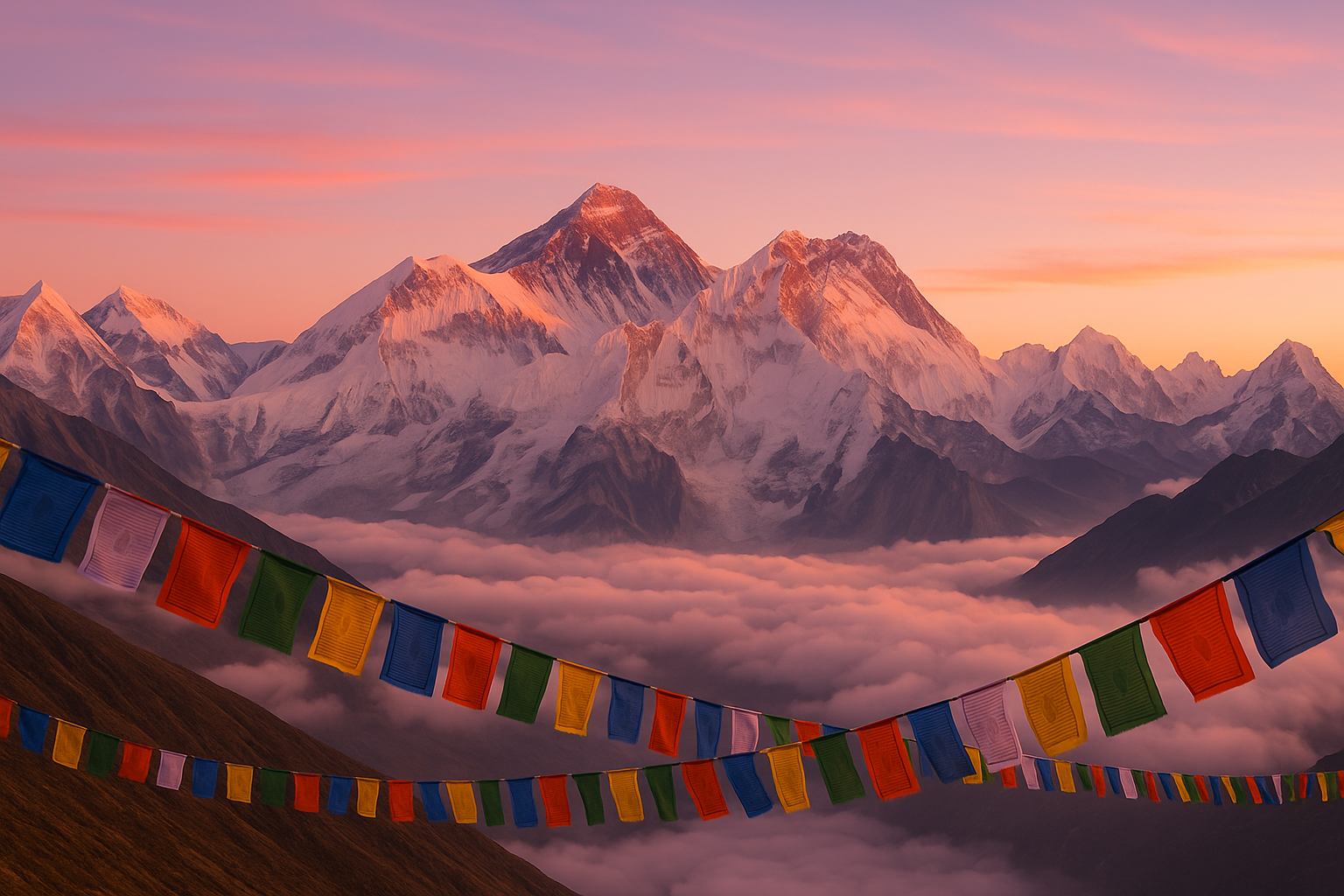
As dawn breaks over the Himalayas, light spills like liquid gold across the frozen summits. The world’s tallest peaks awaken under a soft coral glow, their icy ridges igniting with fire while the valleys below remain cloaked in the lingering hush of night.Prayer flags—worn, frayed, and radiant—flutter across the frame, whispering mantras into the morning wind. Beneath them, a sea of clouds stretches endlessly, blurring the boundary between earth and sky. It is as if the world is suspended between breath and silence.
The image captures more than a mountain; it captures a moment of awakening—of the planet, of the spirit, of the self. To witness such light over the world’s highest point is to understand what it means for nature to transcend beauty and enter the realm of the sacred.
II. The Roof of the World
The Himalayas are more than a mountain range—they are a world unto themselves, a living spine stretching across Asia for nearly 2,500 kilometers. From Pakistan’s Karakoram to Bhutan’s emerald valleys, they cradle more than fifty peaks above 7,000 meters, including the crown jewel of Earth: Mount Everest, or Sagarmatha to Nepalis and Chomolungma to Tibetans—“Mother Goddess of the World.”
These are not passive landscapes; they are active, evolving, and alive. The Himalayas were born from a collision—when the Indian plate slammed into the Eurasian plate around fifty million years ago, the crust buckled upward, forming these colossal walls of rock and ice. Even today, the mountains continue to rise by a few millimeters each year, as if still reaching for the heavens.
To stand before them is to stand at the intersection of geology and divinity. Here, science and spirituality meet not as opposites but as two languages describing the same awe.
III. The Alpenglow Mystery
There’s a word for the pink-gold light that graces mountain peaks at dawn and dusk: alpenglow. It’s not merely sunlight—it’s sunlight filtered, scattered, and reflected by the atmosphere long after the sun has dipped below or before it has risen above the horizon.
In the Himalayas, alpenglow is more than a meteorological phenomenon—it’s a daily ritual of transfiguration. When the first or final rays strike the ice, the entire mountain appears to breathe light. The cold, immovable mass of stone becomes fluid, glowing, almost sentient.
Locals often interpret it as a sign of divine presence. The mountains, they say, are alive—and the light is their spirit showing itself to those who are still enough to notice.
IV. The Language of Flags and Wind
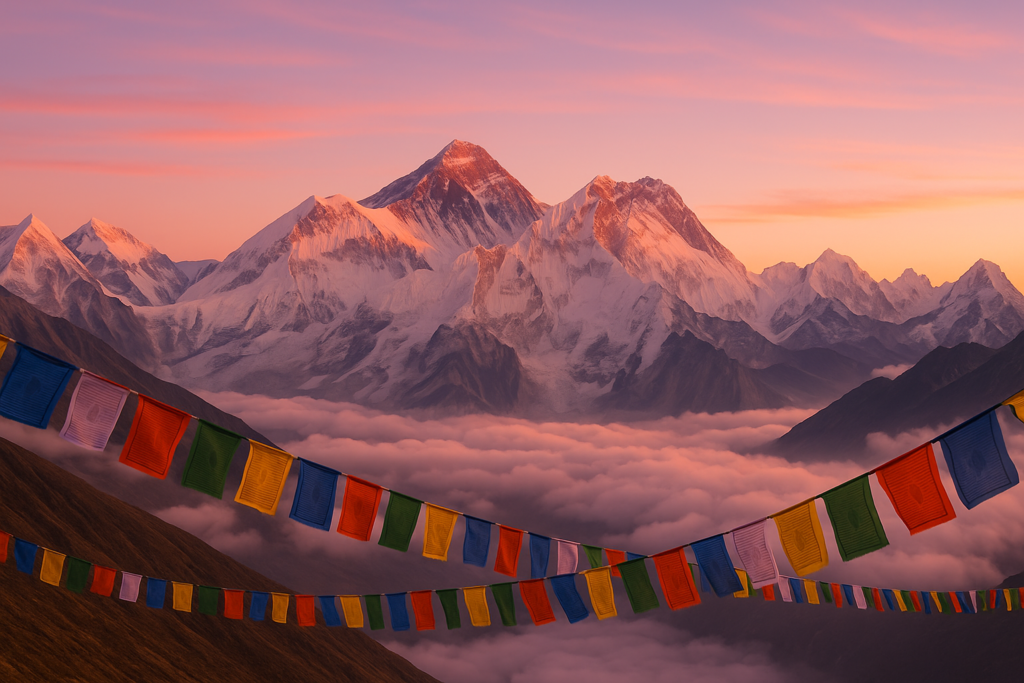
The prayer flags in the foreground tell their own story. In Tibetan, they are called Lungta, or “wind horses.” Each flag carries sacred texts and symbols that are said to spread compassion, peace, and wisdom with every flutter.
The five colors represent the five elements:
- Blue — the sky and space
- White — air and wind
- Red — fire
- Green — water
- Yellow — earth
Together, they form a cosmic balance. As the wind brushes through them, the prayers are believed to be carried across mountains and valleys, touching every corner of the world.
What’s profound is the humility of the act. The flags are not hung for personal gain but for the benefit of all beings. They fade with time, their disintegration a visual sermon on impermanence. Even as they fray and tatter, they continue to serve—a lesson in selfless devotion and beauty in decay.
V. The Mountain of Names
Mount Everest, the centerpiece of this photograph, has many names—each one a reflection of a different relationship with the mountain. To the Nepali, she is Sagarmatha: “Forehead of the Sky.” To Tibetans, Chomolungma: “Goddess Mother of the World.” To Western explorers, she became “Everest,” named in 1865 after the British surveyor Sir George Everest, who ironically never saw the peak himself.
These names tell a story of perspective. Where the Western tradition saw a summit to be conquered, the Himalayan peoples saw a spirit to be respected. For them, these peaks were not “mountains to climb” but deities to be honored from afar.
It’s a profound contrast: one of ambition versus reverence, conquest versus coexistence. And perhaps that’s what this image gently reminds us—to shift from dominion to devotion.
VI. The People of the High Valleys
Life in the Himalayas has always defied reason. Thin air, steep terrain, and extreme cold would seem to make human habitation impossible. Yet for thousands of years, communities have flourished here, adapting to the rhythms of altitude and isolation.
The Sherpa people of Nepal’s Khumbu region are among the most well-known. Their name, derived from “Shar-wa,” means “people from the East.” For them, the mountains are not obstacles but kin. Every peak, stream, and meadow carries a spiritual charge. Before setting out on a climb or journey, offerings are made to mountain gods for protection and permission.
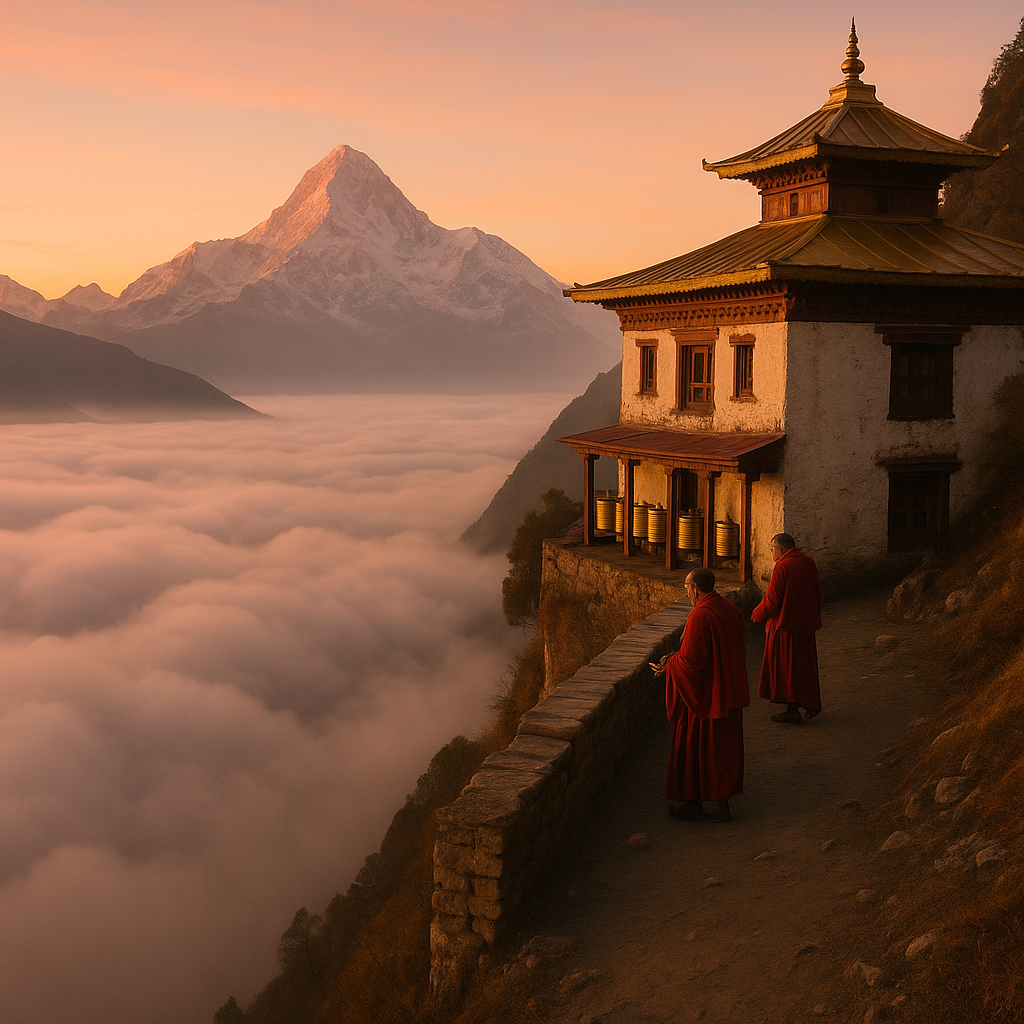
Their resilience is legendary—but so too is their humility. In every gesture, from spinning prayer wheels to offering butter lamps in monasteries, there is an understanding that survival here is not a triumph over nature but a partnership with it.
VII. The Sea of Clouds
Beneath the radiant summits in the image, a sea of clouds rolls across the valleys, soft and infinite. It’s as if the earth has exhaled a great sigh of mist. This “cloud ocean” is a common sight in the high Himalayas, formed when warm, moist air from the lowlands rises and cools against the mountain slopes.
From above, it feels like standing at the edge of heaven. The mountains rise like islands from the white expanse, and for a moment, you lose all sense of scale—are these peaks enormous, or are you simply small?
In Buddhist philosophy, clouds often symbolize the mind: ever-shifting, impermanent, obscuring yet revealing. Just as the peaks stand unmoved above the clouds, the enlightened mind stands still above thought—unperturbed by the turbulence below.

VIII. A World on the Edge
The Himalayas are often called the “Third Pole” because they contain more ice and snow than any region on Earth outside the Arctic and Antarctic. These glaciers feed the great rivers of Asia—the Ganges, Brahmaputra, Indus, Mekong, and Yangtze—nourishing over a billion lives downstream.
But this lifeline is fragile. Rising global temperatures are melting Himalayan glaciers at alarming rates, altering river flows, threatening water security, and destabilizing entire ecosystems. Villages that once relied on predictable snowmelt now face floods or droughts. Ancient trails crumble under landslides.
In the shimmering light of this photograph lies an urgent truth: beauty and vulnerability often coexist. The same peaks that inspire awe also remind us of what we stand to lose if reverence does not translate into responsibility.
IX. Pilgrimage of the Soul
For centuries, pilgrims have ventured into these mountains in search of something beyond the physical. The Himalayas are home to countless sacred sites—Tibet’s Mount Kailash, Nepal’s Tengboche Monastery, India’s Kedarnath, Bhutan’s Paro Taktsang. Each offers not just a destination but a transformation.
To walk these paths is to participate in a kind of spiritual architecture—the carving of patience, the building of humility, the ascent toward understanding. The act of pilgrimage mirrors the mountain itself: steep, slow, demanding surrender.
In the thin air, stripped of distraction, one confronts the essential. The mountain becomes a mirror, reflecting both your insignificance and your infinite potential.
X. The Science of Silence
Silence in the Himalayas is not an absence of sound but a presence of space. It’s the hush between wind gusts, the pause before an avalanche, the stillness of snow settling on a ledge. Scientists have measured that high-altitude soundscapes register some of the lowest decibel levels on Earth.
But the quiet is not empty—it hums with life. The crack of ice, the murmur of rivers beneath frozen skin, the distant call of a lammergeier (a bearded vulture with wings like prayer flags in motion).
Modern life, with its constant noise, rarely allows such silence. Yet it is in this stillness that our minds recalibrate, returning to their natural rhythm. The Himalayas do not just test endurance; they test our capacity for listening.
XI. The Eternal Dialogue
The relationship between humans and the Himalayas has always been a conversation—sometimes gentle, sometimes harsh. The mountains give water, wood, wisdom; humans offer reverence, ritual, and sometimes recklessness.
Mountaineering, for all its glory, is a double-edged pursuit. While early expeditions sought exploration, modern climbing has often tilted toward conquest. Everest, once considered untouchable, now bears the scars of over-tourism—abandoned oxygen tanks, littered camps, traffic jams of climbers waiting their turn for the summit.
Yet even in the face of human intrusion, the mountains remain patient. They have seen empires rise and fall, glaciers come and go. Against such scale, our dramas are but echoes in the wind.
XII. The Light That Endures
What makes this image timeless is its illumination—not just the sunlight, but the illumination it evokes in us. The glow on Everest’s flanks is fleeting, but the feeling it stirs lasts far longer.
Light in the Himalayas has a sacred quality because it reveals the union of opposites: warmth over ice, day born from night, stillness within movement. Every sunrise is a reminder that beauty requires contrast—that even in the harshest environments, grace endures.
Photographers often wait hours, even days, for this exact moment of alignment—when the clouds, light, and landscape conspire to create something transcendent. Yet the best images, like this one, don’t just capture light; they capture reverence.
XIII. The Spirit of Impermanence
In Buddhist philosophy, the mountains are not static monuments but expressions of impermanence. Even Everest, the world’s tallest, is constantly changing—growing, eroding, shifting under the invisible hands of time.
To gaze upon it is to confront the paradox of existence: that permanence is an illusion, yet within change lies continuity. The prayer flags in the image embody this beautifully—they will fade, disintegrate, and be replaced, just as generations come and go.
But the wind remains. The prayers continue. The mountains stand—not as eternal objects, but as eternal processes.
XIV. The Gift of Perspective
Perhaps the greatest gift the Himalayas offer is perspective. Standing before them, one realizes how small our worries truly are. Deadlines, arguments, and ambitions lose their weight when measured against the slow heartbeat of stone and ice.
In that humility lies liberation. To feel small is not to feel insignificant, but to feel part of something vast. The mountains dissolve the illusion of separation. You are not standing before them—you are part of them, made of the same earth, breathing the same air that dances through the flags.
And when you finally turn away, you carry a piece of that immensity inside you.
XV. The Last Light
As evening descends, the golden peaks fade into lavender shadow. The prayer flags grow still. The clouds below blush and dissolve. Night returns, vast and velvet, scattered with stars.
But even as the colors fade, the feeling remains—a quiet reverence, a recognition that beauty and meaning are not things to be possessed but moments to be witnessed.
The Himalayas, in their silence and splendor, teach us the most ancient lesson of all:
That everything we seek—the sacred, the stillness, the sublime—has always been right here, waiting in the light.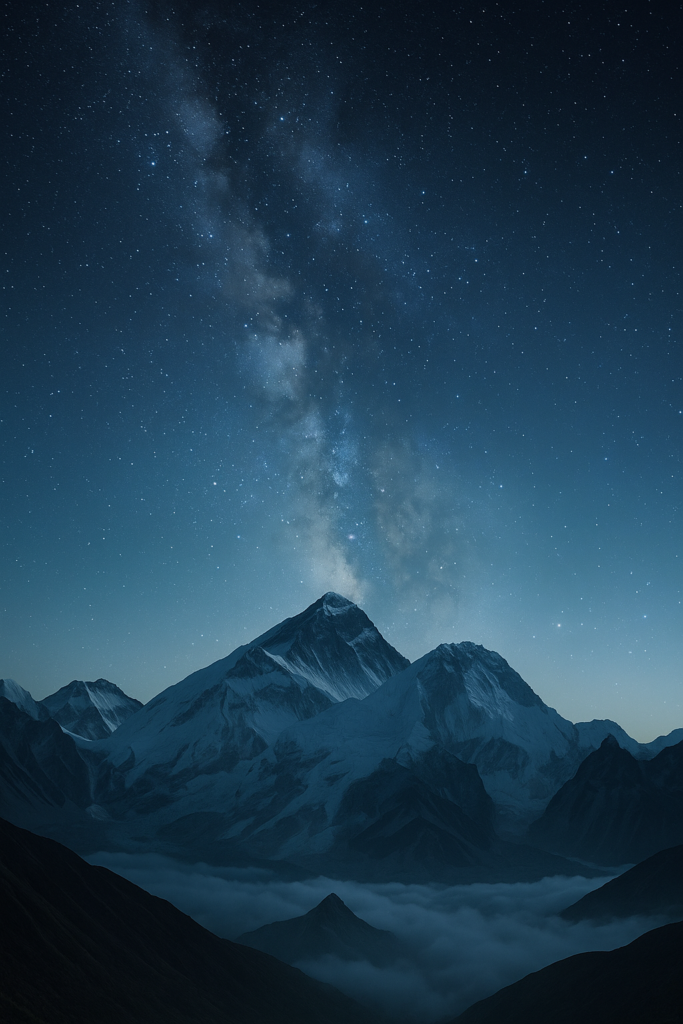
Conclusion: Where Earth Meets Eternity
This photograph is not merely a depiction of Mount Everest. It is a window into the human soul—a reminder of our capacity for wonder, humility, and connection.
The mountains do not need us, but we need them. We need their scale to measure our smallness, their silence to hear ourselves, their endurance to remind us what truly lasts.
As the prayer flags flutter against the dying light, they carry the oldest prayer of all:
May all beings be at peace.
May the earth endure.
May we remember that we, too, are part of the mountain.