Your cart is currently empty!
Tag: wanderlust destinations
-
Where the Sun Bows to the Water: A Journey From Japan’s Floating Torii Gate to the World’s Sacred Sunsets
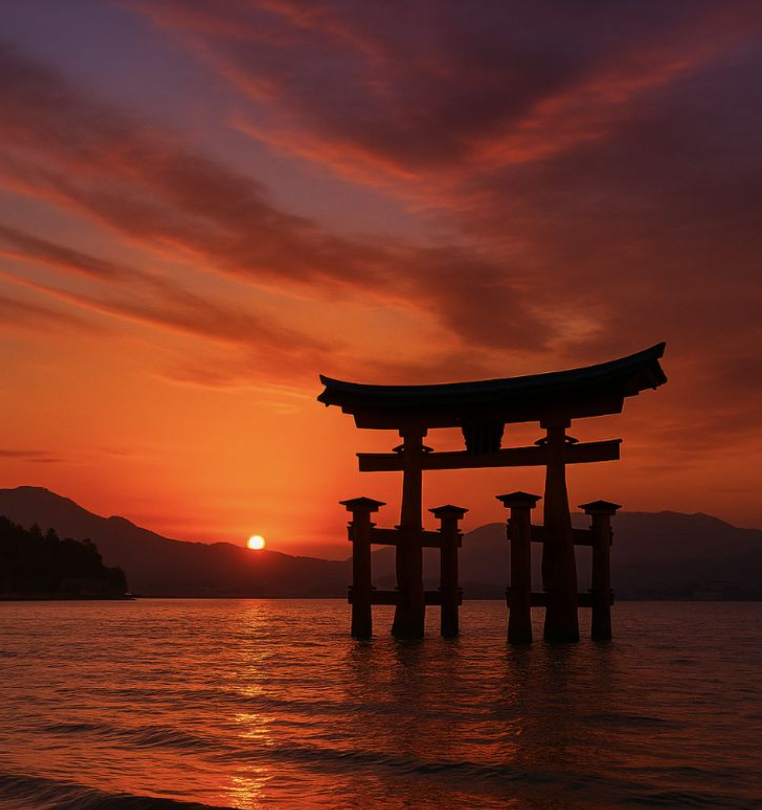
At high tide, the torii gate at Itsukushima Shrine appears to float.
Its vermilion pillars rise from the sea in quiet defiance, glowing against the softening light of evening. The water ripples gently at its base, catching fragments of sunlight like scattered gold. Beyond it, the sky transitions through a palette of apricot, rose, and lavender — a slow, celestial ceremony. On the nearby shore, the scent of pine mingles with ocean breeze. Deer wander freely, unbothered by humans, as if carrying the island’s ancient serenity in their calm footsteps.
A hush falls over the crowd gathered along the beach. People speak more softly. Some sit. Some clasp their hands. Others simply breathe, looking out at the floating gate framed by fading sun.
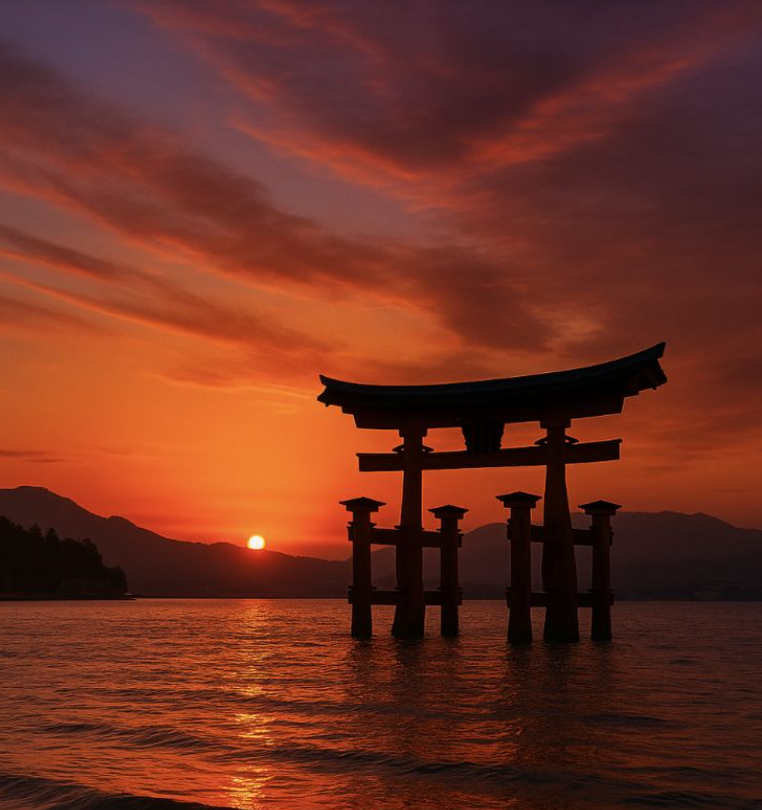
Then it happens — the moment when the sun slips behind the mountains and the torii becomes a silhouette, dark and bold against a sky of liquid colour. For a breath, everything feels suspended. The water stills, the world dims, and existence narrows into a single, reverent pause.
You feel it.
The shift.
The presence.
The smallness and the vastness.Watching sunset at Itsukushima Shrine is more than witnessing beauty. It is an initiation — into stillness, into wonder, into the ancient Japanese understanding that nature and spirit are not separate, but intertwined.
This is where our journey begins.
But the story stretches far beyond this island. Across the world, humanity has always looked to the horizon as a place of endings and beginnings, of ritual and awe. From Bali’s sea temples to Hawaii’s volcanic shores, from the mirrored fjords of Norway to the sacred Ganges in India, sunset becomes a universal prayer — one spoken in colour, silence, and breath.
This is a journey through those sunsets, those waters, those shared human moments where the world becomes not just a place we travel, but a place we feel.
Part I: The Floating Torii — A Threshold Between Worlds
The Sacred Waters of Miyajima
Itsukushima, often called Miyajima (“shrine island”), has been revered for over a thousand years. In Shinto belief, the island itself is considered sacred — a place inhabited by kami, the divine spirits that animate forests, rivers, mountains, and oceans.
Because the land is sacred, the shrine was built over water. To enter it, visitors historically arrived by boat through the floating torii, passing from the everyday world into the realm of the gods.
That is the role of a torii:
a gate, a threshold,
a boundary between the mundane and the divine.Even today, the gate holds this mystery. Something shifts when you look at it. You feel invited to step inward — not physically, but spiritually.
The Symbolism of Torii Gates
Torii gates stand at the entrance of shrines across Japan. Their form seems simple — two pillars supporting two horizontal beams — yet the symbolism runs deep.
- They mark sacred space.
Crossing under one is like crossing into prayer. - They represent purification.
Inside the gate, the heart widens. The body softens. - They frame the natural world as sacred.
A torii over the sea reminds you the ocean itself is holy.
The floating torii at Miyajima heightens these meanings. When water rises, the gate becomes untethered, hovering between worlds. Its reflection doubles, as if one gate stands in the physical realm and the other in the spiritual.
Sunset as Ceremony

Watching sunset here feels like participating in a ritual older than written history.
The light dims slowly.
The air cools.
The tide rises.
The gate darkens into silhouette.Every moment is deliberate, unfolding with the steady patience of a prayer.
You feel your breath match the rhythm of the water.
You feel your thoughts dissolve into colour.
You feel held, humbled, and strangely renewed.Sunset at Miyajima shrine is a reminder that endings can be gentle, sacred things.
Part II: The Universal Pull of Sunset
Why Sunset Captivates Us
Sunsets move us because they speak a language the mind can’t fully translate. They are:
- transition
- surrender
- impermanence
- renewal
- wonder
The colours are ephemeral. The moment is fleeting. And something in the human spirit responds — perhaps because we too are temporal, and sunset mirrors that softness.
Sunset is the world letting go.
When we watch it, we remember how.
The Horizon as a Liminal Space
At sunset, the horizon becomes a threshold — not unlike the torii gate.
A place where something ends and something else begins.
A place between light and dark, day and night, earth and sky.Across cultures, horizons are symbolic:
- For sailors, they were hope.
- For farmers, they marked time.
- For mystics, they were metaphors.
- For lovers, they were poetry.
When we travel, sunsets become anchors — the moments we remember long after we leave.
Let’s follow that horizon across the world.
Part III: Bali — Temples Carved Into the Sea and Sky
Tanah Lot: A Shrine Above the Waves
Fly south to the island of Bali, where spirituality pulses in everyday life — woven into offerings, dances, stone carvings, and the quiet devotion of incense rising each morning.
Tanah Lot stands on a rocky outcrop, surrounded by ocean. During high tide, it becomes an island of shadow and holiness. The temple is dedicated to sea spirits, guardians of the coastline. Waves crash below, sending spray into the burning sky.
At sunset, Tanah Lot becomes a silhouette — much like Miyajima’s torii — but darker, more dramatic. The ocean churns silver and gold. The sky deepens to crimson. Balinese families gather on the shore, sitting on warm rocks, waiting for the moment the sun touches the water.
It feels like watching a painting reveal itself stroke by stroke.
Uluwatu: Cliffside Devotion
Travel further south to Uluwatu Temple, perched on a sheer cliff overlooking the Indian Ocean. Monkeys wander along the stone paths. The air smells of frangipani. And each evening, beneath the blaze of sunset, the Kecak dance unfolds — rhythmic chanting, firelight, and movements that seem to mimic the shifting tides.
Sunset here is not quiet.
It is a celebration — an offering of voice, flame, and energy.
A reminder that spirituality can be lively, embodied, and communal.The Balinese Way of Sunset
For the Balinese, sunsets are invitations:
- to thank the gods
- to cleanse the day
- to release what no longer belongs
- to honour the cycles of nature
You feel that gentleness as the sky dims.
You feel the island breathe.
You feel yourself soften.
Part IV: Hawaii — Where the Sun Descends Into the Pacific
Sunset as Ceremony
In Hawai‘i, sunset feels like a daily benediction.
The sun lowers toward the horizon with slow, deliberate grace.
Palm trees sway in the trade winds.
The smell of plumeria drifts in the air.And people stop.
They stop walking.
They stop talking.
They stop rushing.On beaches across the islands — Maui, Kauai, Oʻahu, the Big Island — you’ll see locals and travelers alike pause to watch the sky ignite in gold and tangerine.
It is a quiet ritual of gratitude — a practice known informally as sunset watching, but experienced as presence.
Puʻu Kekaʻa, Maui — A Leap Into Legend
At Black Rock on Maui, the daily sunset ceremony reenacts the leap of chief Kahekili, who once jumped from this very cliff to honour the spirits.
A torch lighter runs along the cliff, igniting flames as the sun sinks.
He stands at the edge, silhouetted against a burning sky.
He offers a chant.
Then he leaps.The splash echoes like punctuation at the end of a prayer.
Fire meets water.
Sky meets ocean.
Light gives way to night.Kona, Big Island — Lava, Water, and Sky
On the Big Island, the coastline is carved from volcanic fire. Waves crash into black lava rock. Green sea turtles rest on warm sand. And the horizon glows each evening in colours that look molten — as if the sky is remembering the island’s fiery origin.
Sunset in Hawai‘i feels elemental.
Raw.
Primordial.
Like witnessing creation’s ember.
Part V: Norway — Fjords, Silence, and Northern Light
The Stillness of Nordic Water
Travel far north, where mountains tower like ancient guardians and water lies as smooth as brushed metal. In Norway’s fjords — Geiranger, Aurlandsfjord, Hardanger — sunsets linger far longer than anywhere else.
Light stretches across the sky in slow, ethereal gradients: pale gold, soft lavender, deep cobalt. Reflections shimmer on water so still it feels like a second sky.
The fjords are sacred not through religion, but through presence.
Through silence.
Through scale.Midnight Sun: A Sky That Refuses to Sleep
In summer, the sun barely dips below the horizon. Time dissolves. People hike, sail, and wander in perpetual twilight. There is something spiritual about this endless glow — a reminder that the world can break its own rules.
In winter, the opposite occurs: darkness stretches long, and the northern lights dance in place of sunset. Curtains of green and purple ripple across the sky, reflected in icy water.
Here, light feels alive.
Mysterious.
Otherworldly.Nordic Reverence
The Norse once believed the horizon was the edge of the world, where gods and giants met. Today, a quieter reverence remains.
Sunsets in Norway teach stillness.
Patience.
Attention.They remind you that beauty can be soft and slow, not just fiery.
Part VI: India — Sacred Rivers, Golden Evenings
Varanasi at Sundown
On the banks of the Ganges, sunset becomes a ritual — a firelit ceremony called Ganga Aarti. Priests dressed in saffron robes move brass lamps in circles as bells ring and chants fill the evening air.
Flames reflect on the river’s surface.
Petals drift downstream.
Pilgrims pray, bathe, release offerings of light.Here, sunset is not merely an end —
it is a bridge from the earthly to the divine.The Symbolism
To watch sunset in Varanasi is to watch:
- purification
- devotion
- the cycle of life and death
- the acceptance of impermanence
This is not a quiet sunset; it is a spiritual crescendo.
Part VII: The Shared Human Ritual of Sunset
Why We Turn Toward the Light
Across continents and cultures, sunset is a universal moment of pause.
Even the busiest cities soften.
People stop, stare, inhale.Sunsets:
- mark time
- inspire reflection
- offer closure
- awaken awe
- remind us of the day’s gift
In a world obsessed with productivity, sunset insists on presence.
Sunsets as Mirrors
We project onto the horizon:
- our longings
- our worries
- our hopes
- our gratitude
Sunsets become mirrors — of heart, of memory, of transformation.
Travel as Reintegration
Watching sunset in a foreign place reconnects us to something primal:
that we are small,
that the world is vast,
that beauty can find us anywhere.Sunset is the great equalizer —
the same sun touching all lands,
yet each place giving the moment its own story, its own color, its own emotion.
Part VIII: Sunset and Sacred Waters — A Global Reflection
The Connection Between Water and Light
There is something irresistible about sunset over water.
Water reflects.
Water holds.
Water carries light gently.When the sun meets the sea — at Miyajima, Bali, Hawai‘i, Norway — the world becomes double.
Sky above, sky below.
Light above, light below.
A sense of infinity.Water as Spiritual Medium
In many cultures:
- Water cleanses
- Water purifies
- Water connects worlds
- Water symbolizes rebirth
At sunset, this symbolism intensifies.
The day dissolves into the horizon.
Light softens into reflection.
Time itself feels fluid.The Emotional Geography of Coastal Sunsets
Different coasts offer different energies:
- Japan: quiet reverence
- Bali: ceremonial devotion
- Hawai‘i: gratitude and elemental presence
- Norway: meditative stillness
- India: fire, ritual, transcendence
And yet, the essence is shared.
Sunset is the world’s daily prayer —
spoken in colour, water, and silence.
Part IX: The Traveler at Dusk — A Personal Journey
The Feeling of Standing Before the Horizon
Travelers often describe sunset moments as the most memorable part of their journeys: from sitting on a stone wall in Dubrovnik, to watching the sun sink behind Santorini’s caldera, to standing barefoot on Bali’s shore.
These moments pull us out of thought and into experience.
You stand there — eyes soft, breath deep — feeling your own edges blur.
Sunset as a Teacher
Sunset teaches:
- impermanence
- acceptance
- softness
- renewal
- the beauty of letting go
These lessons follow us home.
Sunset and Awe
Modern science suggests awe expands our perception, softens our ego, and deepens our sense of connection.
Sunset is one of the most accessible sources of awe.This is why travelers chase sunsets —
not for photos,
but for feeling.
Conclusion: Returning to the Floating Gate
As the world darkens, return one last time to Itsukushima Shrine.
The torii gate is now a perfect silhouette.
The sky is violet, then indigo.
The water glimmers softly.
The crowd has quieted into reverence.
A deer pads silently along the beach.You feel the presence of something ancient — a whisper of the sacred, a memory of the day’s warmth, a promise of tomorrow’s light.
The sunset fades.
Night embraces the island.
But the moment stays.This is what travel does at its best:
It reconnects us to wonder.
It reminds us of beauty.
It slows us enough to hear the world breathe.And sunset — from Japan to Bali, from Hawai‘i to Norway — is the greatest reminder of all:
The world is always offering us awe.
We need only face the horizon and let ourselves be moved. - They mark sacred space.