Your cart is currently empty!
Tag: nepal travel photography
-
Reflections of the Sacred: The Stillness of Machapuchare
I. Dawn Over the Lake
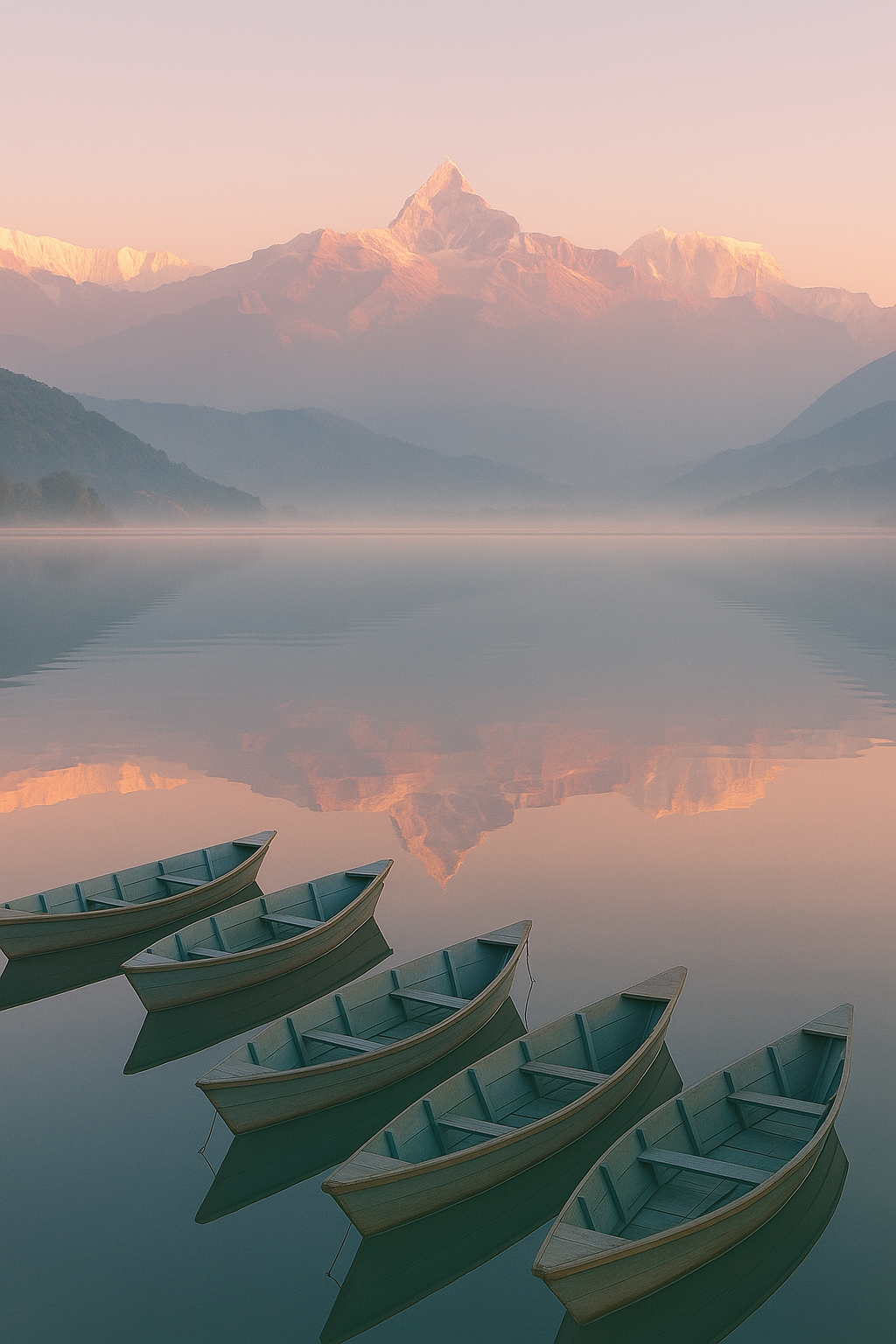
The world awakens slowly in the shadow of the Himalayas. Before the first bird calls, before the fishermen push their boats from the shore, the air lies suspended in perfect stillness. Across the surface of Phewa Lake, a soft mist curls upward, touched by the faintest blush of dawn. The water mirrors the sleeping peaks above — a reflection so clear that sky and earth seem indistinguishable.
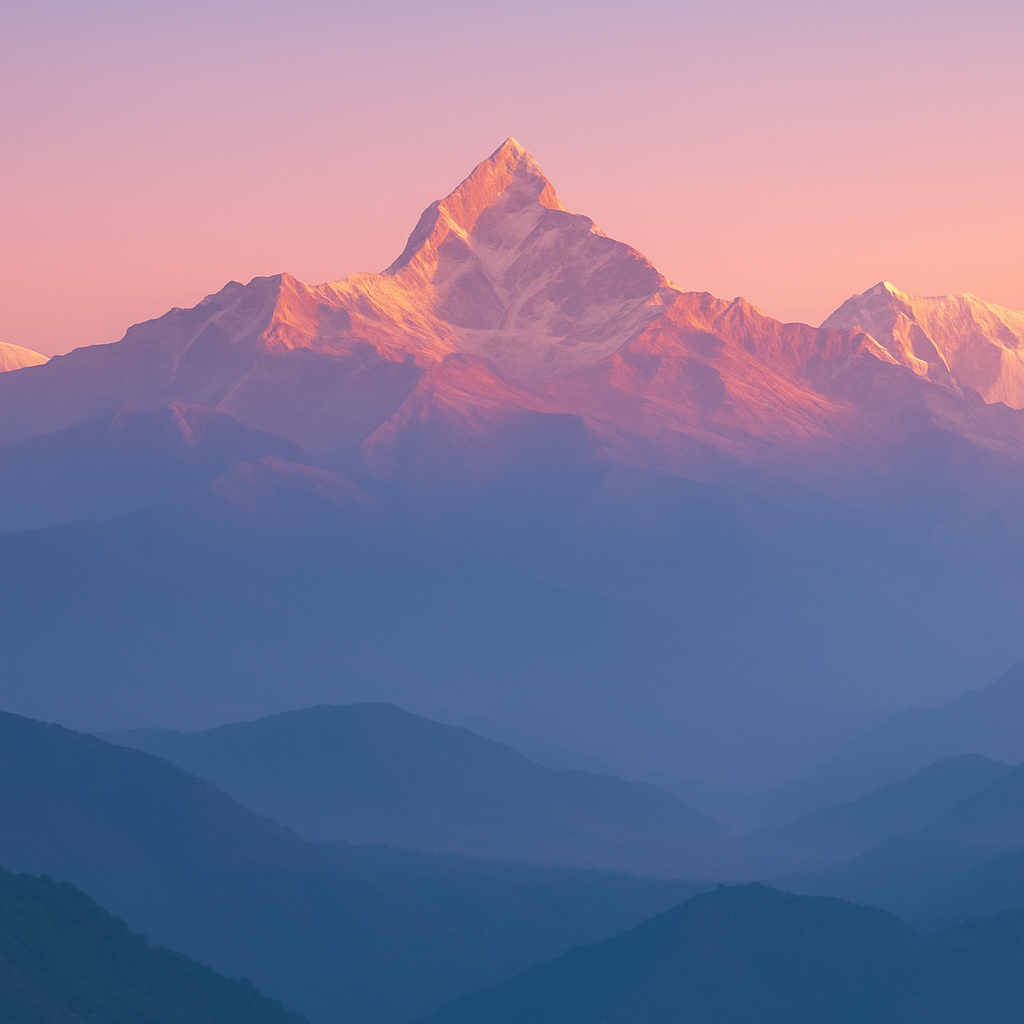
At the center of this vision rises Machapuchare, the sacred mountain of Nepal. Its distinctive double summit, resembling the tail of a fish, pierces the heavens like a divine blade. Bathed in the tender pink of early light, it stands untouched and eternal — both a monument of stone and a symbol of spirit.
In the foreground, five wooden boats float motionless, their hulls gently tracing ripples across the water. They are small human presences in a vast natural symphony — silent witnesses to the meeting of light and stillness. This image, simple and profound, captures a truth often lost in the rush of the modern world: that peace is not found in motion, but in reflection.
II. The Mountain That No One Climbs
Machapuchare — or Machhapuchhre in Nepali — stands at 6,993 meters (22,943 feet). Though not among the tallest of the Himalayan giants, it holds a distinction no other mountain shares: it remains unclimbed. In 1957, a British expedition led by Wilfrid Noyce came within a few hundred meters of the summit but stopped short out of respect for local beliefs. Since then, the Nepalese government has declared the mountain sacred and off-limits to all climbers.
To the Gurung people who live in the region, Machapuchare is the home of Shiva, the great destroyer and transformer in the Hindu pantheon. Its twin peaks are said to represent his presence — masculine and feminine, creation and destruction, held in perfect balance.
Thus, it is not merely a mountain, but a temple — a divine abode where human footsteps have no right to trespass. While Everest and Annapurna have become symbols of conquest, Machapuchare endures as a symbol of reverence. Its untouched summit reminds us that not all summits are meant to be reached. Some are meant to be worshiped from afar.
III. Pokhara: Mirror of the Gods
Nestled in a lush valley beneath the Annapurna range, the city of Pokhara is often described as Nepal’s most beautiful. Its lakes, forests, and mountain vistas have made it a place of pilgrimage for travelers, artists, and seekers alike. But beyond its scenic allure lies something deeper — a spiritual geography that binds the land and the human soul in quiet dialogue.
The heart of Pokhara is Phewa Lake, a natural mirror cradled among rolling hills. Locals rise before dawn to paddle across its tranquil waters, their wooden boats gliding like prayers toward the rising sun. On clear mornings, the snow-capped peaks of Annapurna, Dhaulagiri, and Machapuchare reflect perfectly in its surface, creating a vision so symmetrical it feels like a passage between worlds.
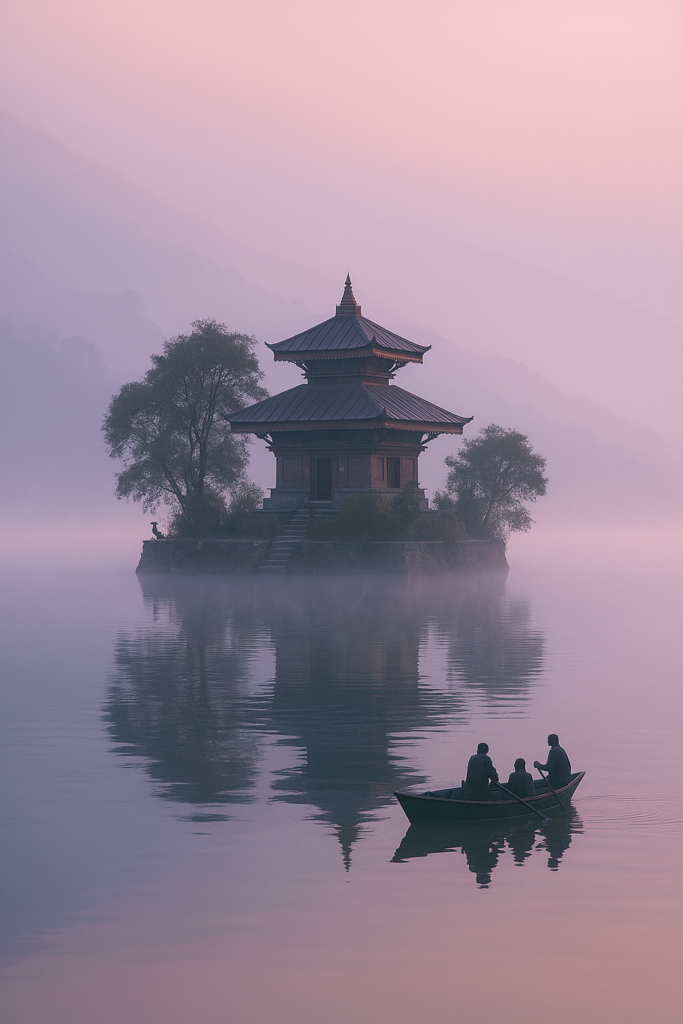
Floating on the lake’s center is the Tal Barahi Temple, a small two-tiered pagoda dedicated to the goddess Barahi — protector of the valley. Pilgrims arrive by boat, carrying offerings of flowers and rice. The gentle sound of bells drifts across the water, mingling with the splash of oars and the cry of herons.
Here, water and mountain, human and divine, all merge into a single frame. Pokhara is not merely a place of beauty; it is a threshold — a point where heaven and earth meet in reflection.
IV. The Language of Stillness
There is something profoundly human in the act of looking into still water. Reflection, both literal and symbolic, has long been a metaphor for contemplation. In the mirror of a lake, the external world becomes internalized — mountains become memories, clouds become thoughts.
To sit by the water’s edge and watch a reflection tremble with the passing breeze is to witness the fragility of perception. What seems solid — the mountain, the sky — becomes fluid, ephemeral. The reflection is perfect until disturbed, just as peace is whole until interrupted by desire or fear.
In Buddhist philosophy, this is the nature of the mind. The surface of the lake is consciousness; the ripples are our thoughts. Only when the mind grows still does it clearly reflect reality. The mountains were always there — we just had to stop stirring the water.
Thus, in the image of Machapuchare reflected on Phewa Lake lies not only natural beauty but a spiritual teaching: to find peace, we must learn to see without disturbance.
V. The Light of Impermanence
The dawn light in the image is not static — it changes by the second. One moment the peaks are rose-gold, the next they are ivory, and soon after, pale blue. The boats, though anchored, drift imperceptibly with the currents. Even the reflection that seems eternal shifts with every ripple.
This, too, is the essence of Buddhist and Hindu thought — the truth of impermanence, or anicca. Everything that exists is in motion, and beauty lies not in permanence but in transience.
The Japanese call it wabi-sabi — the appreciation of fleeting perfection. The Nepali landscape embodies this truth effortlessly: each sunrise is a masterpiece that vanishes within minutes, leaving behind only memory and gratitude.
In a world obsessed with preservation and possession, Machapuchare stands as a silent teacher. Its beauty cannot be conquered or captured. It can only be witnessed, and then — like dawn — let go.
VI. The Boats: Humanity at Rest
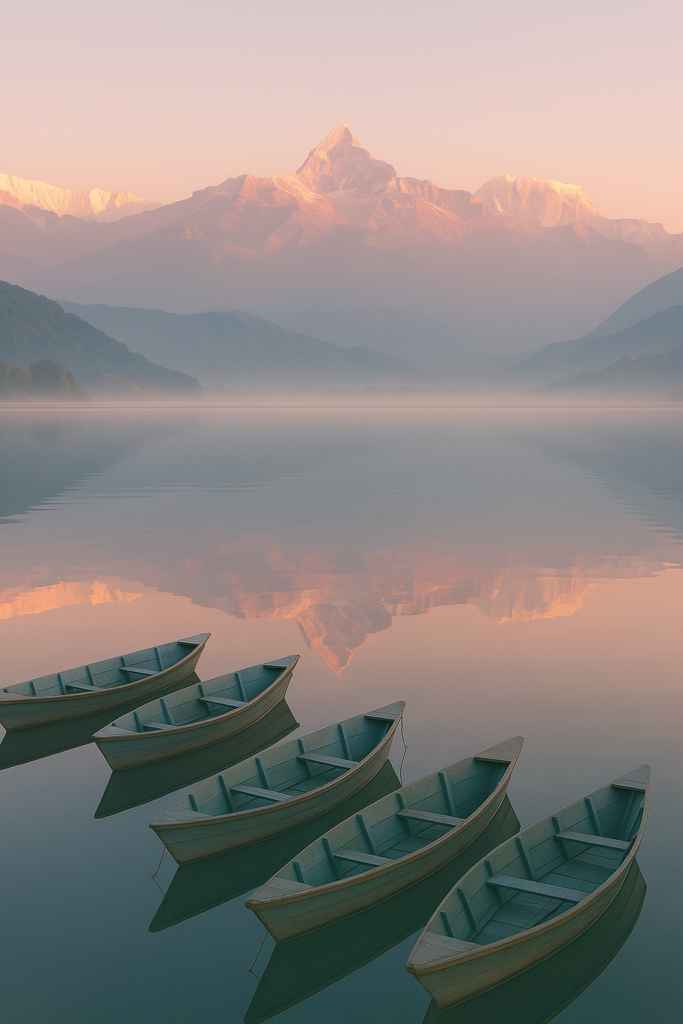
In the foreground of the image, five boats rest gently on the water. Their arrangement feels almost intentional, as if they were placed by an unseen hand to balance the scene. They represent, in their simplicity, human presence — fragile yet enduring, small yet significant.
Each boat tells a story. Perhaps they belong to fishermen who will soon set out to cast their nets as the sun climbs higher. Perhaps they are the same boats used to ferry pilgrims to the temple. Or perhaps they are empty for now, waiting for the day’s first travelers — a pause before movement, a breath before life resumes its rhythm.
Their stillness mirrors the larger stillness of the landscape. In them, humanity’s relationship to nature is expressed not through domination, but through harmony. The boats do not disturb the reflection; they become part of it. They remind us that belonging to the world means learning how to rest within it.
VII. The Sacred Geometry of the Himalayas
The Himalayas are not merely mountains; they are architecture on a cosmic scale. Their ridges, valleys, and summits form patterns of energy that have inspired spiritual seekers for millennia. Ancient yogis believed that the Himalayas were the spinal column of the Earth, channeling divine energy between heaven and ground.
Machapuchare, in particular, holds a unique position in this sacred geometry. It is seen as the guardian of the Annapurna Sanctuary, a natural amphitheater surrounded by peaks that form a circle of snow and silence. To enter it is to step into a temple without walls — a space where nature performs the rituals of creation itself.
Standing at dawn before such majesty, one cannot help but feel the presence of something beyond comprehension. The geometry of the mountain and its reflection form a perfect symmetry — an image of unity, of oneness. It is a reminder that the spiritual and the physical are not separate realms but reflections of one another.
VIII. The Silence of the Morning
Silence in the Himalayas is not absence — it is fullness. It hums softly, like a held note that never fades. The rustle of leaves, the distant cry of a bird, the whisper of wind over water — all become part of this larger stillness.
To those who listen, silence is not empty; it speaks. It tells stories of time before humanity, of glaciers carving valleys, of gods dwelling among peaks. It invites humility — not as submission, but as reverence.
In a time when noise dominates our days — the hum of machines, the chatter of screens, the constant rush of thought — to encounter such silence is to rediscover a forgotten dimension of being.
This silence is what makes the image so powerful. It captures not movement, but the moment before movement. It is the pause that holds eternity.
IX. The Human Need for Mountains
Throughout history, mountains have drawn humanity upward. They appear in our myths, our scriptures, our dreams. From Mount Olympus to Mount Sinai, from Kailash to Fuji, they have served as bridges between mortals and the divine.
The Himalayas, however, are unique. They are not just a mountain range — they are a state of mind. For the people who live in their shadow, the mountains are not obstacles but teachers. They embody endurance, patience, and balance. They remind humans of their smallness and their belonging.
Machapuchare, being forbidden to climbers, amplifies this truth. It invites awe instead of ambition. In its untouchability lies a subtle critique of modernity — a world that measures worth by conquest. Here, reverence replaces victory. The goal is not to reach the top, but to understand why some peaks are sacred.
X. Pokhara’s Morning Rituals

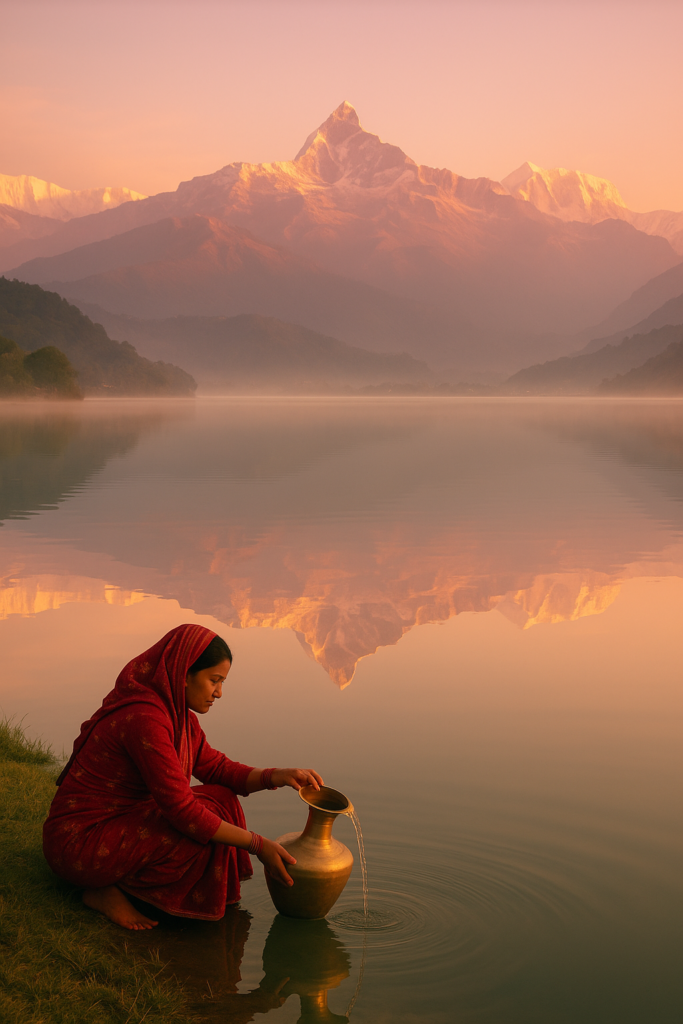
Each morning, Pokhara awakens in quiet reverence. Women walk to the lake carrying copper pots to collect water for their households. Fishermen untie their boats and cast nets that shimmer like silk in the first light. Monks from local monasteries chant along the shore, their voices rising and falling with the lapping waves.
Tourists, too, join this ritual — though unknowingly. Some come with cameras, others with sketchbooks or journals. They stand in awe as the reflection of Machapuchare unfolds before them. Whether or not they understand the mythology, they feel its presence.
The air itself seems charged with gratitude — gratitude for another sunrise, another chance to see the sacred in the ordinary.
XI. The Philosophy of Reflection
Reflection, in Eastern philosophy, is not merely introspection; it is participation. The world reflects the self, and the self reflects the world. What you see depends on the clarity of your perception — just as the mountain’s reflection depends on the stillness of the water.
In the image, if the water were disturbed, the reflection would break apart. Similarly, when the mind is restless, truth becomes fragmented. Thus, the act of contemplation is not passive but active — a discipline of stillness.
This understanding is central to Nepal’s spiritual heritage. Whether in Hindu temples, Buddhist stupas, or quiet lakes, reflection is always at the heart of enlightenment. To see clearly, one must first become still enough to allow reality to appear as it truly is.
XII. Between Heaven and Earth
Machapuchare’s sharp peak rises like an arrow pointing heavenward, while its reflection descends into the water like a mirror arrow pointing toward the depths. The symmetry forms a complete mandala — heaven above, earth below, and human presence in between.
This duality — ascent and descent, light and shadow — is the essence of balance. The mountain reaches upward, but its beauty depends on its reflection below. One cannot exist without the other.
In this, the image becomes more than a landscape; it becomes a visual koan, a teaching on the nature of harmony. To reach the divine, one must also embrace the ground. To ascend, one must also reflect.
XIII. The Quiet Lessons of Nature
Every element in the image carries a lesson. The snow teaches purity. The water teaches acceptance. The boats teach patience. The light teaches impermanence.
Together, they form a silent scripture — one that requires no words, only attention.
Nature, in this sense, is not a backdrop but a guide. It speaks in shapes and silences, in reflections and rhythms. Those who listen to it deeply enough begin to understand that spirituality is not separate from the physical world — it is the way the physical reveals the infinite.
XIV. Memory and Meaning
Long after one leaves Pokhara, the image of Machapuchare lingers in the mind. It returns in dreams, in moments of stillness, in reflections caught on quiet ponds. It becomes a personal symbol — of peace, of humility, of the longing for clarity.
What makes such images unforgettable is not their grandeur but their gentleness. They remind us that beauty need not be loud to be profound. A single mountain reflected on still water can hold more meaning than the loudest spectacle.
In a sense, to carry the image of Machapuchare within is to carry a compass — a reminder of the direction we must return to whenever life grows turbulent: inward, toward stillness.
XV. The Eternal Reflection
As the day rises and the mist dissolves, the reflection fades. The mountain remains, but its mirror vanishes. Yet even in absence, it leaves an imprint — the memory of harmony.
This is the way of all things sacred. They appear briefly, illuminate deeply, and disappear gracefully. Their gift is not permanence but transformation.
To witness Machapuchare at dawn is to glimpse eternity — not in duration, but in depth. The mountain may be eternal, but the reflection teaches us how to see eternity in a fleeting moment.
And that, perhaps, is the truest reflection of all.