Your cart is currently empty!
Tag: nature and spirituality
-
Where the Sun Bows to the Water: A Journey From Japan’s Floating Torii Gate to the World’s Sacred Sunsets
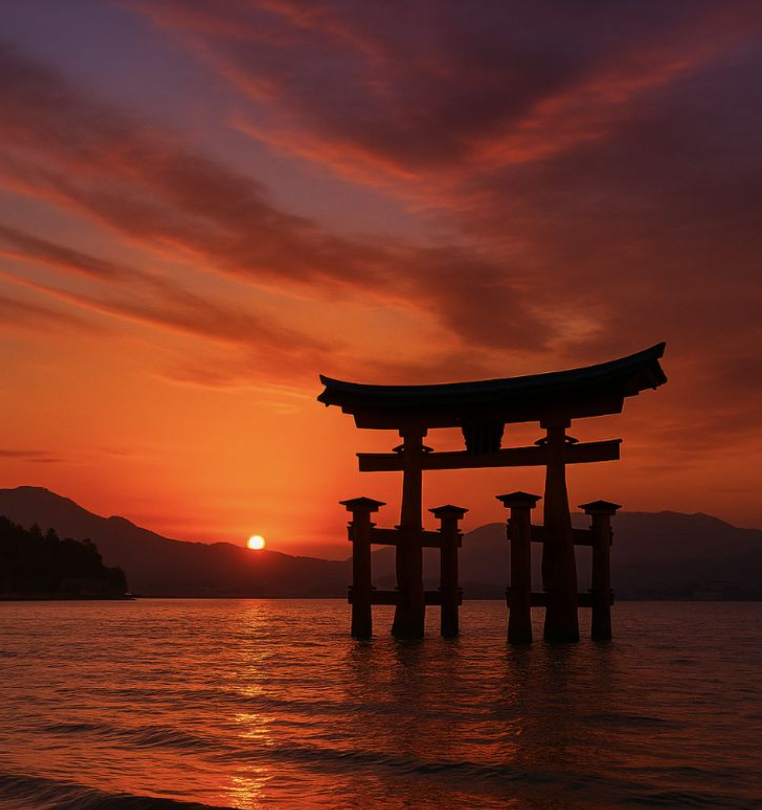
At high tide, the torii gate at Itsukushima Shrine appears to float.
Its vermilion pillars rise from the sea in quiet defiance, glowing against the softening light of evening. The water ripples gently at its base, catching fragments of sunlight like scattered gold. Beyond it, the sky transitions through a palette of apricot, rose, and lavender — a slow, celestial ceremony. On the nearby shore, the scent of pine mingles with ocean breeze. Deer wander freely, unbothered by humans, as if carrying the island’s ancient serenity in their calm footsteps.
A hush falls over the crowd gathered along the beach. People speak more softly. Some sit. Some clasp their hands. Others simply breathe, looking out at the floating gate framed by fading sun.
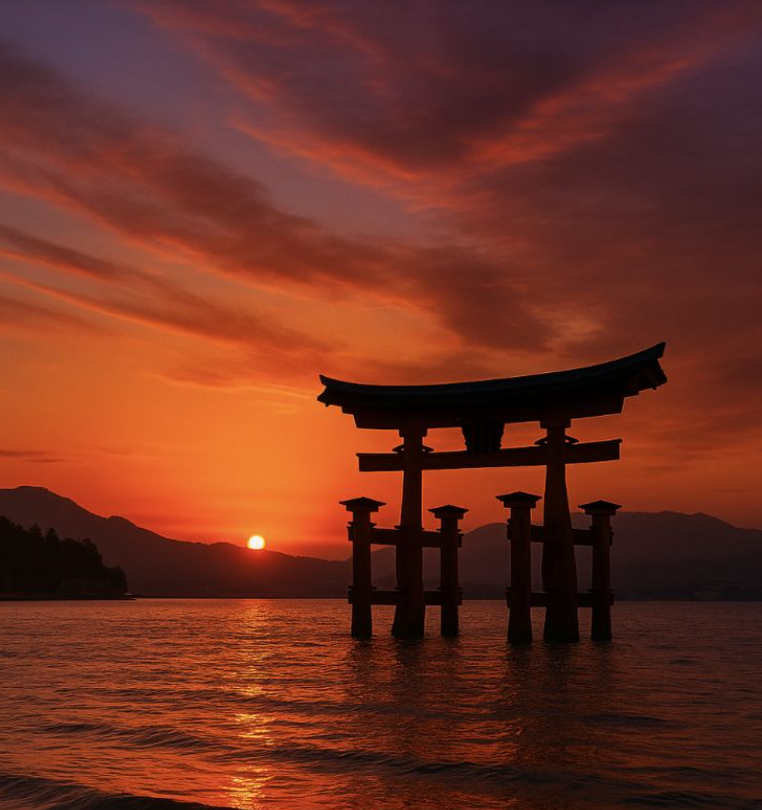
Then it happens — the moment when the sun slips behind the mountains and the torii becomes a silhouette, dark and bold against a sky of liquid colour. For a breath, everything feels suspended. The water stills, the world dims, and existence narrows into a single, reverent pause.
You feel it.
The shift.
The presence.
The smallness and the vastness.Watching sunset at Itsukushima Shrine is more than witnessing beauty. It is an initiation — into stillness, into wonder, into the ancient Japanese understanding that nature and spirit are not separate, but intertwined.
This is where our journey begins.
But the story stretches far beyond this island. Across the world, humanity has always looked to the horizon as a place of endings and beginnings, of ritual and awe. From Bali’s sea temples to Hawaii’s volcanic shores, from the mirrored fjords of Norway to the sacred Ganges in India, sunset becomes a universal prayer — one spoken in colour, silence, and breath.
This is a journey through those sunsets, those waters, those shared human moments where the world becomes not just a place we travel, but a place we feel.
Part I: The Floating Torii — A Threshold Between Worlds
The Sacred Waters of Miyajima
Itsukushima, often called Miyajima (“shrine island”), has been revered for over a thousand years. In Shinto belief, the island itself is considered sacred — a place inhabited by kami, the divine spirits that animate forests, rivers, mountains, and oceans.
Because the land is sacred, the shrine was built over water. To enter it, visitors historically arrived by boat through the floating torii, passing from the everyday world into the realm of the gods.
That is the role of a torii:
a gate, a threshold,
a boundary between the mundane and the divine.Even today, the gate holds this mystery. Something shifts when you look at it. You feel invited to step inward — not physically, but spiritually.
The Symbolism of Torii Gates
Torii gates stand at the entrance of shrines across Japan. Their form seems simple — two pillars supporting two horizontal beams — yet the symbolism runs deep.
- They mark sacred space.
Crossing under one is like crossing into prayer. - They represent purification.
Inside the gate, the heart widens. The body softens. - They frame the natural world as sacred.
A torii over the sea reminds you the ocean itself is holy.
The floating torii at Miyajima heightens these meanings. When water rises, the gate becomes untethered, hovering between worlds. Its reflection doubles, as if one gate stands in the physical realm and the other in the spiritual.
Sunset as Ceremony

Watching sunset here feels like participating in a ritual older than written history.
The light dims slowly.
The air cools.
The tide rises.
The gate darkens into silhouette.Every moment is deliberate, unfolding with the steady patience of a prayer.
You feel your breath match the rhythm of the water.
You feel your thoughts dissolve into colour.
You feel held, humbled, and strangely renewed.Sunset at Miyajima shrine is a reminder that endings can be gentle, sacred things.
Part II: The Universal Pull of Sunset
Why Sunset Captivates Us
Sunsets move us because they speak a language the mind can’t fully translate. They are:
- transition
- surrender
- impermanence
- renewal
- wonder
The colours are ephemeral. The moment is fleeting. And something in the human spirit responds — perhaps because we too are temporal, and sunset mirrors that softness.
Sunset is the world letting go.
When we watch it, we remember how.
The Horizon as a Liminal Space
At sunset, the horizon becomes a threshold — not unlike the torii gate.
A place where something ends and something else begins.
A place between light and dark, day and night, earth and sky.Across cultures, horizons are symbolic:
- For sailors, they were hope.
- For farmers, they marked time.
- For mystics, they were metaphors.
- For lovers, they were poetry.
When we travel, sunsets become anchors — the moments we remember long after we leave.
Let’s follow that horizon across the world.
Part III: Bali — Temples Carved Into the Sea and Sky
Tanah Lot: A Shrine Above the Waves
Fly south to the island of Bali, where spirituality pulses in everyday life — woven into offerings, dances, stone carvings, and the quiet devotion of incense rising each morning.
Tanah Lot stands on a rocky outcrop, surrounded by ocean. During high tide, it becomes an island of shadow and holiness. The temple is dedicated to sea spirits, guardians of the coastline. Waves crash below, sending spray into the burning sky.
At sunset, Tanah Lot becomes a silhouette — much like Miyajima’s torii — but darker, more dramatic. The ocean churns silver and gold. The sky deepens to crimson. Balinese families gather on the shore, sitting on warm rocks, waiting for the moment the sun touches the water.
It feels like watching a painting reveal itself stroke by stroke.
Uluwatu: Cliffside Devotion
Travel further south to Uluwatu Temple, perched on a sheer cliff overlooking the Indian Ocean. Monkeys wander along the stone paths. The air smells of frangipani. And each evening, beneath the blaze of sunset, the Kecak dance unfolds — rhythmic chanting, firelight, and movements that seem to mimic the shifting tides.
Sunset here is not quiet.
It is a celebration — an offering of voice, flame, and energy.
A reminder that spirituality can be lively, embodied, and communal.The Balinese Way of Sunset
For the Balinese, sunsets are invitations:
- to thank the gods
- to cleanse the day
- to release what no longer belongs
- to honour the cycles of nature
You feel that gentleness as the sky dims.
You feel the island breathe.
You feel yourself soften.
Part IV: Hawaii — Where the Sun Descends Into the Pacific
Sunset as Ceremony
In Hawai‘i, sunset feels like a daily benediction.
The sun lowers toward the horizon with slow, deliberate grace.
Palm trees sway in the trade winds.
The smell of plumeria drifts in the air.And people stop.
They stop walking.
They stop talking.
They stop rushing.On beaches across the islands — Maui, Kauai, Oʻahu, the Big Island — you’ll see locals and travelers alike pause to watch the sky ignite in gold and tangerine.
It is a quiet ritual of gratitude — a practice known informally as sunset watching, but experienced as presence.
Puʻu Kekaʻa, Maui — A Leap Into Legend
At Black Rock on Maui, the daily sunset ceremony reenacts the leap of chief Kahekili, who once jumped from this very cliff to honour the spirits.
A torch lighter runs along the cliff, igniting flames as the sun sinks.
He stands at the edge, silhouetted against a burning sky.
He offers a chant.
Then he leaps.The splash echoes like punctuation at the end of a prayer.
Fire meets water.
Sky meets ocean.
Light gives way to night.Kona, Big Island — Lava, Water, and Sky
On the Big Island, the coastline is carved from volcanic fire. Waves crash into black lava rock. Green sea turtles rest on warm sand. And the horizon glows each evening in colours that look molten — as if the sky is remembering the island’s fiery origin.
Sunset in Hawai‘i feels elemental.
Raw.
Primordial.
Like witnessing creation’s ember.
Part V: Norway — Fjords, Silence, and Northern Light
The Stillness of Nordic Water
Travel far north, where mountains tower like ancient guardians and water lies as smooth as brushed metal. In Norway’s fjords — Geiranger, Aurlandsfjord, Hardanger — sunsets linger far longer than anywhere else.
Light stretches across the sky in slow, ethereal gradients: pale gold, soft lavender, deep cobalt. Reflections shimmer on water so still it feels like a second sky.
The fjords are sacred not through religion, but through presence.
Through silence.
Through scale.Midnight Sun: A Sky That Refuses to Sleep
In summer, the sun barely dips below the horizon. Time dissolves. People hike, sail, and wander in perpetual twilight. There is something spiritual about this endless glow — a reminder that the world can break its own rules.
In winter, the opposite occurs: darkness stretches long, and the northern lights dance in place of sunset. Curtains of green and purple ripple across the sky, reflected in icy water.
Here, light feels alive.
Mysterious.
Otherworldly.Nordic Reverence
The Norse once believed the horizon was the edge of the world, where gods and giants met. Today, a quieter reverence remains.
Sunsets in Norway teach stillness.
Patience.
Attention.They remind you that beauty can be soft and slow, not just fiery.
Part VI: India — Sacred Rivers, Golden Evenings
Varanasi at Sundown
On the banks of the Ganges, sunset becomes a ritual — a firelit ceremony called Ganga Aarti. Priests dressed in saffron robes move brass lamps in circles as bells ring and chants fill the evening air.
Flames reflect on the river’s surface.
Petals drift downstream.
Pilgrims pray, bathe, release offerings of light.Here, sunset is not merely an end —
it is a bridge from the earthly to the divine.The Symbolism
To watch sunset in Varanasi is to watch:
- purification
- devotion
- the cycle of life and death
- the acceptance of impermanence
This is not a quiet sunset; it is a spiritual crescendo.
Part VII: The Shared Human Ritual of Sunset
Why We Turn Toward the Light
Across continents and cultures, sunset is a universal moment of pause.
Even the busiest cities soften.
People stop, stare, inhale.Sunsets:
- mark time
- inspire reflection
- offer closure
- awaken awe
- remind us of the day’s gift
In a world obsessed with productivity, sunset insists on presence.
Sunsets as Mirrors
We project onto the horizon:
- our longings
- our worries
- our hopes
- our gratitude
Sunsets become mirrors — of heart, of memory, of transformation.
Travel as Reintegration
Watching sunset in a foreign place reconnects us to something primal:
that we are small,
that the world is vast,
that beauty can find us anywhere.Sunset is the great equalizer —
the same sun touching all lands,
yet each place giving the moment its own story, its own color, its own emotion.
Part VIII: Sunset and Sacred Waters — A Global Reflection
The Connection Between Water and Light
There is something irresistible about sunset over water.
Water reflects.
Water holds.
Water carries light gently.When the sun meets the sea — at Miyajima, Bali, Hawai‘i, Norway — the world becomes double.
Sky above, sky below.
Light above, light below.
A sense of infinity.Water as Spiritual Medium
In many cultures:
- Water cleanses
- Water purifies
- Water connects worlds
- Water symbolizes rebirth
At sunset, this symbolism intensifies.
The day dissolves into the horizon.
Light softens into reflection.
Time itself feels fluid.The Emotional Geography of Coastal Sunsets
Different coasts offer different energies:
- Japan: quiet reverence
- Bali: ceremonial devotion
- Hawai‘i: gratitude and elemental presence
- Norway: meditative stillness
- India: fire, ritual, transcendence
And yet, the essence is shared.
Sunset is the world’s daily prayer —
spoken in colour, water, and silence.
Part IX: The Traveler at Dusk — A Personal Journey
The Feeling of Standing Before the Horizon
Travelers often describe sunset moments as the most memorable part of their journeys: from sitting on a stone wall in Dubrovnik, to watching the sun sink behind Santorini’s caldera, to standing barefoot on Bali’s shore.
These moments pull us out of thought and into experience.
You stand there — eyes soft, breath deep — feeling your own edges blur.
Sunset as a Teacher
Sunset teaches:
- impermanence
- acceptance
- softness
- renewal
- the beauty of letting go
These lessons follow us home.
Sunset and Awe
Modern science suggests awe expands our perception, softens our ego, and deepens our sense of connection.
Sunset is one of the most accessible sources of awe.This is why travelers chase sunsets —
not for photos,
but for feeling.
Conclusion: Returning to the Floating Gate
As the world darkens, return one last time to Itsukushima Shrine.
The torii gate is now a perfect silhouette.
The sky is violet, then indigo.
The water glimmers softly.
The crowd has quieted into reverence.
A deer pads silently along the beach.You feel the presence of something ancient — a whisper of the sacred, a memory of the day’s warmth, a promise of tomorrow’s light.
The sunset fades.
Night embraces the island.
But the moment stays.This is what travel does at its best:
It reconnects us to wonder.
It reminds us of beauty.
It slows us enough to hear the world breathe.And sunset — from Japan to Bali, from Hawai‘i to Norway — is the greatest reminder of all:
The world is always offering us awe.
We need only face the horizon and let ourselves be moved. - They mark sacred space.
-
Where Earth Meets Heaven: A Reflective Journey Through the World’s Sacred Mountains
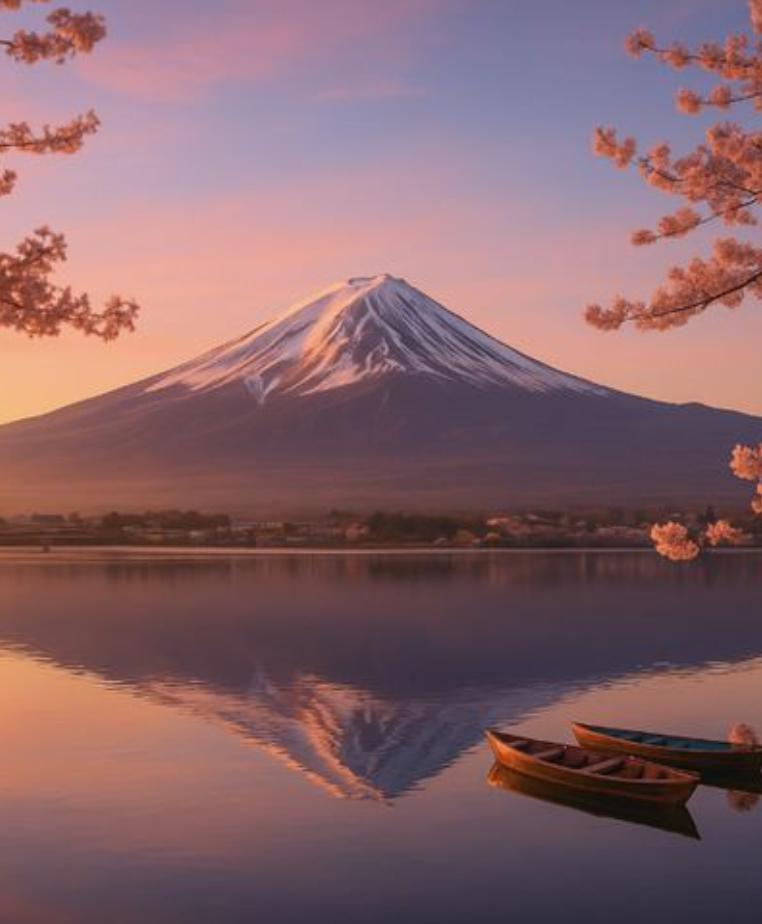
At sunrise, Mount Fuji looks less like a mountain and more like a breath held by the Earth.
The sky warms slowly — pale lavender shifting to rose, then to soft peach as the sun begins its gentle climb. A hush lies over Lake Kawaguchi. Cherry blossoms, delicate as sighs, drift on the breeze and float on the water’s surface. Each petal seems suspended in time, as if reluctant to disturb the lake’s flawless stillness. And there, rising with elegant certainty, is Fuji — perfectly mirrored in the glassy reflection below.
The symmetry is astonishing.
A mountain in both earth and water.
A symbol suspended between worlds.In this early morning quiet, with the scent of blossoms drifting through cool air and the warmth of light beginning to touch your skin, something inside you softens. You feel small and infinite at the same time. You inhale deeply, and it feels like the mountain is breathing with you.
This is where our journey begins — at the foot of Japan’s sacred peak, in the tender quiet where nature carries wisdom older than any temple.
But the story of mountains is a global one.
Every culture has its peaks — places where earth meets sky, where myth and geology intertwine, where pilgrims climb not only upward but inward. From the Himalayas to Mount Sinai, from Mauna Kea’s star-drenched summit to the volcanic spires of the Andes, mountains shape identity, spirituality, and the timeless desire to rise above the world’s noise.This is a journey through those mountains — a meditation on their stories, their symbolism, and the way they shape us as we stand before them, humbled by their silence and strength.
Part I: Fuji at Dawn — The Heartbeat of Japan
Fuji as Image and Spirit
Mount Fuji, or Fujisan, is not merely Japan’s tallest mountain. It is an icon of perfection — its symmetrical cone almost impossibly balanced, its presence woven into the nation’s collective imagination. Fuji appears everywhere: on screens, in paintings, on postcards, in poems, in the whispered recollections of travelers who first saw it through morning mist on a speeding train.
To the Japanese spirit, Fuji is not just a location.
It is a guardian.
A muse.
A spiritual axis around which countless lives have turned.For centuries, pilgrims have climbed its slopes seeking purification, enlightenment, and connection to something beyond human time. To see Fuji is to feel the echo of that longing.
Cherry Blossoms and Seasons of the Soul
No image captures the Japanese spirit more tenderly than Fuji framed by cherry blossoms. These blossoms — soft, ephemeral, and fleeting — symbolize the impermanence of life. Their bloom is both celebration and reminder: beauty is momentary, and it is precisely its brevity that makes it sacred.
Fuji, in contrast, stands eternal.
One represents the passing of time; the other, the persistence beyond it.
When the two meet — blossoms drifting before an ancient volcanic peak — the Japanese concept of mono no aware becomes tangible: the bittersweet awareness of impermanence, of beauty that slips through fingers even as it fills the heart.
Fuji in Shinto Tradition
In Shintoism, mountains are sacred embodiments of kami — divine spirits that inhabit natural features. Fuji is home to Konohanasakuya-hime, the blossom princess and guardian of volcanos. Shrines dedicated to her dot its base and summit, inviting travelers to pause, bow, and offer gratitude before beginning their journey upward.
Climbing Fuji has long been considered a spiritual pilgrimage. Historically, only priests and monks ascended its sacred slopes. Today, thousands climb every summer, following the same ancient paths that once echoed with chants and prayers.
There is a saying in Japan:
“Everyone should climb Fuji once, but only a fool climbs it twice.”The ascent is grueling — steep, rocky, exposed to unpredictable weather.
But reaching the summit at dawn, watching sunlight spill across the world from 3,776 meters above sea level, feels like witnessing creation itself.Fuji in Art — Hokusai’s Endless Inspiration
No artist immortalized Fuji more powerfully than Katsushika Hokusai in his famous woodblock series Thirty-Six Views of Mount Fuji. Each print shows the mountain from a different angle, in different seasons, through storms, in calm, behind waves, beside travelers, over villages.
What Hokusai captured was not just scenery.
He captured the relationship between people and the mountain — the way it watches, shelters, and witnesses life.Fuji is not simply a background.
It is a presence.
A reminder of nature’s permanence in contrast to human ephemerality.
Part II: The Himalayas — Where the Earth Touches the Heavens
Stepping Into the Realm of Giants
Leave Japan’s gentle symmetry behind and travel west to a place where mountains rise like gods themselves: the Himalayas.
Here, the peaks are not poetic silhouettes but monumental spires, sharp and awe-inducing. The air thins. The horizon teeths with jagged snow. Prayer flags flutter from every ridge, carrying whispered wishes into thin blue air.
If Fuji feels like a guardian, the Himalayas feel like creators — ancient forces shaping both land and spirit.
Spirituality Written Into Stone
For Buddhists and Hindus alike, these mountains are more than geographic.
They are cosmological.Mount Kailash is believed to be the home of Shiva.
Mount Meru, a mythic peak, is thought to stand at the center of the universe.
The snow-capped summits symbolize purity, transcendence, enlightenment.Monasteries cling to cliffs, saffron-robed monks chant at dawn, and yak bells echo across valleys that feel untouched by time.
To travel here is to feel the Earth’s spiritual pulse.
The Slow Ascent of Self
Trekkers who journey through Nepal, Bhutan, or northern India often speak not of reaching summits but of being transformed. The thin air forces slow footsteps; the altitude requires humility. Each step is a meditation.
The Himalayas remind you that climbing is not conquering.
It is surrendering — to breath, to silence, to something bigger than yourself.The Stories of Sherpa Tradition
Many travelers encounter the Sherpa people — a community whose resilience, kindness, and deep mountain knowledge have guided climbers for generations. For the Sherpa, mountains like Everest (Chomolungma, “Mother of the World”) are sacred, alive, and deserving of respect.
Their belief is profound:
You do not climb a mountain. The mountain allows you to come.It is a worldview rooted in reverence — an understanding that mountains offer not challenge, but communion.
Part III: Mount Sinai — Where Revelation Meets Landscape
The Desert at Dawn
From the snowy Himalayas, travel southwest into the heat of the Sinai Peninsula, where copper-coloured peaks rise from golden sands. Here, the landscape feels stripped to its essence — rock, sky, silence. Nothing unnecessary. Nothing to distract from what is eternal.
Mount Sinai, known as Jebel Musa, is a place of profound religious significance to Judaism, Christianity, and Islam. According to tradition, it is here that Moses received the Ten Commandments.
When you climb before sunrise — as many pilgrims do — you move upward guided only by starlight and the soft conversations of travelers. Camels occasionally shuffle past, their silhouettes outlined against moonlit stone.
At the summit, as dawn begins to bloom, clouds blush pink and orange, and the desert shifts from darkness to gold. The experience feels biblical even if you’ve never opened a scripture.
A Mountain of Messages
Unlike Fuji’s symmetry or the Himalayas’ majesty, Sinai’s power lies in its starkness.
It feels ancient.
It feels humbling.
It feels like a place where silence is its own language.Mount Sinai teaches a different kind of spirituality — one rooted in restraint, reflection, and the simplicity of listening.
Faith as Pathway
Pilgrimages up Sinai are acts of devotion, but also acts of transformation.
The journey is not hard in a physical sense, but emotionally it becomes something else: a time to release, to remember, to seek clarity.You reach the top, sit on warm stone, and watch the world wake.
And something shifts — quietly, undeniably.This is what sacred mountains do.
They change you without demanding anything in return.
Part IV: Mauna Kea — Stars, Creation, and the Sacred Hawaiian Sky
A Mountain Born From Fire
Cross the ocean to Hawai‘i, and stand before a very different kind of sacred peak: Mauna Kea. At first glance, it does not resemble the sharp, dramatic mountains of the Himalayas or the iconic silhouette of Fuji. Its summit is gentle, rounded, often snow-covered — even though it rises from tropical shores.
But what makes Mauna Kea extraordinary is this:
Measured from its base beneath the ocean, it is the tallest mountain on Earth.A Sacred Summit
In Hawaiian spirituality, Mauna Kea is the meeting place of the gods — a bridge between earth and sky. It is said to be the birthplace of the islands themselves, formed by volcanic fire and shaped by ancient forces.
Because of its height and remoteness, the summit is one of the best places in the world for stargazing. Observatories from around the globe dot the peak, but the land remains sacred — a site of ceremony, offering, and deep cultural meaning.
The Night Sky Like an Ocean
Visit Mauna Kea at night and you witness something unforgettable:
The Milky Way stretches across the sky with impossible clarity. Stars look close enough to touch. The universe feels vast and intimate at the same time.Here, the concept of “mountain” expands.
It becomes not just a rise in land, but a rise in consciousness.You stand on Mauna Kea’s summit and feel both anchored and uplifted.
The mountain connects you to Earth — and the sky invites you into infinity.Respect and Responsibility
Hawaiian culture teaches that sacred places require care. Visitors are encouraged to treat the mountain with humility, leaving no trace, listening to its quiet, and understanding its significance beyond tourism.
Mauna Kea reminds us that spirituality is not only about ascent —
but about respect.
Part V: Other Sacred Peaks — Myth, Memory, and Meaning
The Andes — Mountains that Hold Stories
In South America, the Andes rise like a jagged spine across the continent.
For the Quechua and Aymara peoples, mountains — known as apus — are living guardians.They believe the apus watch over villages, guide travelers, and protect the land. Offerings are left at stone altars. Stories pass through generations. Even today, hikers who journey to Machu Picchu feel that presence — a quiet power woven into the landscape.
Mount Kilimanjaro — The Roof of Africa
Lone and majestic, Kilimanjaro stands above the plains of Tanzania like a snow-crowned king. For the Chagga people, it is a symbol of life, fertility, and ancestral connection. Climbers speak of the meditative silence on its slopes, where each step feels like a conversation with the horizon.
Mount Athos — The Holy Mountain
In Greece, Mount Athos has been a monastic sanctuary for over a thousand years. Its slopes are home to twenty monasteries where monks live in deep devotion, surrounded by mist, forest, and silence. It is a mountain of contemplation — a place where time seems to breathe more slowly.
Part VI: Why Mountains Transform Us
Mountains Offer Perspective
When you stand before a mountain, something inside you reorders.
The worries of daily life shrink.
The horizon widens.
Breath deepens.Mountains place us in scale — reminding us of our fragility and strength at once.
They Teach Us Stillness

Mountains do not rush.
They do not bend easily.
They stand, they witness, they wait.Travelers often describe mountain moments as pauses — times when life’s pace shifts from frantic to meditative.
They Hold Our Stories
Mythology everywhere is full of mountains:
- Olympus, home of Greek gods
- Ararat, where Noah found land
- Fuji, beacon of poetry
- Sinai, site of divine revelation
- Kailash, axis of the cosmos
Mountains gather human imagination like rivers gather rain.
They Inspire Pilgrimage
People climb mountains not only to reach the top, but to understand themselves.
The upward path becomes inward reflection.
The summit becomes a moment of awakening.
Part VII: The Traveler’s Journey — Mountains as Mirrors
The Mountain Inside You
What we seek in mountains is often something we seek in ourselves:
- clarity
- courage
- peace
- perspective
- renewal
We hike to reconnect.
We climb to reset.
We stand before peaks to remember what matters.The Power of Being Small
Mountains invite humility.
Not the kind that diminishes —
but the kind that opens you.Standing at Fuji’s lakeside, or on a ridge in the Himalayas, or beneath Sinai’s dawn, or atop Mauna Kea’s star-soaked summit, you feel it:
The world is vast.
And yet you belong in it.Wanderlust and the Call of Heights
Travelers have long been drawn to mountains because they symbolize possibility.
A high place.
A clear view.
A rising path.We visit them not only to see the world, but to see ourselves differently.
Conclusion: A World Shaped by Peaks and Dreams
Imagine Fuji at sunrise once more.
The lake still calm.
The blossoms still drifting.
The mountain glowing softly as the day begins.Travel begins in moments like this — when something inside you shifts quietly, when you feel the world speaking in a language beyond words.
Mountains are those moments made physical.
They rise from the earth like reminders — of myth, of memory, of meaning.
They hold centuries of stories and offer them freely to anyone willing to look up and listen.From Japan to Nepal, from Sinai to Hawai‘i, the sacred peaks of the world guide us inward as much as they guide us across continents. They invite reflection, reverence, and renewal.
And long after you descend — long after the path becomes flat and ordinary again —
you carry the mountain with you.In breath.
In memory.
In perspective.
In the quiet knowing that you, too, have touched the place where earth meets heaven.