Your cart is currently empty!
Tag: mediterranean travel inspiration
-
Where the Sea Paints the World: A Poetic Journey Through the Most Enchanting Coastal Towns on Earth
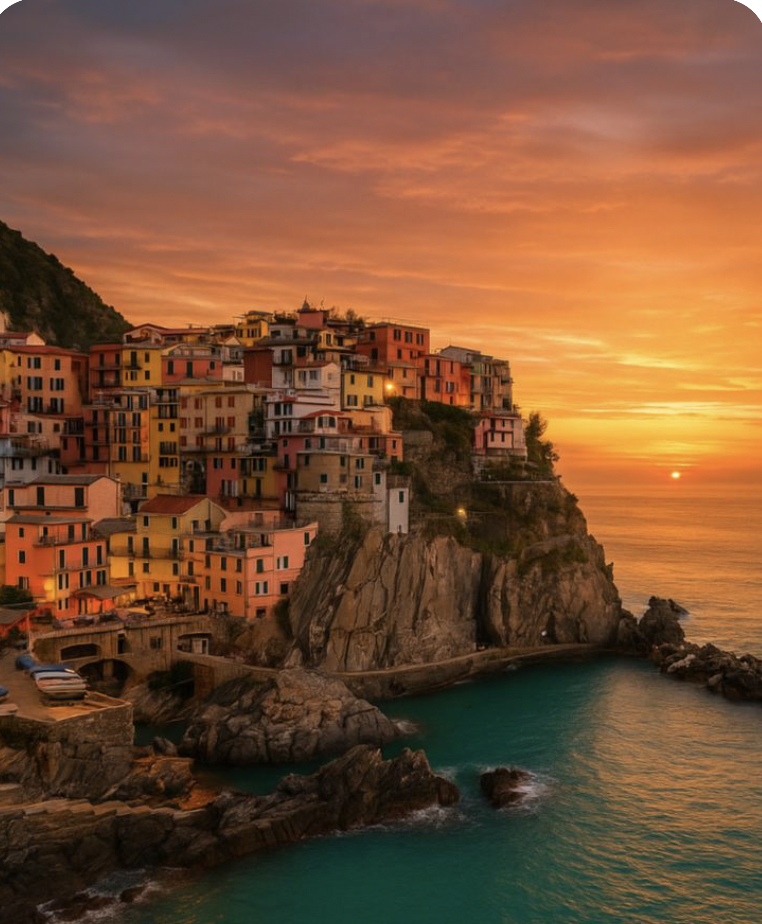
At sunset, Cinque Terre looks like a dream someone painted onto the cliffs.
The sky burns in shades of apricot and rose, the kind of colours that feel too dramatic to be real. The sea below glows with molten gold as waves inhale and exhale against darkened stone. And there, clinging to impossible cliffs like a cluster of precious jewels, are the pastel villages — Riomaggiore in rust-red, Vernazza in sunflower yellow, Manarola glowing like a lantern on the water.Laundry sways like soft flags from balconies. Fishing boats rock gently in little harbours. The smell of salt, lemons, and warm tomato sauce mixes with the breeze.
This is where our journey begins: on a cliffside path in Liguria, watching the sun sink into the Mediterranean while the world slows to a heartbeat you can finally hear.
Cinque Terre is not just a place.
It is a feeling.
A rhythm.
A moment you want to fold carefully and place inside your pocket.But so many coastal towns share this magic — the sparkle of water, the scent of ancient stone, the stories told through food and colour. The world’s coasts are living poems, and the towns built along them are verses shaped by salt, wind, and time.
Tonight, we follow that poem.
From Italy’s dramatic cliffs to the whitewashed glow of Greece, from the terracotta romance of Positano to the walled majesty of Dubrovnik, this is a journey along the edges of the world — where land surrenders to water, and beauty surrenders to memory.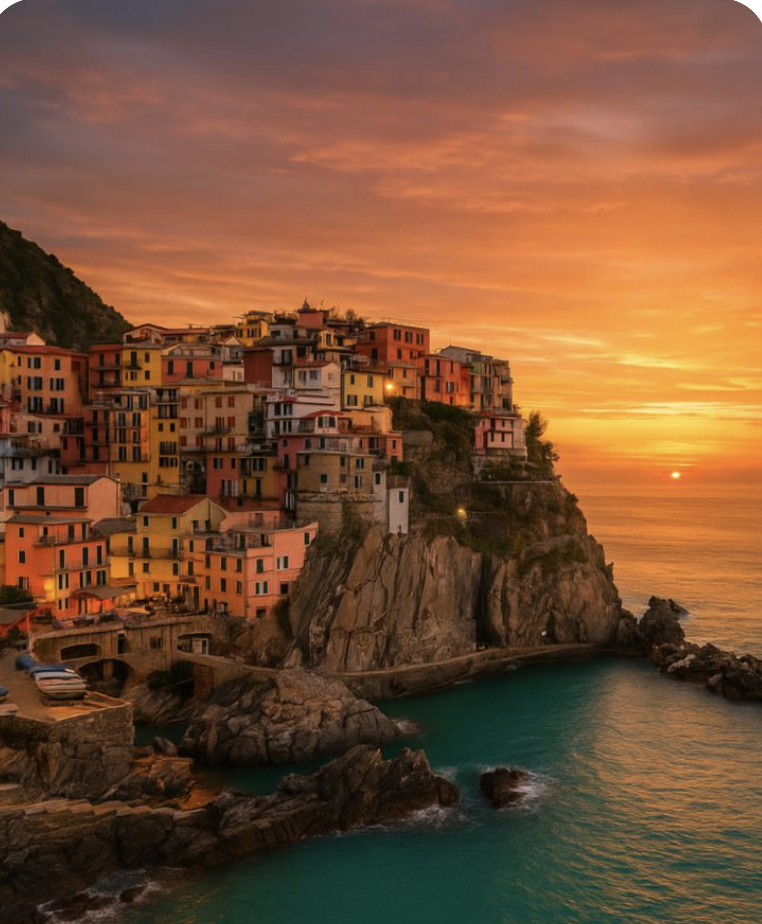
Part I: Cinque Terre — Where Colour Meets the Sea
The Five Villages of the Slow Life
Cinque Terre was once five isolated fishing hamlets connected only by mule paths and the sea. Today, the train makes the journey easy, but the villages still glow with old-world simplicity.
Riomaggiore is all narrow lanes and leaning facades, like a deck of cards tilted against the wind.
Manarola is a painter’s palette — houses stacked like warmth itself.
Corniglia, perched high above the sea, feels like a secret whispered between cliffs.
Vernazza is the jewel — its harbour a perfect embrace of boats and turquoise water.
Monterosso is the beach lover’s dream — long sands and relaxed charm.Each town has its own personality, but together they form a symphony of Italian coastal life.
The Taste of Liguria
Food here is a kind of devotion.
Basil grown on terraced hillsides becomes pesto — bright, fragrant, almost shockingly alive.
Anchovies caught minutes before find their way into lemony, tender dishes.
Focaccia appears everywhere — salted, oiled, sometimes topped with rosemary and olives.And the wine — the crisp, dry white grown on steep terraces — tastes like sunlight trapped in a bottle.

The Pace of a Place Untouched by Hurry
In Cinque Terre, people walk more than they drive. They swim before breakfast. They greet neighbours with a nod that feels like a ritual. Time stretches out — not in boredom, but in presence.
This is the essence of slow travel:
not checking sights off a list,
but surrendering to the rhythm of a place.Cinque Terre teaches you to sit.
To breathe.
To feel the way the sea speaks without words.
Part II: The Amalfi Coast — Cliffs, Lemons, and Golden Light
Positano: A Vertical Poem
Approach Positano by boat and it feels as if a giant hand carved the cliffs and sprinkled houses like confetti. The whole town is a cascade of peach, coral, and white homes clinging to Mount Lattari, tumbling toward the sea.
The air smells of jasmine, espresso, and sun-warmed stone. Bougainvillea spills over balconies in purple clouds.
This place feels cinematic because it is — Fellini, Steinbeck, and half the poets of Europe found inspiration in these serpentine paths and shimmering coves.
Positano is romance sculpted in stone.
The Limoncello Coast
Sorrento and Amalfi are bathed in citrus. Lemons grow impossibly large — sweeter, more fragrant than anywhere else in the world. Their zest perfumes everything:
- gelato tart and golden
- limoncello sipped slowly on warm nights
- pastries dusted with citrus sugar
- seafood kissed with brightness
On the Amalfi Coast, lemons aren’t ingredients — they’re companions.
The Road of Dreams
The Amalfi Drive is legendary. Hairpin bends, sheer drops into infinite blue, terraced villages glowing like secrets. This coastline feels alive — pulsing with history, beauty, and the voices of travellers who fell in love with it long before you arrived.
Here, the sea is not just a view.
It is a presence.
A reminder that nature writes better poetry than we ever could.
Part III: Santorini — Whitewashed Light and Endless Blue
A Floating Village on the Edge of a Volcano
If Positano is a poem, Santorini is a dream made of colour. White walls. Blue domes. Pink bougainvillea. Black volcanic sand. The kind of beauty that feels mythical — because it is.
Santorini sits on the rim of a caldera formed by one of the largest volcanic eruptions in history. And yet what remains is breathtaking: villages perched like pearls above the Aegean, light so bright it feels divine.
Oia at Sunset
Oia is the most famous sunset in the world. Thousands gather every evening to watch the sky ignite — gold, pink, lavender, deep blue. The white buildings catch the light and glow as though lit from inside.
It’s not just the view.
It’s the feeling of witnessing something ancient and familiar, something the island has repeated for thousands of years.Greek Hospitality and Slow-Living Magic
Santorini’s charm goes far beyond beauty. It lies in the details:
- tomatoes grown in volcanic soil
- wine aged in cool cellars carved from stone
- fishermen mending nets at dawn
- donkeys trotting through lanes
- the aroma of grilled fish drifting through evening air
Greek coastal life is slow, warm, and full of stories.
Part IV: Dubrovnik — The Pearl of the Adriatic
A City of Stone and Sea
Dubrovnik rises on Croatia’s coast like a fortress of dreams — marble streets, terracotta rooftops, ancient ramparts overlooking sapphire water.
Walk its walls and you feel as if you’re walking the spine of history itself.
Below you: the old port, glittering with boats.
Beyond you: the Adriatic stretching infinitely.The town feels suspended between eras — medieval yet modern, vibrant yet timeless.
Courage and Culture
Dubrovnik has endured earthquakes, sieges, and war. And yet it stands — proud, intact, radiant. Its resilience is part of its beauty.
Inside the walls, you hear music, laughter, clinking glasses.
Seafood grills over open flames.
Church bells echo softly.
Cats lounge in every sunny corner.Dubrovnik is both strong and soft — a combination only sea towns can carry.
Part V: Beyond the Icons — Hidden Coastal Gems
Portofino, Italy
A crescent-shaped harbour painted in peach and coral. Luxury yachts beside tiny fishing boats. Restaurants spilling onto the waterfront. Portofino is a postcard — elegant, quiet, intoxicating.
Kotor, Montenegro
An emerald bay surrounded by mountains. A medieval town of stone alleys and red roofs. The smell of pine, sea, and wood-fired bread. Kotor feels like a secret whispered between peaks and water.
Essaouira, Morocco
Blue-and-white buildings. Atlantic winds. Fishermen with bright boats. Sea mist mixed with spices. Essaouira is raw, musical, soulful — a coastal town touched by both Africa and the sea.
Madeira, Portugal
Black cliffs, emerald terraces, natural lava pools, flowers blooming year-round. Madeira feels like nature singing.
Part VI: The Deep Connection Between Humans and the Sea
Why We Gravitate Toward Water
Across cultures, humans have always built their lives around water. Not just for survival — but for emotion.
The sea:
- calms us
- humbles us
- invites introspection
- inspires creativity
- connects us to something larger
When you stand at a cliff’s edge, watching waves fold into each other, something inside you settles.
Coastal Towns as Emotional Sanctuaries
Every coastal village has a rhythm:
- mornings of soft light and quiet
- afternoons of shimmering heat
- evenings scented with grilled fish and sea breeze
- nights where the sound of waves is the only song
These rhythms create presence — the feeling of being exactly where you are.
The Romance of Edges
Coastal towns live on edges — where land ends and water begins. Edges are places of transformation, invitation, imagination.
This is why travellers fall in love with cliffs, harbours, beaches, and bays.
Edges remind us that change is inevitable and beautiful.
Part VII: Food, History, and the Art of Slow Coastal Living
Food as Story
In every coastal town, food tells the tale of the sea:
- pesto in Liguria
- lemons in Amalfi
- fava in Santorini
- oysters in Dubrovnik
- grilled sardines in Portugal
- couscous and fresh catch in Morocco
Dishes are simple, fresh, immediate — the kind of food that demands nothing but appreciation.
History Written in Stone
Cliffs hold stories.
Villages keep whispers.
Ports remember every ship.Coastal towns have seen pirates, traders, explorers, lovers, storms, wars, and peace. When you walk their narrow paths, you are walking through centuries.
Slow Living by the Water
Fishermen know patience.
Sailors know surrender.
Villagers know the value of each day.Slow living is not a trend here — it is a tradition shaped by tides.
In coastal towns, people measure time by sunlight, seasons, and sea moods.
Part VIII: Travel Reflections — The Meaning of Edges
The Sea Teaches You to Let Go
Standing on a balcony in Manarola, watching the waves crash far below, you realize: the sea has been doing this forever — moving, shifting, breaking, returning.
It teaches you to:
- release what no longer serves
- trust your own rhythm
- embrace change
- find beauty in impermanence
Coastal Towns Invite You to Be Present
In these towns, you are not just a visitor — you become part of the scenery. You slow down, breathe deeply, eat well, sleep softly, walk with purpose but without hurry.
You begin to live in colour and light again.
Wanderlust Was Born From Waves
Travel began with the sea — with sailors, dreamers, explorers leaning over the edges of boats and imagining what lay beyond.
Maybe that’s why coastal towns touch something ancient in us. They remind us that we’ve always been wanderers, guided by tides and sunset horizons.
Conclusion: The World Written in Water
At sunset, Cinque Terre glows again in your mind.
The colours return — apricot sky, coral cliffs, lemon light on the water.
You remember the sound of waves folding onto rocks, the smell of pesto and wine, the warmth of stone beneath your hands.You remember Positano’s terraces at dusk.
Santorini’s white walls glowing blue.
Dubrovnik’s ramparts glowing gold.
Small harbours where fishermen mend nets.
Terraced vineyards catching the sun.
The laughter of strangers.
The silence of the sea.The world is full of coastal towns, each one a love letter written in water and stone.
And when you wander through them — when you climb their steps, taste their food, breathe their air — you carry their rhythm inside you.Because the sea does not just shape landscapes.
It shapes the human heart.And in the end, all great coastal towns remind us of the same truth:
We are meant to slow down.
We are meant to feel the wind.
We are meant to stand at the edge of the world and remember that we, too, are made of water.