Your cart is currently empty!
Tag: matsuri traditions
-
Under Lantern Light: The Spirit of Japan’s Summer Festivals
I. The Evening Begins
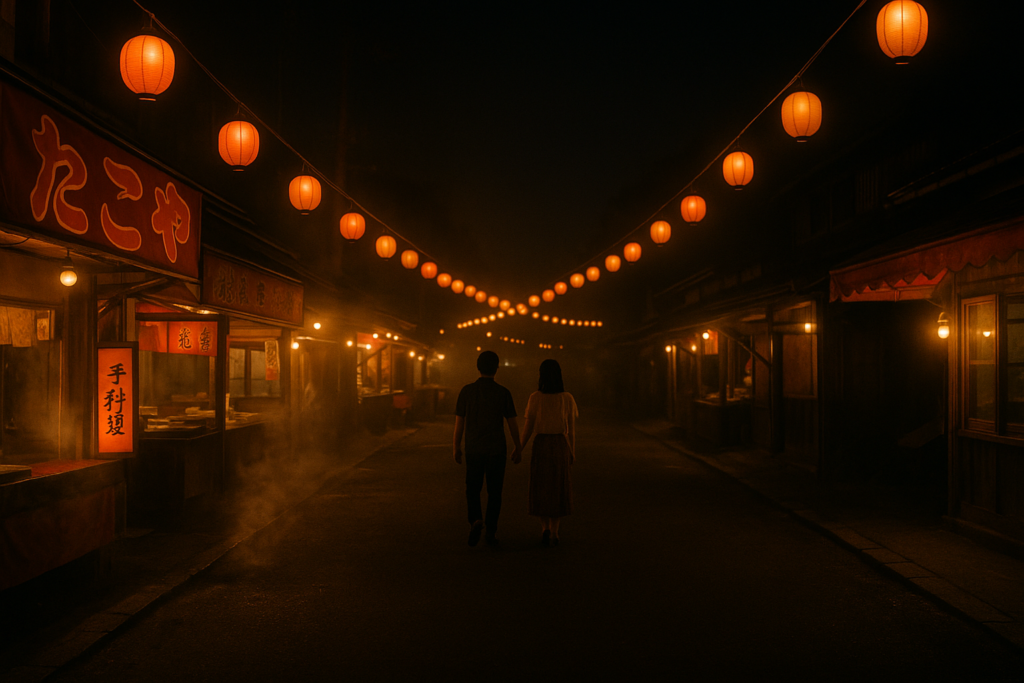
As the last light of day fades, a quiet anticipation fills the air. The heat of summer lingers like a memory, softened by a faint evening breeze. Down narrow streets lined with red paper lanterns, people begin to gather—children in bright yukata, couples holding hands, elders moving slowly but smiling as they take in the familiar sounds and scents of the matsuri, the festival.
The first lanterns flicker to life, glowing like fireflies suspended between rooftops. Somewhere, a taiko drum echoes—a deep, steady heartbeat calling the night to awaken. And then, as dusk deepens, the festival begins in earnest.
This is Natsu Matsuri, Japan’s beloved summer festival season—a time when cities, towns, and even remote mountain villages burst into celebration. It is a season of joy, nostalgia, and renewal. Every step, every scent, every spark in the sky carries centuries of tradition and the quiet poetry of impermanence.
II. The Origins of Celebration
Japanese festivals, or matsuri, are as old as the country’s myths. They trace their roots to Shinto, Japan’s indigenous spirituality, where humans, nature, and the divine coexist in delicate balance. Originally, these gatherings were offerings to kami—the spirits of mountains, rivers, rice fields, and ancestors—thanking them for the blessings of the harvest or asking for protection from disaster.
Over the centuries, these sacred rituals evolved into grand communal events, blending Shinto purification with Buddhist reverence and a uniquely Japanese love for seasonal beauty. By the Edo period (1603–1868), matsuri had become both spiritual observance and cultural celebration—a living link between the celestial and the earthly.

The summer festivals, in particular, are deeply connected to gratitude for nature’s bounty and the honoring of the departed. They are moments when the boundary between the worlds of the living and the spirits grows thin, allowing remembrance and joy to coexist beneath the same sky.
III. A Symphony of Senses
To walk through a Japanese festival is to step into a symphony of sensation.
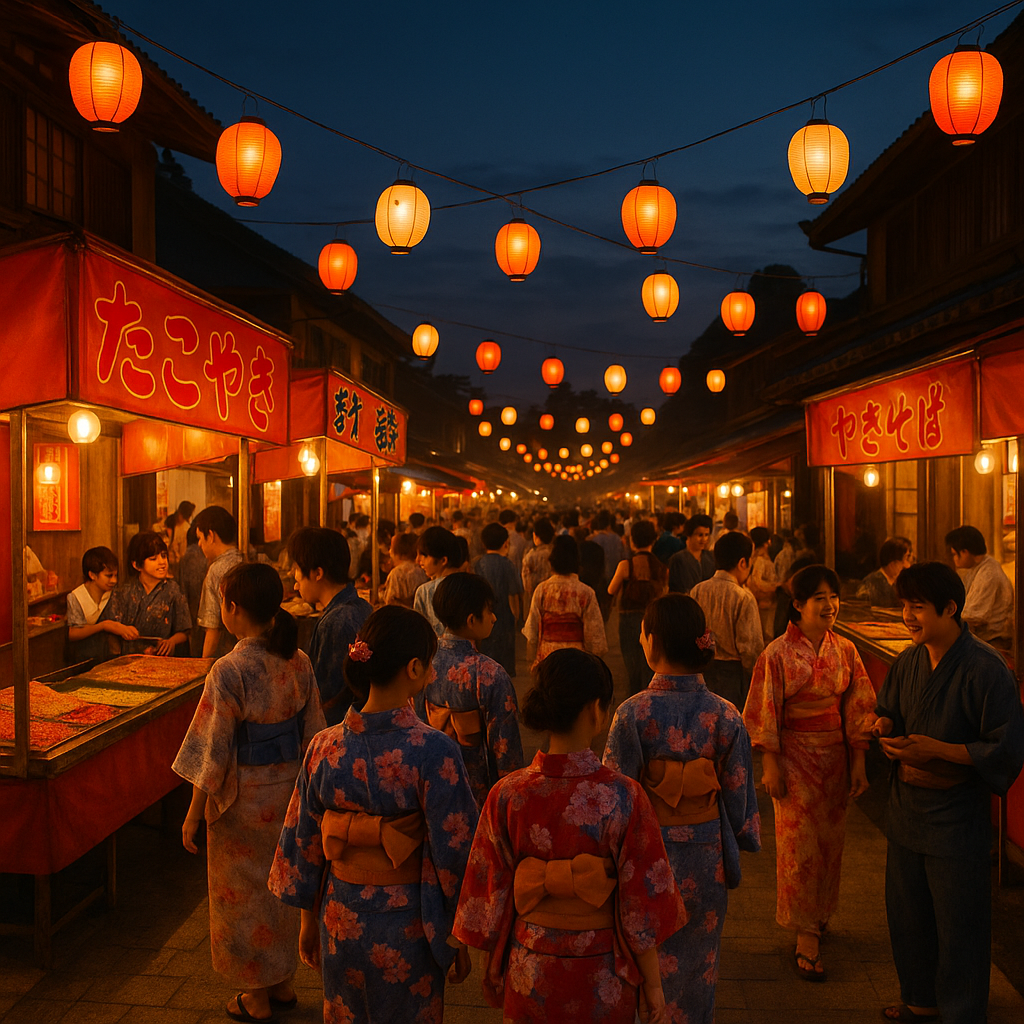
The air is thick with the scent of sizzling food—grilled yakitori skewers, sweet-and-savory okonomiyaki, buttery roasted corn, and the irresistible aroma of takoyaki—golden spheres filled with octopus and topped with bonito flakes that dance in the steam.
Vendors shout their welcomes, children laugh as they play goldfish scooping (kingyo sukui) or ring toss, and the rhythmic drumming of taiko echoes from a distant stage where dancers prepare for the Bon Odori.
Lanterns sway gently overhead, their light casting a warm glow on faces painted with fleeting joy. The sounds, smells, and colors blur into a kind of dream—one that feels both timeless and heartbreakingly brief.
IV. The Yukata: Summer’s Kimono
Among the festival crowd, the yukata reigns supreme. Made of light cotton and tied with an obi sash, it is both elegant and practical—a garment born for summer evenings. Women’s yukata bloom with floral patterns in indigo, crimson, and violet; men’s are understated, in shades of slate and navy.
The ritual of dressing is itself an act of celebration. The fabric rustles softly, the obi tightens at the waist, and sandals—geta or zōri—clack gently on the stone streets. Hair is adorned with pins or flowers, and the air smells faintly of yuzu and sandalwood perfume.
For many, the yukata carries a sense of nostalgia. It transforms the wearer, if only for a night, into part of an unbroken tradition. Under the glow of lanterns, everyone becomes a participant in something larger than themselves—a shared expression of beauty and belonging.
V. The Dance of Bon Odori
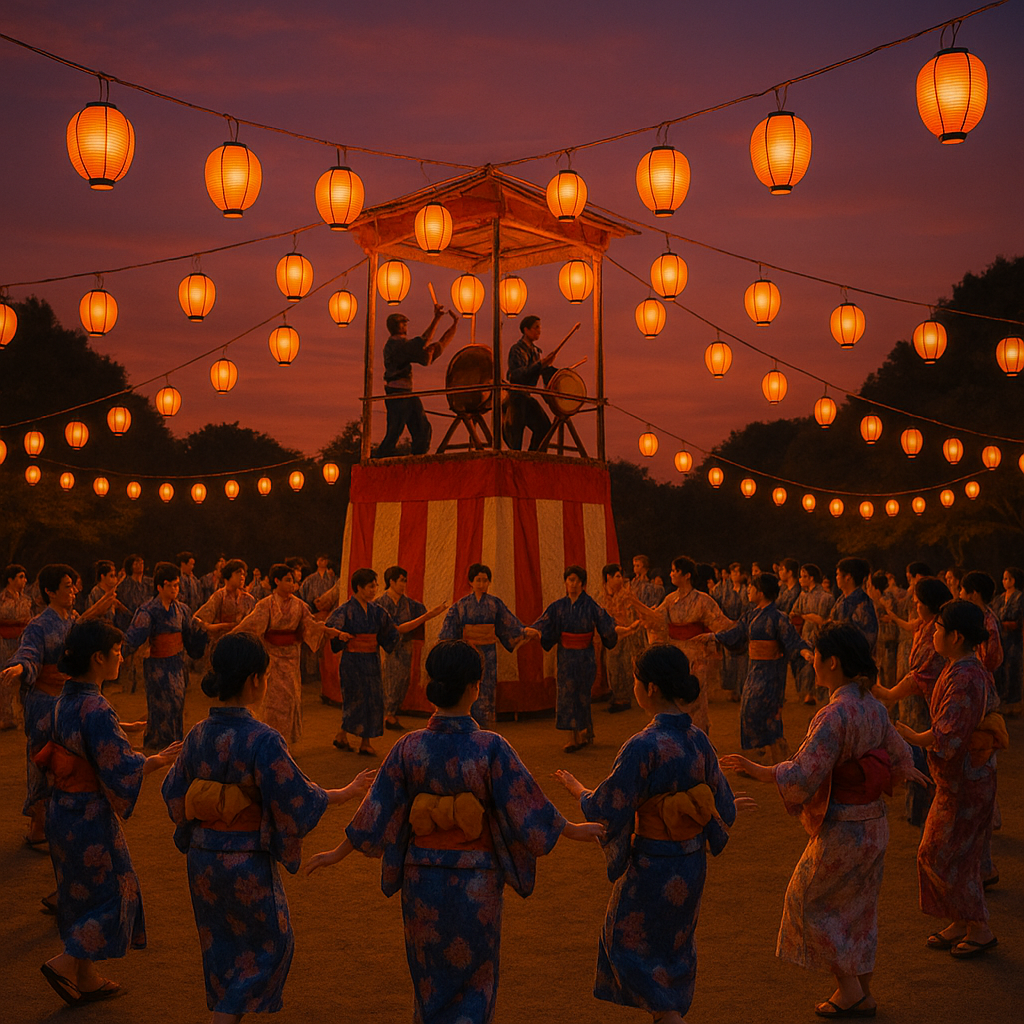
As the night deepens, the crowd begins to move toward the main square. At the center stands a raised platform draped with lanterns—the yagura. Drummers strike their taiko in steady rhythm, and the festival’s heart begins to pulse.
This is Bon Odori, the dance of Obon, one of Japan’s most sacred times. According to tradition, during Obon the spirits of ancestors return to visit their descendants. Families welcome them with lanterns and offerings, and communities gather to dance in their honor.
The steps of Bon Odori are simple, circular, and repetitive—hands raised, feet sliding, fans turning. But in their simplicity lies something profound. Young and old, strangers and friends move together, their shadows swaying in unison beneath the paper lanterns. It is not performance but participation—a living connection to those who came before.
As the drums continue, one can almost feel the veil between worlds lifting—the living and the departed dancing side by side in the timeless rhythm of remembrance.
VI. Fire in the Sky
Then comes the hush. The crowd turns toward the river or the open field. Children sit on their parents’ shoulders. The lights dim, and for a heartbeat, the festival holds its breath.
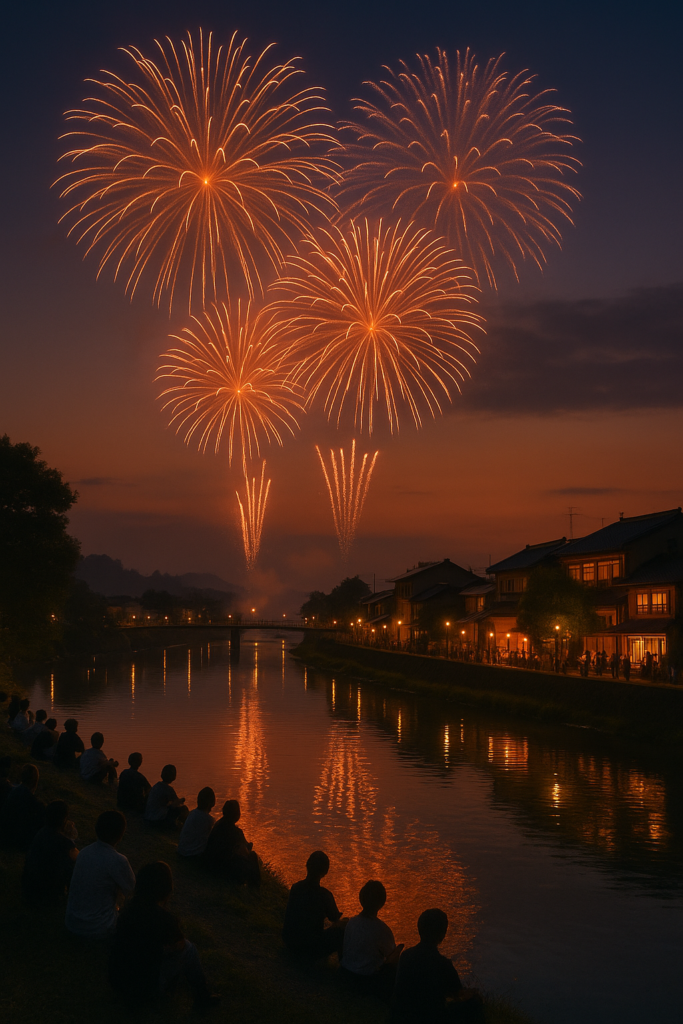
A single flare arcs upward—then bursts open, scattering petals of fire across the heavens. The first firework of the night.
The sky becomes a canvas of color and sound. Gold, crimson, and violet explode into chrysanthemums and willows of light, their reflections trembling in nearby waters. Each burst blooms, fades, and dies in moments, yet the joy it ignites endures.
Fireworks, or hanabi (literally “flower fire”), are central to Japan’s summer identity. Their fleeting beauty embodies mono no aware—the bittersweet awareness of impermanence that runs through Japanese art and philosophy. Like cherry blossoms in spring, fireworks remind the heart that all beauty is temporary, and that is what makes it precious.
For many, this is the climax of summer—the instant when light, sound, and emotion converge into something indescribable, leaving the air thick with wonder and the faint scent of smoke.
VII. The Street of Lanterns
When the fireworks fade, the festival resumes with renewed intimacy. The crowd disperses into side streets where paper lanterns hang low, each painted with family crests, poetry, or the names of local businesses. Their reflections shimmer in puddles left by afternoon rain, turning the ground into a mirror of the sky.
These lanterns are more than decoration—they are prayers made visible. Each flame carries a wish: for good fortune, for love, for health, for the safe journey of the departed souls.
In the hush that follows the spectacle, people slow their steps. Conversations grow quieter. The festival softens into a gentle hum—the calm after celebration, where gratitude takes the place of excitement.
VIII. The Flavor of Memory
No matsuri would be complete without its flavors—each bite a thread in the tapestry of summer memory. Vendors call out in cheerful tones, their stalls bright with color: red apples gleaming in sugar glaze (ringo ame), cups of shaved ice (kakigōri) drenched in syrup, skewers of grilled eel, and steaming piles of yakisoba noodles sprinkled with seaweed.
Each food is ephemeral, meant to be enjoyed in the moment and remembered long after it’s gone. The act of eating at a festival is itself a celebration of life’s fleeting pleasures—simple, sensory, shared.
Many Japanese adults can recall a childhood festival—the first taste of sweet corn, the sticky fingers from candy, the sound of fireworks blending with laughter. These memories linger, returning each summer with the smell of charcoal and the sound of distant drums.
IX. Between Modernity and Tradition
In today’s Japan, summer festivals are both ancient and new. The modern skyline may rise beyond the trees, and smartphones may light up among the lanterns, but the essence remains unchanged. The matsuri endures because it speaks to something timeless—the need to gather, to celebrate, to belong.
For a few nights each year, the boundaries of everyday life dissolve. The salaryman becomes a dancer; the child becomes a keeper of tradition. The air hums with laughter and prayer, commerce and communion. In this space, Japan’s future and past intertwine.
And though the festival may look different in Tokyo’s neon streets or a countryside shrine, its spirit remains the same: gratitude for life, connection to others, and reverence for the beauty of now.
X. Fireworks and Philosophy
The Japanese relationship with impermanence—mono no aware—finds its purest expression in summer festivals. Everything that defines the matsuri is transient: the fireworks vanish, the lanterns burn out, the food is eaten, the laughter fades. And yet, that transience is what makes it meaningful.
In this way, the matsuri mirrors life itself. It teaches through joy rather than sorrow. Where Western thought often seeks permanence, Japanese philosophy celebrates the fleeting. Beauty lies not in what lasts, but in what glows briefly and then disappears—leaving memory in its wake.
To stand beneath the fireworks, surrounded by warmth and sound, is to feel this truth: that happiness is not something to hold, but to witness, again and again, in moments like these.
XI. The Art of Togetherness
Festivals also reveal something deeper about Japanese society—the art of wa, or harmony. Even in the bustle of a crowded street, there is a quiet order. People move naturally, respectfully, attuned to the rhythm of the collective.
Children bow before elders; strangers share food; volunteers clean the streets after the festivities end. The matsuri is not chaos—it is choreography. Its joy is communal, not individualistic. Each person contributes to the atmosphere simply by being present, kind, and aware.
In this way, the festival becomes a microcosm of Japan itself: a place where beauty and discipline, reverence and exuberance, coexist in perfect balance.
XII. The Final Lanterns
As midnight approaches, the crowd begins to thin. Vendors douse their fires, and the last notes of taiko echo off temple walls. The fireworks are long gone, but the air still holds their echo.
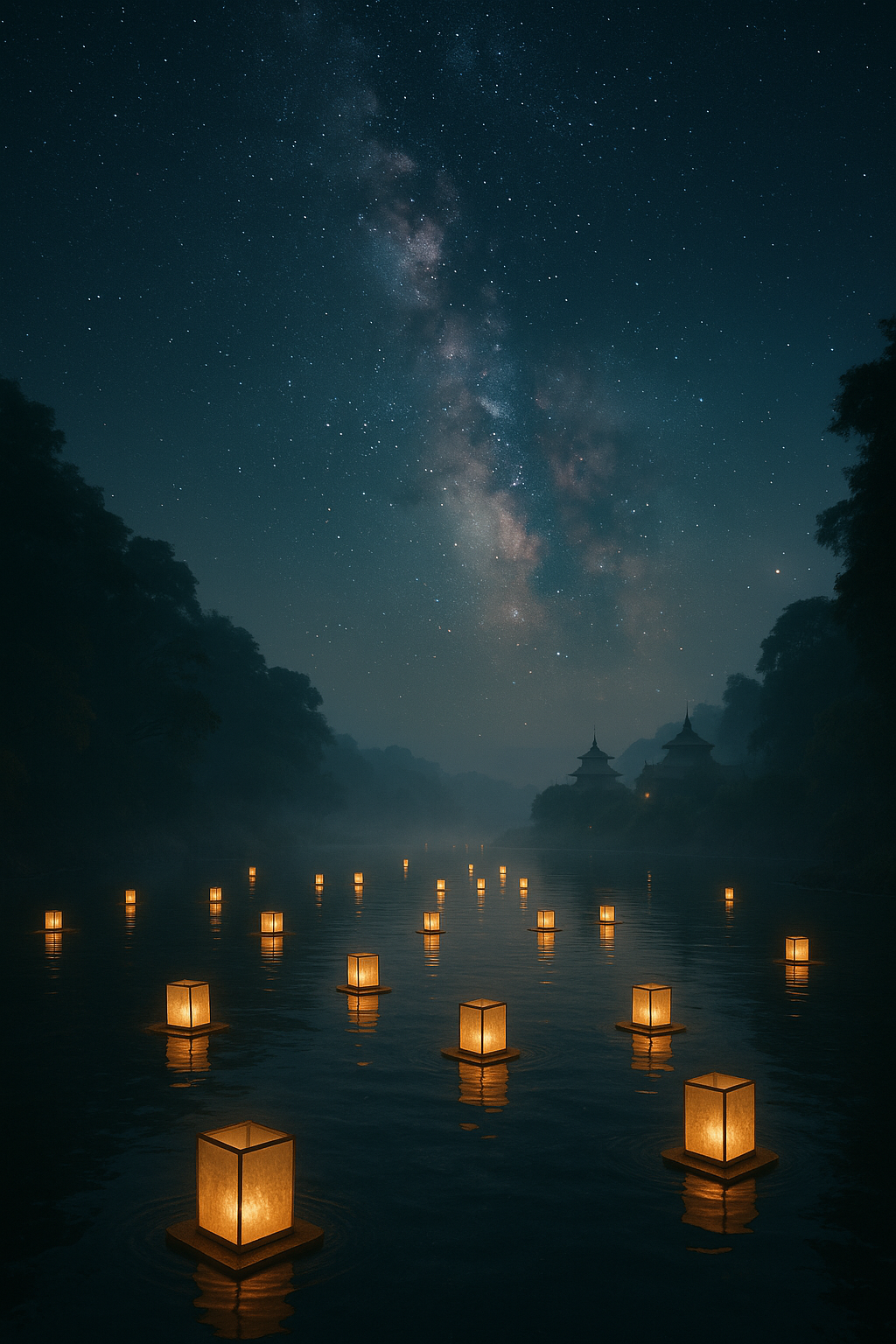
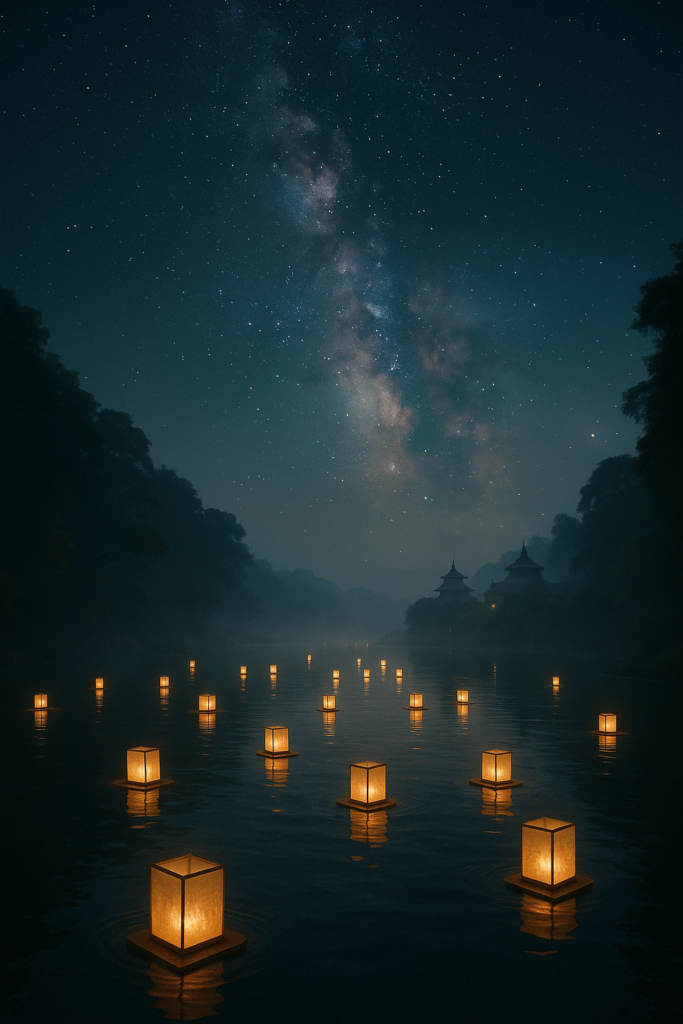
A final procession moves toward the river, carrying paper lanterns lit from within. People lower them onto the water, one by one, watching as they drift away in silence.
This is tōrō nagashi—the floating lantern ceremony. Each light represents a soul, a prayer, or a farewell. Together, they form a glowing constellation upon the dark surface, moving gently toward the horizon.
It is perhaps the most hauntingly beautiful moment of the festival—the transformation from noise to stillness, from celebration to contemplation.
The lights fade into the distance, and with them, summer itself begins to wane.
XIII. What Remains
When morning comes, the streets are empty again. The lanterns are gone, the stalls dismantled, the paper scraps swept away. But something lingers—an invisible warmth, a collective exhale.
The festival may have ended, but its essence remains in the hearts of those who walked its streets. It survives in the smell of grilled food, in the memory of laughter, in the colors that danced across the night sky. And when the next summer comes, the lanterns will rise again, the drums will sound, and the dance will begin anew.
Because matsuri is not an event—it is a rhythm. It is Japan’s heartbeat in summer.
XIV. A Season of Soul
For outsiders, a Japanese summer festival may seem like a spectacle of lights and crowds. But for those who live it, it is something deeper: a reunion of the senses and the spirit.
It is the way the yukata feels against the skin, the sound of geta clogs on stone, the shared smiles between strangers. It is the hum of life magnified, made visible, made sacred.
In a country that moves with quiet precision, the matsuri is an act of joyful surrender—a reminder that even within order, there is room for celebration, spontaneity, and awe.
XV. The Eternal Firework
And so, the fireworks fade, but their echo stays within us. Each explosion, each sparkle, is a brief resurrection of light against darkness—a symbol of hope renewed every year.
In their vanishing brilliance lies the oldest lesson of all: that to live is to shine briefly and beautifully before disappearing into memory.
As lanterns dim and the crowd disperses, the matsuri whispers its final blessing:
Cherish the moment, for it is already passing.