Your cart is currently empty!
Tag: cultural pilgrimage journeys
-
The Tiger’s Nest: Where Earth Meets the Divine
I. The Edge of the World
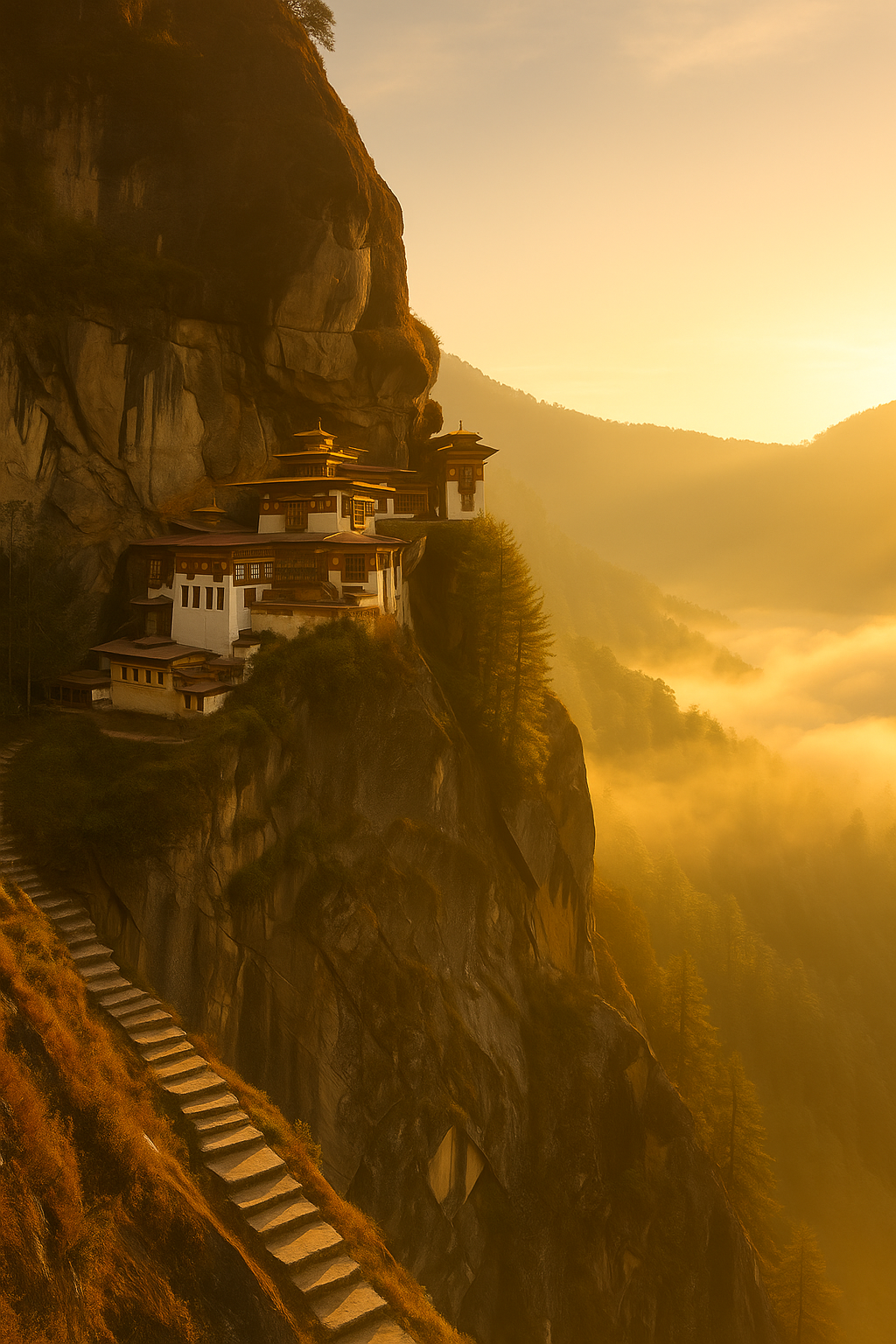
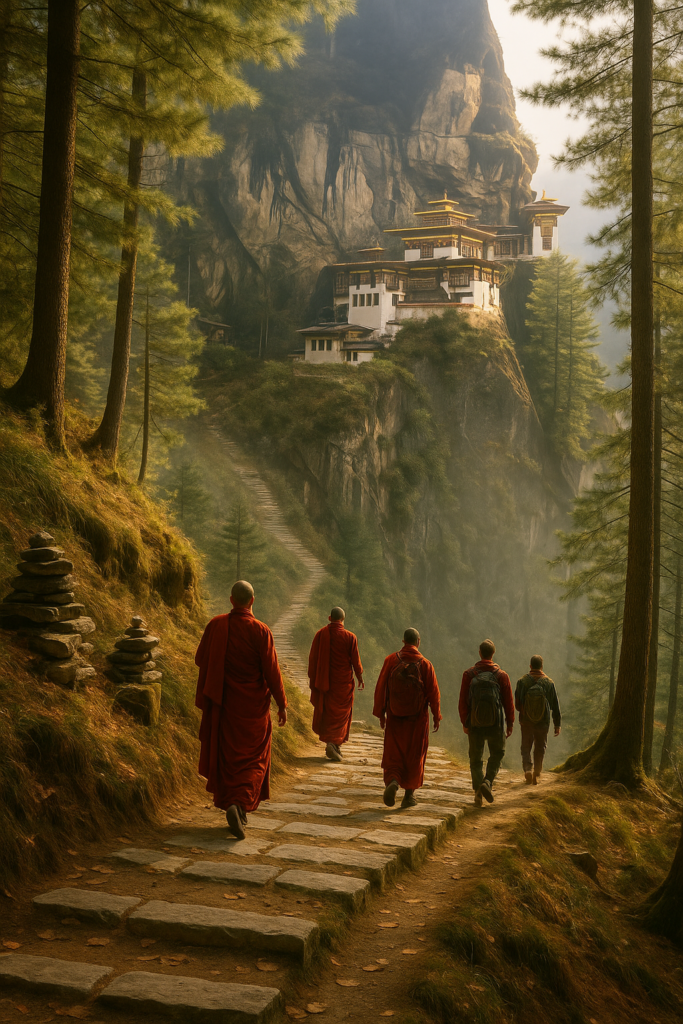
The trail winds upward through whispering pines, prayer flags strung like rainbows between ancient trunks. The air thins as the path climbs, each step heavy but sacred. And then, as the forest parts, you see it: a monastery clinging to the cliffs like a vision, suspended between sky and stone.
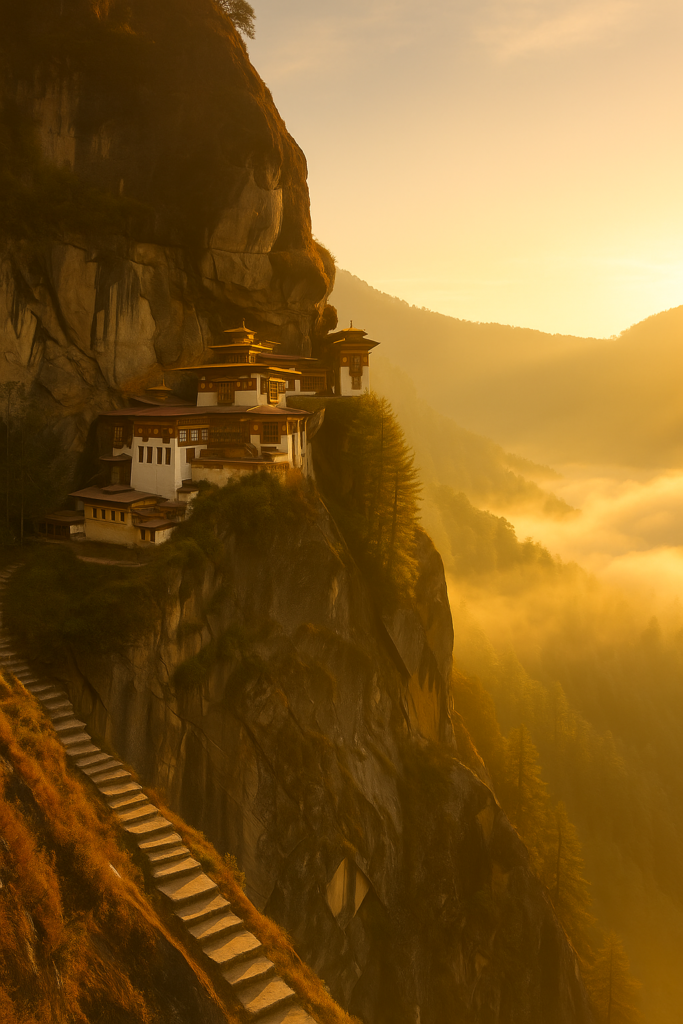
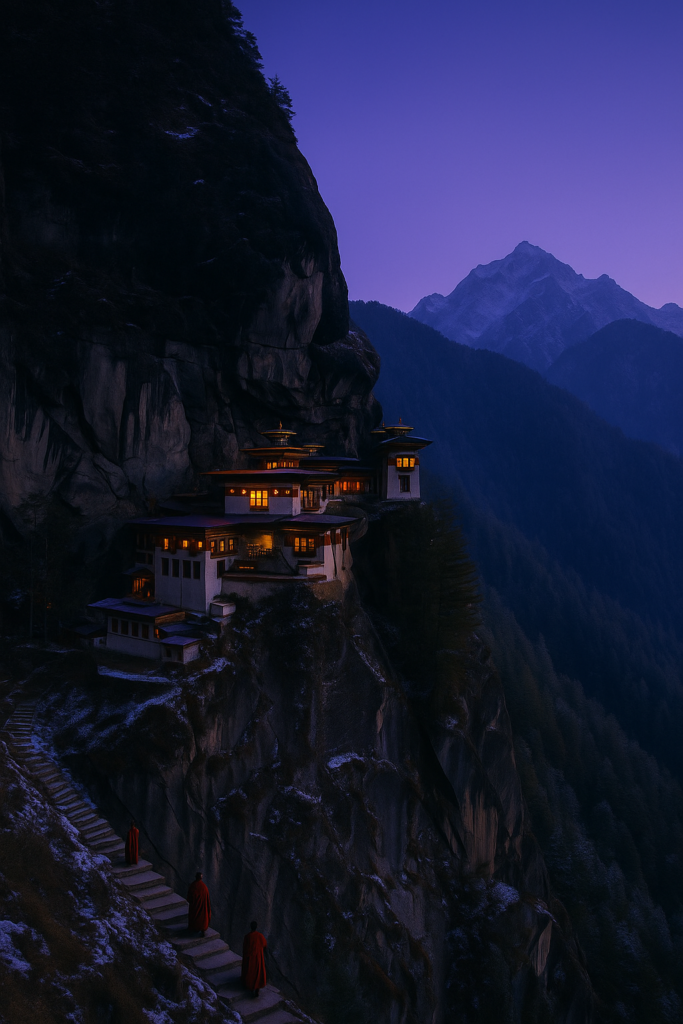
Paro Taktsang — the Tiger’s Nest — looks less like a building and more like a revelation. Perched high on a sheer granite face in Bhutan’s Paro Valley, it seems to defy the laws of gravity and reason alike. Clouds curl below it, as if the earth itself has exhaled. The golden roofs glint in the thin sunlight, and crimson-robed monks descend a staircase carved into the rock, their movements slow and measured against the immensity of the landscape.
To stand before it is to witness the impossible made real — a structure built on faith, maintained by centuries of devotion, and existing at the seam between the human and the divine.
II. A Myth Born of Meditation
The legend of Taktsang begins not with stone and timber, but with spirit. Over 1,300 years ago, Guru Padmasambhava — known across the Himalayas as Guru Rinpoche, the “Precious Master” — flew to this cliffside on the back of a tigress. Some say she was his consort transformed into a blazing creature of light; others say she was a manifestation of his enlightened power.
Landing upon this very rock, Guru Rinpoche entered a cave and meditated for three years, three months, three weeks, three days, and three hours. It was here that he subdued local demons and blessed the land, sowing the seeds of Buddhism in Bhutan.
From this legend, the name Taktsang — “Tiger’s Nest” — was born. And centuries later, a monastery was built around that sacred cave to honor his presence, turning the site into one of the most venerated pilgrimage destinations in the Himalayan world.
The monastery is not just a physical structure; it is a living continuation of myth. Every stone and stair tells the story of human devotion meeting the divine.
III. The Architecture of Faith
At first glance, the Tiger’s Nest seems impossibly placed — as though the mountain itself is holding its breath to keep it aloft. Built in 1692 by Gyalse Tenzin Rabgye, the fourth Druk Desi (temporal ruler of Bhutan), the monastery is a masterpiece of Bhutanese architecture and spiritual design.
It consists of four main temples and several smaller shrines, interconnected by winding stairways and wooden bridges that hug the cliffside. The structures are built into the rock itself, blending seamlessly with the mountain. Their whitewashed walls, golden roofs, and red banded trim glimmer with understated majesty.
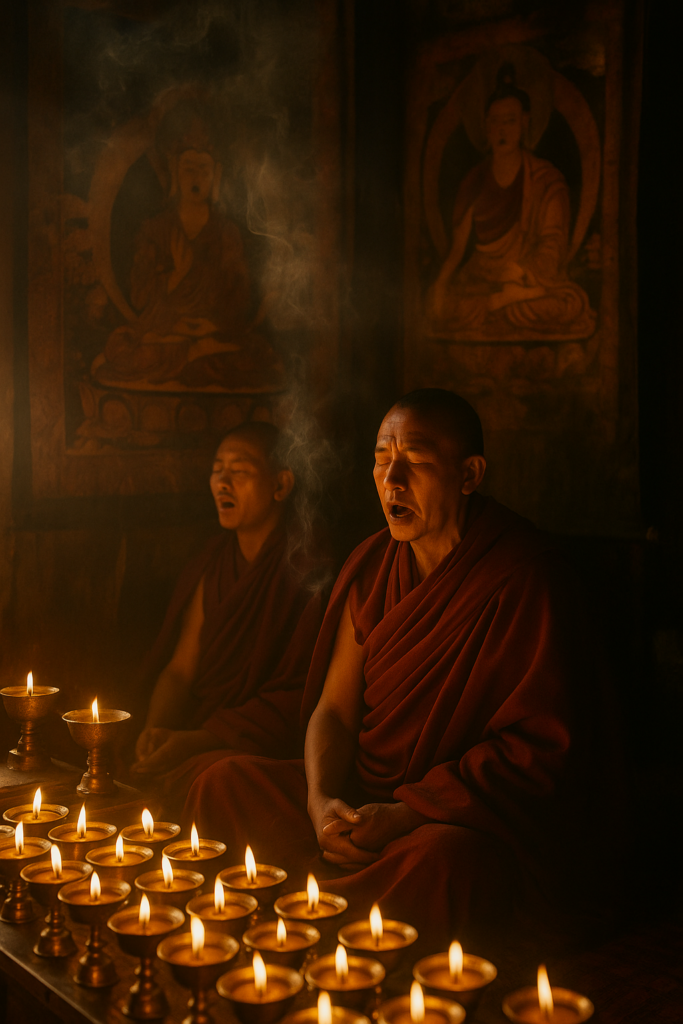
Inside, flickering butter lamps illuminate thangkas (sacred paintings), altars, and statues of Guru Rinpoche. Incense smoke curls upward, mingling with the mountain air that seeps through cracks in the stone. Chanting resonates softly through the chambers — a rhythm that feels eternal.
This is architecture not as conquest, but as prayer. Each beam, each nail, seems to bow before the vastness around it. The monastery’s design does not dominate nature; it listens to it, breathes with it, becomes part of it.
IV. The Path to the Nest
Reaching the Tiger’s Nest is not a casual walk — it is a pilgrimage in every sense. The trail ascends nearly 900 meters (3,000 feet) from the valley floor, snaking through pine forests draped in moss and lichen. The scent of juniper and sandalwood fills the air, and at intervals, visitors pass chortens (stupas) and spinning prayer wheels, each whispering blessings into the wind.
About halfway up lies a viewpoint where trekkers rest, sip butter tea, and gaze across the ravine at the monastery perched impossibly high above. From here, the trail narrows, leading to a final descent into a gorge and a steep climb up to the entrance itself.
At the last stair, as you catch your breath, you cross a wooden bridge above a waterfall — a final threshold between the mundane and the sacred. The sound of rushing water mixes with the chants of monks, and for a moment, the senses blur — you are neither entirely here nor elsewhere.
Those who make the journey say the climb mirrors the inner path of awakening: challenging, humbling, and deeply rewarding.
V. The Monks and the Mountain
The monastery is home to monks who live in quiet devotion, following a rhythm that has changed little over centuries. Their day begins before sunrise, with the deep sound of the dungchen (long horn) echoing across the valley. They chant sutras, light butter lamps, and turn the great prayer wheels, sending blessings to all beings.
Their crimson robes flow like rivers of life against the gray rock and snow. Watching them descend the narrow stairways carved into the cliff is to glimpse a kind of grace — a harmony between human fragility and divine purpose.
Isolation is not loneliness here. It is communion — with silence, with the mountain, with something greater than self. In their simplicity, these monks embody what so many seekers journey to find: peace born not of escape, but of presence.
VI. Fire and Rebirth
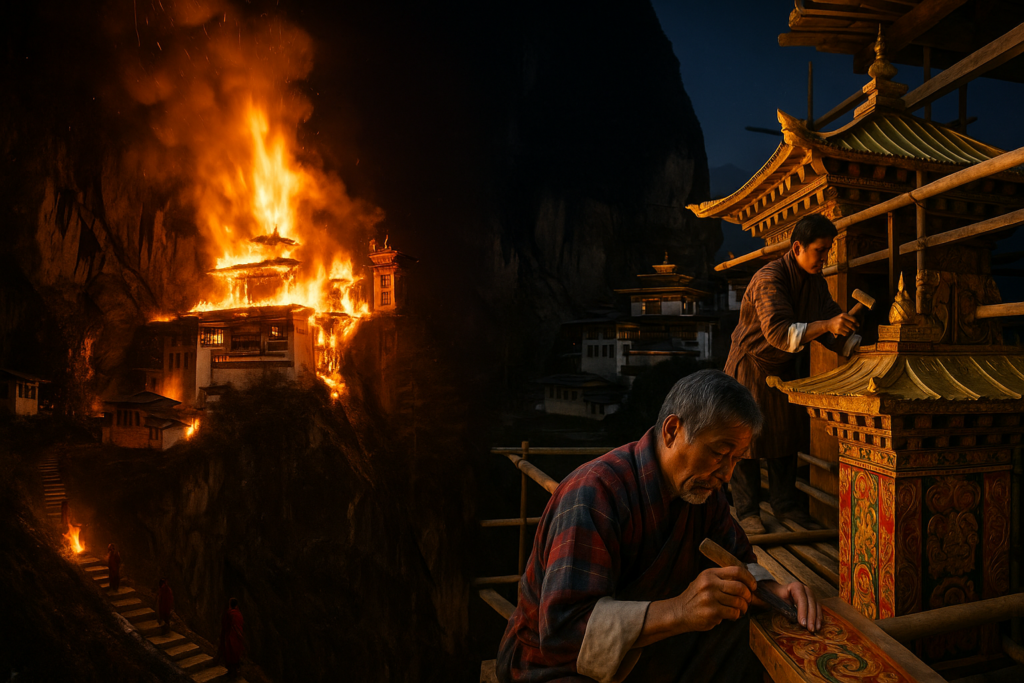
In 1998, tragedy struck. A fire broke out in the monastery, believed to have started from a butter lamp. Flames consumed much of the complex, destroying priceless relics and paintings. For Bhutan, the loss was not just architectural; it was spiritual — a wound to the nation’s soul.
But like the phoenix, Taktsang rose again. With the same devotion that had built it centuries earlier, the Bhutanese people — from kings to commoners — came together to rebuild the monastery. The reconstruction was painstaking, guided by traditional craftsmanship and rituals. Every stone was laid with reverence; every detail was restored as an act of devotion.
By 2005, the Tiger’s Nest was reborn — not as a replica, but as a continuation of its eternal story: impermanence, loss, and renewal woven into one unbroken cycle.
VII. The Philosophy of Height
Why do humans build sacred spaces in impossible places? From Machu Picchu to Meteora, from cliffside temples in China to Taktsang in Bhutan, there is something universal in our impulse to reach upward — to make the climb a metaphor for transcendence.
In Buddhism, mountains represent both physical and spiritual elevation. The journey upward mirrors the ascent toward enlightenment — each step a shedding of attachment, each breath a prayer.
Taktsang’s location is not meant to intimidate but to invite. The cliff face is not a barrier but a teacher, reminding pilgrims that spiritual awakening is not found in comfort, but in the courage to go higher, even when the air grows thin.
In a world obsessed with ease, the Tiger’s Nest reminds us of the value of effort. Enlightenment, like the monastery itself, must be earned one step at a time.
VIII. Bhutan: The Land of Gross National Happiness
To understand the monastery is to understand Bhutan — a kingdom that measures success not by GDP, but by Gross National Happiness. This small Himalayan nation is the last remaining stronghold of Vajrayana Buddhism, a philosophy that infuses every aspect of its culture, governance, and daily life.
Bhutan’s approach to progress is rooted in harmony: between development and nature, tradition and modernity, material and spiritual well-being. The Tiger’s Nest stands as the perfect emblem of that balance — a place where human hands and divine purpose coexist without conflict.
For the Bhutanese, visiting Taktsang is not tourism; it is an act of renewal. It reminds them — and the world — that happiness does not lie in abundance, but in alignment.
IX. The Silence Between Worlds
Inside the monastery, time dissolves. The air is thick with incense, and the murmur of monks’ chants reverberates through stone corridors. Butter lamps flicker before images of Guru Rinpoche, casting a golden glow that seems to breathe.
There are moments of profound stillness, where the only sound is the wind moving through the mountain. In that silence, visitors often feel something stir within — an ancient recognition, a reminder of the sacred that lies dormant in all of us.
Perhaps this is the true power of Taktsang: it does not ask for belief, only presence. You don’t need to understand its rituals to feel its truth. The mountain, the monastery, the monks — all speak a universal language of awe.
X. A Lesson in Impermanence
In Buddhism, everything is impermanent — even mountains crumble, even gods fade. Yet impermanence is not tragedy; it is liberation. The Tiger’s Nest embodies this teaching in its very being.
Perched precariously on stone, rebuilt after fire, buffeted by centuries of wind and snow, it endures not by resisting change, but by embracing it. Its beauty lies in its fragility — in the way it survives precisely because it does not cling.
As one monk once told a visiting pilgrim, “Even the cliff will one day fall. But the prayer carried by the wind — that will never end.”
XI. Pilgrimage and Perspective
Every year, thousands of pilgrims from around the world make the journey to Taktsang. They come for different reasons — some seeking peace, others healing, others meaning. Yet all leave transformed.
The climb strips away distraction. The altitude slows you down. The silence humbles you. And when you finally stand before the monastery, suspended between heaven and earth, something in you softens. You realize that enlightenment is not a destination, but a way of seeing — a way of being.
In a world that worships speed, the Tiger’s Nest is a call to stillness. It teaches that progress is not always upward, but inward.
XII. A Living Icon
Though ancient in spirit, Taktsang continues to shape the present. It is a site of pilgrimage for Bhutanese kings, scholars, and monks, and an enduring symbol of Bhutan’s identity. Its image adorns stamps, art, and textbooks. Yet its power remains undiminished — because it is not merely seen; it is felt.
The monastery has also become a bridge between cultures. Travelers from across the globe, regardless of faith, find something universal here — a reminder that all human longing, in the end, points toward the same summit: connection, meaning, transcendence.
XIII. Beyond the Cliff
When the day ends, and the sun sinks behind the peaks, the Tiger’s Nest glows in the last light — an ember against the vastness of dusk. The monks return to their quarters, and the valley below falls silent. The mountain breathes.
In that quiet, the monastery seems to float — a dream made of stone, a whisper made visible. Its beauty is not in grandeur but in grace; not in permanence but in persistence.
Taktsang is more than a place. It is an idea — that even in the most fragile conditions, the human spirit can reach the heights of the divine.
XIV. The Eternal Return
Long after you’ve descended the mountain, Taktsang remains with you. You remember the sound of the wind, the rhythm of footsteps on stone, the faint scent of incense. You remember how small you felt — and how right that felt.
Perhaps that is its final teaching: that humility and wonder are the same thing. That the divine is not somewhere above, but within the act of looking up.
The Tiger’s Nest doesn’t simply belong to Bhutan. It belongs to all who seek — all who, even for a moment, believe that the sacred might still exist in this world.
Conclusion: The Cliff Between Worlds
The image of the Tiger’s Nest Monastery is more than photography. It is a meditation. A reminder that human aspiration, when aligned with reverence, can create miracles.
As mist gathers and monks descend its stone stairs, the monastery stands — fragile yet eternal, humble yet transcendent. It is the meeting point of heaven and earth, of myth and reality, of impermanence and eternity.
In a single glance, it asks — and answers — the oldest question of all:
How do we touch the divine while still being human?