Your cart is currently empty!
Bridging the Heavens: A Journey Through the Himalayas
I. The First Glimpse
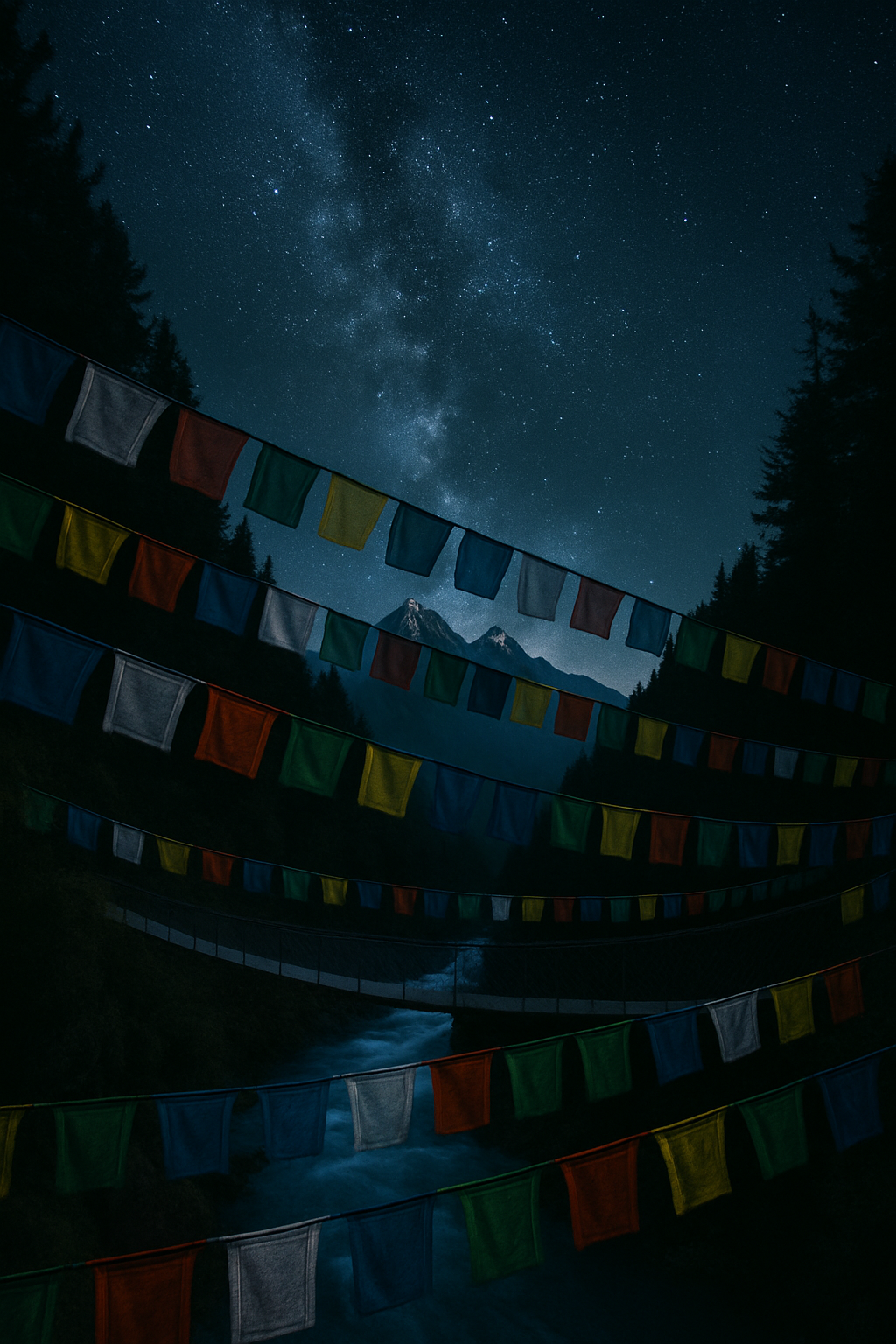
The wind catches the fabric before you even see the bridge.
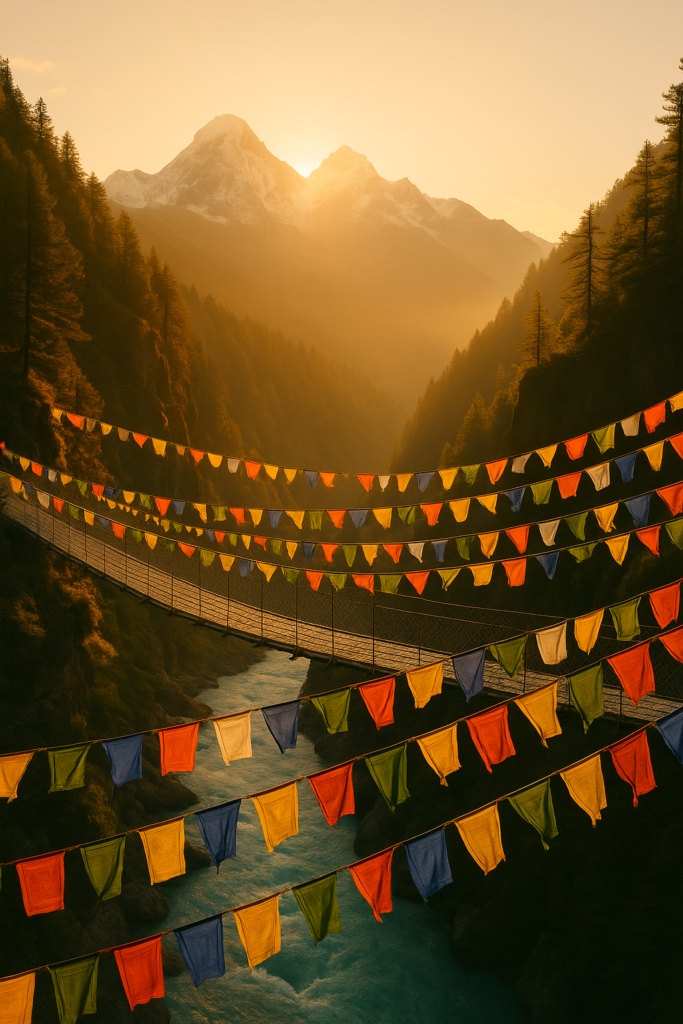
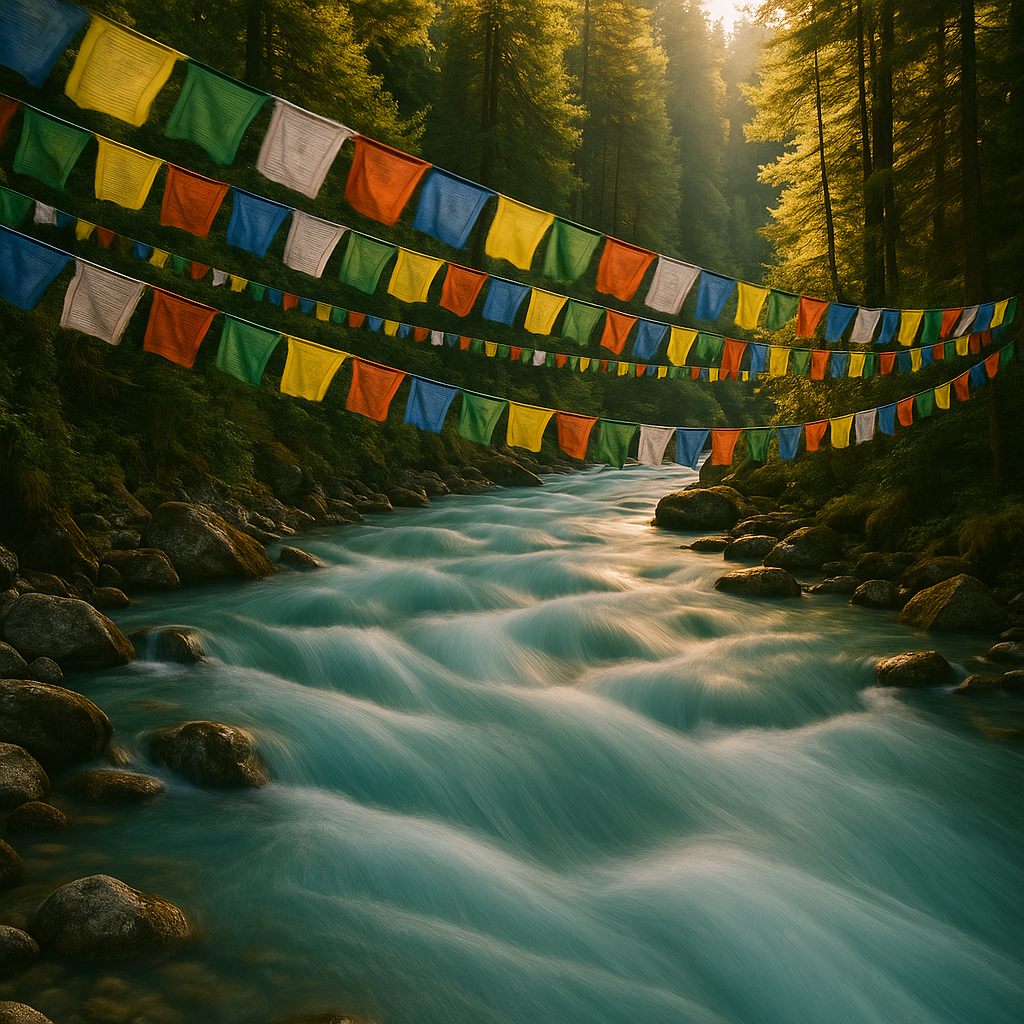
Red, blue, yellow, green, and white flags flutter in wild unison, whispering ancient mantras into the rushing gorge below. Beyond them, the path narrows—just a few wooden planks suspended by steel cables, trembling slightly in the breeze. Across the divide, dense pine forests rise steeply toward a snow-veined skyline, and beyond that, the radiant crown of the Himalayas cuts clean against the sky.
It’s a scene that feels timeless—both profoundly spiritual and strikingly human. The bridge is a marvel of simplicity and courage: a slender thread stretched between two cliffs, binding not only land to land, but soul to soul. To step onto it is to cross into another rhythm of existence, where each sway underfoot is a reminder of fragility, and each breath of mountain air a hymn of gratitude.
This is the heart of the Himalayas—not merely a place of rock and ice, but a realm of reverence. The people who live among these peaks have long understood what modern travelers often forget: that awe is not a fleeting emotion but a practice, and humility the only way to truly stand tall in the shadow of giants.
II. The Land of the Living Mountains
The Himalayas are not a single range but a vast, living system—a spine of the world stretching across five nations: India, Nepal, Bhutan, China, and Pakistan. Formed over fifty million years ago when the Indian tectonic plate collided with Eurasia, these mountains are still rising today, growing a few millimeters each year as if reaching ever closer to the heavens.
They hold within them the planet’s most dramatic geography and its deepest cultural heartbeat. Here are glaciers the size of cities, rivers that give life to nearly half of humanity, and forests so vertical they seem to defy gravity. But beyond the statistics lies a quieter truth: the Himalayas are a home.

For centuries, their slopes have cradled the stories of countless peoples—Sherpas, Tamangs, Lepchas, Bhutias, and many others—whose lives are intertwined with the moods of these mountains. Their songs echo through the valleys, their legends fill the clouds. Every stone, every stream, carries a story, and every path is both journey and prayer.
To walk here is not simply to travel; it is to enter a conversation that has been unfolding for millennia between earth and sky.
III. Prayer Flags in the Wind
The prayer flags that span the bridge are more than decoration—they are living texts, fluttering messengers of goodwill. Known as lungta (“wind horses”), these rectangular cloths are inscribed with mantras, prayers, and sacred symbols. The five colors represent the elements: blue for sky, white for air, red for fire, green for water, and yellow for earth. Together, they harmonize the natural world, spreading compassion and balance through the movement of the wind.
Each gust carries the written prayers across the landscape, dispersing blessings to all beings, seen and unseen. The act of hanging them is a gesture of hope—not for oneself alone but for all life. As the flags fade and fray under the sun, they are said to release their energy into the cosmos, teaching that beauty lies not in permanence but in the grace of impermanence.
To stand among them is to feel something ineffable—like hearing a thousand whispered promises from the past, still alive in the air.
IV. The Path of the Pilgrim
The Himalayas have always been more than mountains; they are the axis of faith. Pilgrims have crossed these valleys for centuries, following sacred routes to monasteries, shrines, and remote hermitages clinging to impossible cliffsides.
From the Buddhist stupas of Nepal’s Khumbu region to the Hindu pilgrimage sites of Kedarnath and Badrinath, from Bhutan’s cliff-hanging Tiger’s Nest Monastery to Tibet’s Mount Kailash—every step along these trails is infused with devotion.
The bridge in the image may well be part of one of these ancient pathways—a link between the physical and the spiritual world. To walk it is to embody an act of faith: to trust that the unseen cables will hold, that the wind will not betray, that the crossing itself is a kind of prayer.
Many travelers who come here seeking adventure find something far more enduring—a quiet confrontation with themselves. Amid thin air and thinner excuses, the mountains strip away the noise of modern life, leaving only what is essential: breath, heartbeat, awareness.
V. The Mountain as Teacher
The peaks in the distance—perhaps Ama Dablam or Machapuchare, depending on where you stand—are not simply geological wonders. They are teachers.
Each contour, each avalanche path, each gleaming cornice holds a lesson in humility and endurance.
Locals often refer to these summits with honorifics: Sagarmatha, “Forehead of the Sky,” or Chomolungma, “Mother Goddess of the World.” These names reflect a worldview in which nature is not a backdrop but a being—a divine presence worthy of reverence. To harm it is not merely to damage an ecosystem but to commit a spiritual wound.
As climate change accelerates glacial melt and alters weather patterns across the Himalayas, that reverence takes on new urgency. Ancient glaciers that once fed rivers like the Ganges and Brahmaputra are receding at alarming rates. Villages that depended on predictable snowmelt now face droughts or floods. The prayers that flutter on these flags may now carry a new plea: that humanity learn to live again in balance with its source.
VI. The River Below
Below the bridge, a ribbon of turquoise water carves through the gorge. This could be the Dudh Kosi, the “Milk River” of Nepal, famous among trekkers heading toward Everest Base Camp. Its color comes from glacial meltwater—fine rock particles suspended in the current, turning the flow into liquid light.
The river is both peril and provider. It has drowned the careless and sustained the humble. For mountain communities, water is life in its purest form, an inheritance and a responsibility. It irrigates barley fields, turns prayer wheels, and powers micro-hydroelectric plants that light remote hamlets. Yet it also connects these high valleys to the plains far below, linking the snow line to the sea.
Standing on the bridge, you can feel that connection viscerally—the river’s roar merging with the flutter of prayer flags, the rush of air, the distant echo of bells from a monastery hidden in the pines. It is the sound of a living world, undivided.
VII. Crossing
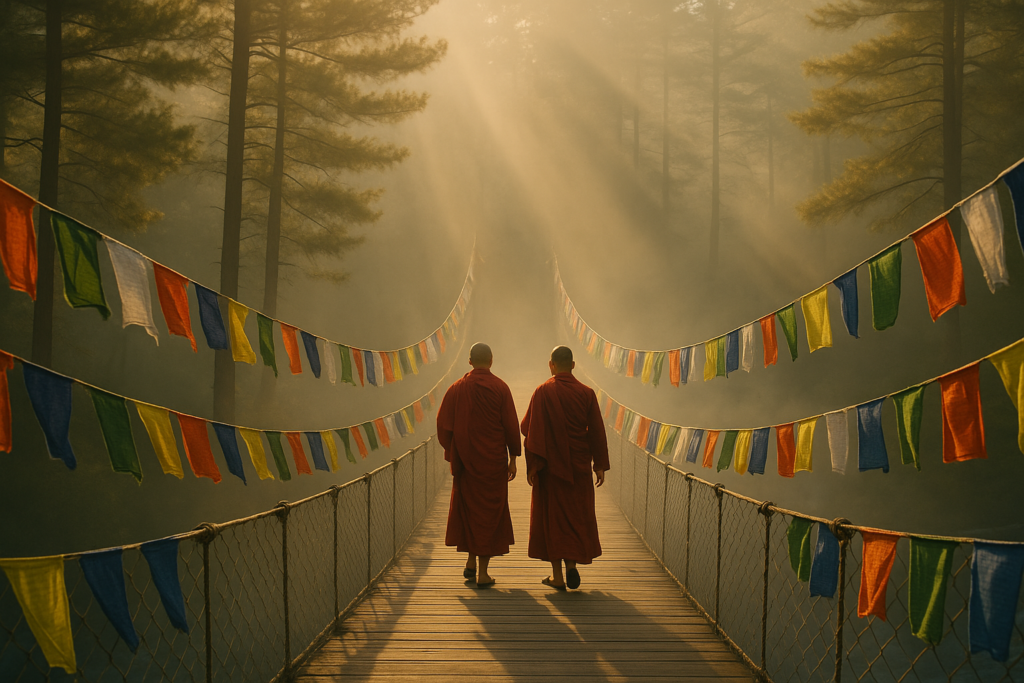
There’s a rhythm to walking these suspension bridges. The first step is hesitation; the second, surrender. The planks creak, the cables hum. Midway across, you are neither here nor there—suspended in every sense. It’s a moment that collapses all boundaries: between self and surrounding, between fear and faith.
For travelers from the modern world, accustomed to the solidity of concrete and control, this moment can be transformative. You begin to realize that life itself is a kind of crossing—an ongoing movement between certainties, held up by unseen forces: trust, community, belief.
The prayer flags dance wildly around you, each a fragment of human hope stitched into the greater fabric of existence. It’s as if the mountain wind itself were urging you onward—not to conquer, but to commune.
VIII. The Culture of the High Valleys
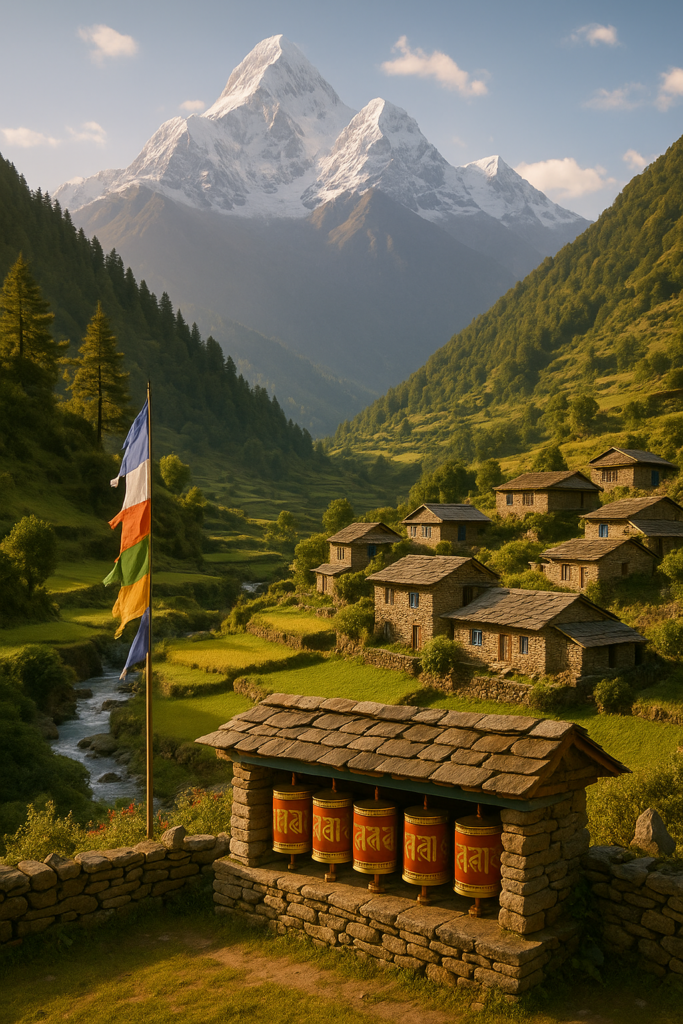
The people of these regions have adapted to the thin air and rugged terrain through generations of resilience. Sherpa culture, for instance, is deeply woven into Buddhist philosophy and mountain ecology. Their architecture mirrors the land: stone walls, yak-dung hearths, flat roofs weighted with stones against the wind.
Festivals punctuate the harsh seasons with bursts of color—masked dances, chanting monks, butter lamps glowing against cold nights. The prayer flags are renewed each Losar (Tibetan New Year), not as a decorative act but as a ritual of renewal for the world itself.
Even food tells the story of adaptation: steaming bowls of thukpa noodle soup, butter tea churned from yak milk, and hearty barley bread sustain both body and spirit in the high cold.
Visitors often remark on the kindness of the people here—a warmth that seems to defy the climate. But it’s more than hospitality; it’s a worldview born of interdependence. In these valleys, survival has always depended on cooperation. To share warmth, food, or shelter is not charity—it is nature’s law.
IX. The Sound of Silence
At dawn, before the sun strikes the peaks, there’s a stillness unlike anywhere else. The wind hushes, the river softens, and for a fleeting moment, the entire valley seems to hold its breath.
Then, slowly, light unfurls from the highest ridges, spilling down like a benediction. Snow ignites into gold, pine needles glimmer, and the prayer flags glow like stained glass. The silence isn’t empty—it’s full, resonant, alive.
In that space, you understand why mystics and poets have always come to the mountains. Here, the noise of the world dissolves into the vastness of being. Here, you realize that silence is not the absence of sound, but the presence of everything.
X. The Environmental Heartbeat
The Himalayas are sometimes called the “Third Pole,” holding the largest reserve of freshwater outside the Arctic and Antarctic. Over 1.5 billion people downstream depend on their meltwater. Yet this ecosystem—one of the most vital on Earth—is among the most fragile.
Warming rates in the Himalayas are nearly double the global average. Glacial lakes swell, threatening catastrophic outburst floods. Forests creep higher as snowlines retreat. Species once anchored to the cold, such as the snow leopard or Himalayan pika, find their habitats shrinking.
Local communities, whose livelihoods depend on predictable seasons, face increasing uncertainty. Yet amid the challenges, resilience shines through. Grassroots groups plant trees, build check dams, and revive traditional water-harvesting systems. Monks organize river-cleaning campaigns. Scientists collaborate with local herders to track climate shifts through indigenous knowledge.
The bridge, then, becomes a symbol of this delicate connection—the need to bridge not just valleys but ways of understanding. Between tradition and science, faith and action, human need and planetary care.
XI. The Journey Within
For many travelers, the trek through the Himalayas becomes less about reaching a destination and more about returning to oneself. The landscape is both mirror and teacher. Its vastness reflects your smallness; its silence, your inner noise.
On the trail, every breath is earned. The altitude strips away vanity. You begin to walk not to arrive but to align—with your own rhythm, your own heartbeat, the pulse of the earth beneath your boots.
The bridge in the photograph captures that moment of transformation—a literal and metaphorical crossing from one state of being to another. It is a rite of passage disguised as a path.
When you reach the other side, you may find the view unchanged—but you are not the same.
XII. The Spiritual Geography
There’s a concept in Himalayan thought that landscapes possess their own consciousness. Mountains are not inert; they are sentient presences that observe and respond. Sacred peaks such as Kanchenjunga or Kailash are never climbed, only circled in reverence. Rivers are not “resources” but relatives—mothers, sisters, guardians.
This worldview offers a profound alternative to modernity’s extractive mindset. It invites humility rather than mastery, coexistence rather than conquest. It teaches that to belong to the earth is a greater honor than to own it.
The prayer flags on the bridge flutter in this understanding. Each one is an offering to the unseen—an acknowledgment that the divine resides not in temples alone but in wind, stone, and water. To cross beneath them is to pass through a curtain of blessings, each color a strand in the tapestry of existence.
XIII. Photography as Pilgrimage
Capturing such a moment through a lens is itself an act of reverence. The photographer who stood before this scene did not merely document it—they participated in it.
Good travel photography, especially in sacred landscapes, demands more than technical skill. It requires presence. To wait for the right light, to sense the pulse of the wind, to understand the rhythm of human life that animates the scene—this is to see with respect.
In the age of social media, where landscapes risk becoming backdrops for self-promotion, this kind of mindful seeing is revolutionary. It transforms photography from consumption to communion. The resulting image becomes not just a visual but an invitation—to pause, to breathe, to remember the world’s wonder.
XIV. The Universal Bridge
At its essence, the suspension bridge is a metaphor for connection. Between people. Between times. Between belief and disbelief. Between the visible and the invisible.
The prayer flags do not discriminate; their blessings are carried by wind, touching all who pass—pilgrims, porters, tourists, monks, herders, dreamers. The bridge itself becomes a symbol of shared humanity: fragile, trembling, yet enduring through mutual trust.
In a divided world, such images remind us that the threads holding us together are worth cherishing. They ask us to look up, to let the colors of compassion and courage ripple once more across our own crossings.
XV. Return to the Mountains
Every traveler eventually leaves the Himalayas, but the mountains never leave them. Their memory lingers in the rhythm of breath, the craving for simplicity, the ache for silence.
Long after the journey ends, you’ll find yourself recalling the flutter of flags, the scent of pine, the roar of the river. You’ll remember how small you felt, and how strangely that smallness made you whole.
Because to stand in the Himalayas is to stand inside a prayer—not one spoken, but lived. It is to feel the infinite brushing softly against the finite and realize that, for one luminous moment, they are one and the same.
Conclusion: The Bridge Within Us
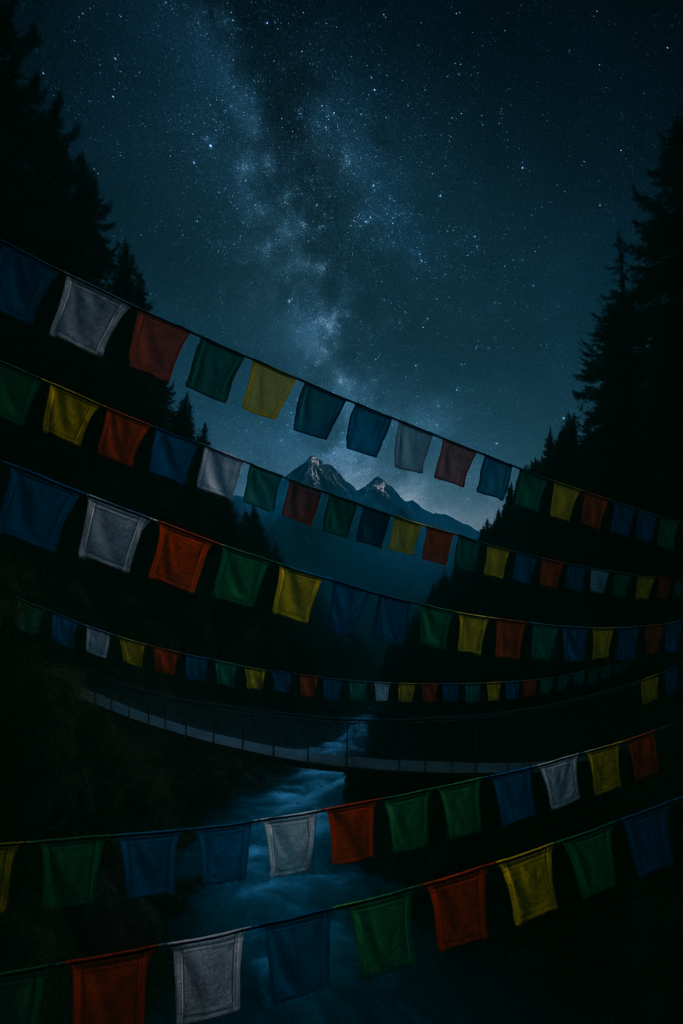
The image of the suspension bridge beneath snow-clad peaks is more than a travel photograph. It’s an allegory for existence itself: a crossing through uncertainty, held aloft by faith, brightened by hope.
We, too, are bridges—carrying the prayers of our ancestors, the dreams of our descendants, the weight and wonder of being alive in a changing world.
And as long as we keep walking, step by step, across the tremor and beauty of this life, perhaps that is enough.
Perhaps that is the prayer.
Leave a Reply