Your cart is currently empty!
Author: Natural Universe Co.
-
The Taj Mahal, Agra: A Complete Travel Guide to India’s Most Iconic Monument
Few places in the world carry the emotional weight, architectural brilliance, and timeless beauty of the Taj Mahal. Located in Agra, Uttar Pradesh, this ivory-white marble mausoleum is not just one of the Seven Wonders of the World, but a deeply personal monument built out of love.
Whether you’re planning your first visit or creating travel content, this guide covers architecture, history, exact places to stay, where to eat, and how to experience the Taj Mahal properly.
The Story Behind the Taj Mahal
The Taj Mahal was commissioned in 1631 by Mughal Emperor Shah Jahan in memory of his wife Mumtaz Mahal, who died during childbirth.
- Construction: ~1632–1648
- Workforce: ~20,000 artisans
- Materials: White marble from Rajasthan, precious stones from across Asia
- Purpose: Mausoleum (tomb complex)
It is widely regarded as the greatest example of Mughal architecture, blending:
- Persian design
- Islamic geometry
- Indian craftsmanship
🧱 Architectural Details (This is where it gets fascinating)
1. The Perfect Symmetry
The entire complex is built on strict symmetry:
- The main mausoleum sits at the center
- Four identical minarets frame it
- Gardens are divided into equal quadrants
The only asymmetrical element?
👉 Shah Jahan’s tomb — added later beside Mumtaz’s.
2. The Dome
- Height: ~73 metres
- Shape: Onion dome
- Topped with a finial combining Islamic crescent + Hindu trident symbolism
Recent conservation efforts even focused on repairing leaks beneath this dome—showing how carefully the structure is maintained centuries later.
3. The Marble Work
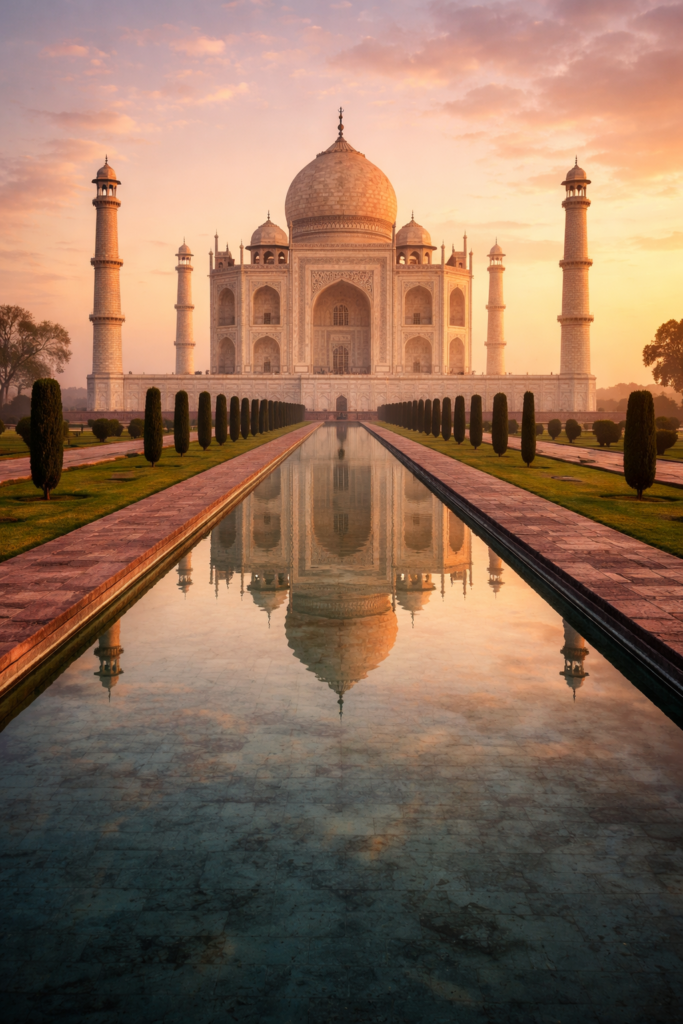
The Taj Mahal’s marble isn’t just white — it changes colour depending on light:
- Pink at sunrise
- White during the day
- Golden at sunset
- Silvery under moonlight
The walls are decorated with pietra dura (stone inlay), featuring:
- Jasper
- Jade
- Turquoise
- Lapis lazuli
These form intricate floral patterns that look painted — but are actually stone.
🌿 The Gardens (Charbagh Layout)
The Taj is set within a Charbagh garden, a Persian-inspired layout symbolising paradise.
- Divided into 4 sections (representing rivers of paradise)
- Central reflecting pool mirrors the Taj
- Walkways lined with cypress trees
The reflecting pool is deliberately aligned to create that iconic mirror image you see in photos.
📍 Best Time to Visit
- Best months: October – March
- Best time of day: Sunrise (least crowded + best lighting)
- Avoid: Midday heat and peak tourist hours
🏨 Where to Stay Near the Taj Mahal (Exact Hotels)
Luxury (Best Views)
🏆 The Oberoi Amarvilas
4.7•Hotel
- Distance: ~600 metres from Taj Mahal
- Every room has a view of the Taj
- Mughal-style gardens, fountains, terraces
- One of the most luxurious hotels in India
👉 If budget allows, this is the best possible stay experience
🏨 Taj Hotel & Convention Centre Agra
City
- ~10-minute walk to Taj Mahal
- Rooftop views of the monument
- Modern luxury + great food
Mid-Range Options
🏨 DoubleTree by Hilton Agra
City
- ~10 minutes from Taj Mahal
- Pool, gym, modern rooms
- Reliable international standard
🏨 Tajview Agra – IHCL SeleQtions
4.3•Hotel
- Known for Taj views
- Heritage-style interiors
Budget / Close-to-Gate Stays
🏨 Hotel Saniya Palace
3.8•Hotel
- Rooftop Taj view
- Budget-friendly
- Walking distance
🏨 Joey’s Hostel
4.3•Hostel
- Backpacker-friendly
- Social atmosphere
- ~0.6 km from Taj
🏨 Hotel Sidhartha
4.0•Hotel
- Near Western Gate
- Simple but excellent location
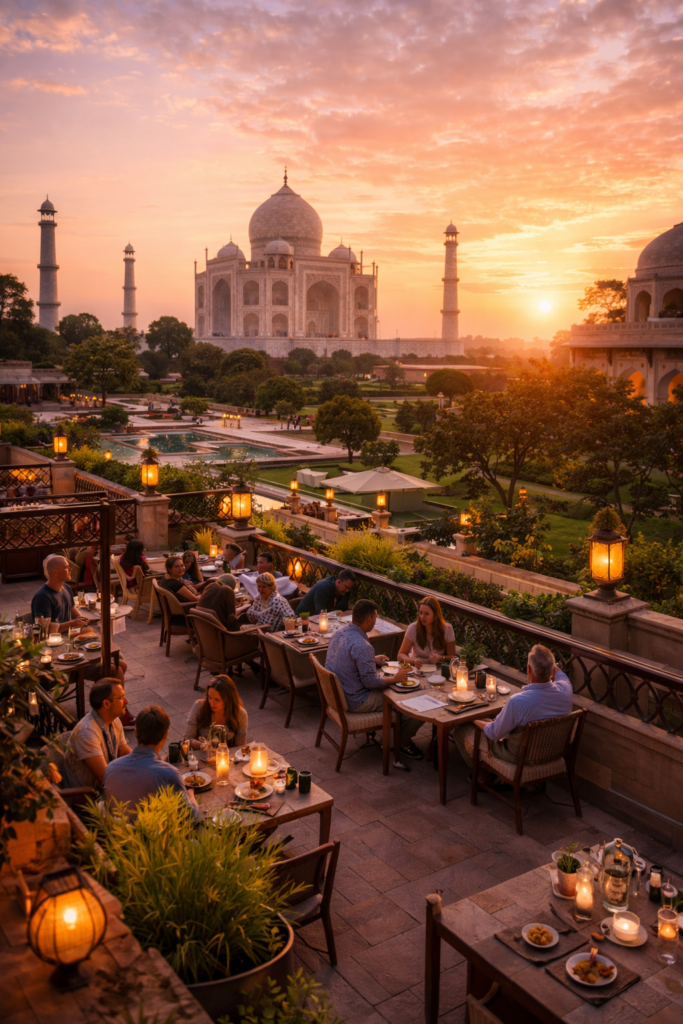
🍽️ Where to Eat Near the Taj Mahal
🍛 Fine Dining
🍽️ Esphahan
4.4•Mughlai restaurant
- Located inside Oberoi Amarvilas
- Authentic Mughlai cuisine
- One of the best dining experiences in Agra
🍽️ Mid-Range & Popular
🍽️ Pinch of Spice
4.2•Mughlai restaurant
- Highly rated
- Butter chicken + North Indian dishes
🍽️ Joney’s Place
4.7•Indian restaurant•Open
- Backpacker favourite
- Cheap + reliable
☕ Cafes with Taj Views
☕ Sky Deck Restaurant
3.7•North Indian restaurant
- Rooftop Taj view
- Best for sunset photos
☕ Cafe Sheroes Hangout
3.9•Indian•Open
- Social initiative café run by acid attack survivors
- Great vibe + meaningful experience
📸 Best Photography Spots
1. Main Gate Reflection Pool
- Classic symmetrical shot
- Best at sunrise
2. Mehtab Bagh
- Across the river
- Perfect for sunset shots
- Less crowded
3. Mosque Side View
- Unique angle
- Red sandstone contrast
🚶 How to Visit Properly (Pro Tips)
- Arrive before sunrise
- Enter via East Gate (least crowded)
- Spend at least 2–3 hours exploring
- Bring minimal items (security is strict)
⚠️ Things to Know Before You Go
- Closed on Fridays
- No large bags allowed
- Shoes must be removed or covered inside
🌍 Why the Taj Mahal Matters
The Taj Mahal is more than a building — it’s:
- A symbol of eternal love
- A masterpiece of architecture
- A UNESCO World Heritage Site
It attracts millions of visitors every year and remains India’s most iconic landmark.
✨ Final Thoughts
Visiting the Taj Mahal isn’t just about seeing a monument — it’s about experiencing:
- History
- Emotion
- Art
- Culture
From the soft glow of sunrise to the intricate marble details, every part of the Taj tells a story.
-
Where the Sun Bows to the Water: A Journey From Japan’s Floating Torii Gate to the World’s Sacred Sunsets
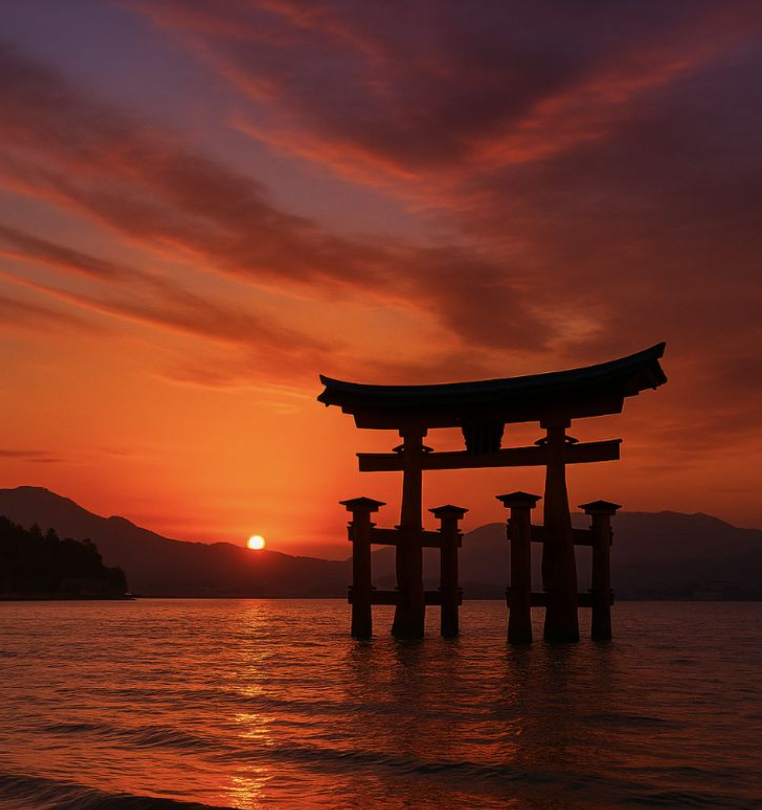
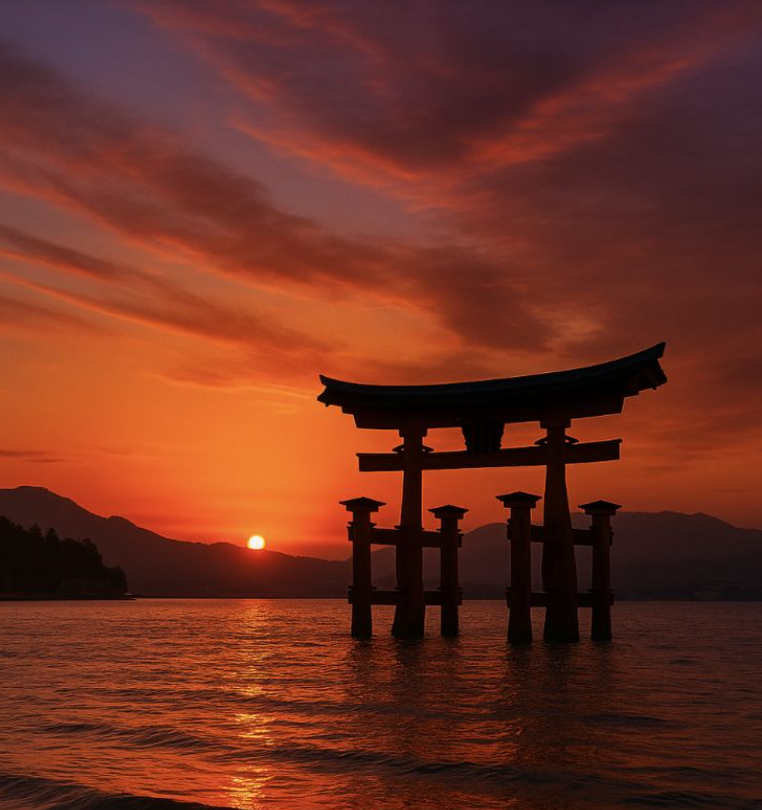
At high tide, the torii gate at Itsukushima Shrine appears to float.
Its vermilion pillars rise from the sea in quiet defiance, glowing against the softening light of evening. The water ripples gently at its base, catching fragments of sunlight like scattered gold. Beyond it, the sky transitions through a palette of apricot, rose, and lavender — a slow, celestial ceremony. On the nearby shore, the scent of pine mingles with ocean breeze. Deer wander freely, unbothered by humans, as if carrying the island’s ancient serenity in their calm footsteps.
A hush falls over the crowd gathered along the beach. People speak more softly. Some sit. Some clasp their hands. Others simply breathe, looking out at the floating gate framed by fading sun.
Then it happens — the moment when the sun slips behind the mountains and the torii becomes a silhouette, dark and bold against a sky of liquid colour. For a breath, everything feels suspended. The water stills, the world dims, and existence narrows into a single, reverent pause.
You feel it.
The shift.
The presence.
The smallness and the vastness.Watching sunset at Itsukushima Shrine is more than witnessing beauty. It is an initiation — into stillness, into wonder, into the ancient Japanese understanding that nature and spirit are not separate, but intertwined.
This is where our journey begins.
But the story stretches far beyond this island. Across the world, humanity has always looked to the horizon as a place of endings and beginnings, of ritual and awe. From Bali’s sea temples to Hawaii’s volcanic shores, from the mirrored fjords of Norway to the sacred Ganges in India, sunset becomes a universal prayer — one spoken in colour, silence, and breath.
This is a journey through those sunsets, those waters, those shared human moments where the world becomes not just a place we travel, but a place we feel.
Part I: The Floating Torii — A Threshold Between Worlds
The Sacred Waters of Miyajima
Itsukushima, often called Miyajima (“shrine island”), has been revered for over a thousand years. In Shinto belief, the island itself is considered sacred — a place inhabited by kami, the divine spirits that animate forests, rivers, mountains, and oceans.
Because the land is sacred, the shrine was built over water. To enter it, visitors historically arrived by boat through the floating torii, passing from the everyday world into the realm of the gods.
That is the role of a torii:
a gate, a threshold,
a boundary between the mundane and the divine.Even today, the gate holds this mystery. Something shifts when you look at it. You feel invited to step inward — not physically, but spiritually.
The Symbolism of Torii Gates
Torii gates stand at the entrance of shrines across Japan. Their form seems simple — two pillars supporting two horizontal beams — yet the symbolism runs deep.
- They mark sacred space.
Crossing under one is like crossing into prayer. - They represent purification.
Inside the gate, the heart widens. The body softens. - They frame the natural world as sacred.
A torii over the sea reminds you the ocean itself is holy.
The floating torii at Miyajima heightens these meanings. When water rises, the gate becomes untethered, hovering between worlds. Its reflection doubles, as if one gate stands in the physical realm and the other in the spiritual.
Sunset as Ceremony

Watching sunset here feels like participating in a ritual older than written history.
The light dims slowly.
The air cools.
The tide rises.
The gate darkens into silhouette.Every moment is deliberate, unfolding with the steady patience of a prayer.
You feel your breath match the rhythm of the water.
You feel your thoughts dissolve into colour.
You feel held, humbled, and strangely renewed.Sunset at Miyajima shrine is a reminder that endings can be gentle, sacred things.
Part II: The Universal Pull of Sunset
Why Sunset Captivates Us
Sunsets move us because they speak a language the mind can’t fully translate. They are:
- transition
- surrender
- impermanence
- renewal
- wonder
The colours are ephemeral. The moment is fleeting. And something in the human spirit responds — perhaps because we too are temporal, and sunset mirrors that softness.
Sunset is the world letting go.
When we watch it, we remember how.
The Horizon as a Liminal Space
At sunset, the horizon becomes a threshold — not unlike the torii gate.
A place where something ends and something else begins.
A place between light and dark, day and night, earth and sky.Across cultures, horizons are symbolic:
- For sailors, they were hope.
- For farmers, they marked time.
- For mystics, they were metaphors.
- For lovers, they were poetry.
When we travel, sunsets become anchors — the moments we remember long after we leave.
Let’s follow that horizon across the world.
Part III: Bali — Temples Carved Into the Sea and Sky
Tanah Lot: A Shrine Above the Waves
Fly south to the island of Bali, where spirituality pulses in everyday life — woven into offerings, dances, stone carvings, and the quiet devotion of incense rising each morning.
Tanah Lot stands on a rocky outcrop, surrounded by ocean. During high tide, it becomes an island of shadow and holiness. The temple is dedicated to sea spirits, guardians of the coastline. Waves crash below, sending spray into the burning sky.
At sunset, Tanah Lot becomes a silhouette — much like Miyajima’s torii — but darker, more dramatic. The ocean churns silver and gold. The sky deepens to crimson. Balinese families gather on the shore, sitting on warm rocks, waiting for the moment the sun touches the water.
It feels like watching a painting reveal itself stroke by stroke.
Uluwatu: Cliffside Devotion
Travel further south to Uluwatu Temple, perched on a sheer cliff overlooking the Indian Ocean. Monkeys wander along the stone paths. The air smells of frangipani. And each evening, beneath the blaze of sunset, the Kecak dance unfolds — rhythmic chanting, firelight, and movements that seem to mimic the shifting tides.
Sunset here is not quiet.
It is a celebration — an offering of voice, flame, and energy.
A reminder that spirituality can be lively, embodied, and communal.The Balinese Way of Sunset
For the Balinese, sunsets are invitations:
- to thank the gods
- to cleanse the day
- to release what no longer belongs
- to honour the cycles of nature
You feel that gentleness as the sky dims.
You feel the island breathe.
You feel yourself soften.
Part IV: Hawaii — Where the Sun Descends Into the Pacific
Sunset as Ceremony
In Hawai‘i, sunset feels like a daily benediction.
The sun lowers toward the horizon with slow, deliberate grace.
Palm trees sway in the trade winds.
The smell of plumeria drifts in the air.And people stop.
They stop walking.
They stop talking.
They stop rushing.On beaches across the islands — Maui, Kauai, Oʻahu, the Big Island — you’ll see locals and travelers alike pause to watch the sky ignite in gold and tangerine.
It is a quiet ritual of gratitude — a practice known informally as sunset watching, but experienced as presence.
Puʻu Kekaʻa, Maui — A Leap Into Legend
At Black Rock on Maui, the daily sunset ceremony reenacts the leap of chief Kahekili, who once jumped from this very cliff to honour the spirits.
A torch lighter runs along the cliff, igniting flames as the sun sinks.
He stands at the edge, silhouetted against a burning sky.
He offers a chant.
Then he leaps.The splash echoes like punctuation at the end of a prayer.
Fire meets water.
Sky meets ocean.
Light gives way to night.Kona, Big Island — Lava, Water, and Sky
On the Big Island, the coastline is carved from volcanic fire. Waves crash into black lava rock. Green sea turtles rest on warm sand. And the horizon glows each evening in colours that look molten — as if the sky is remembering the island’s fiery origin.
Sunset in Hawai‘i feels elemental.
Raw.
Primordial.
Like witnessing creation’s ember.
Part V: Norway — Fjords, Silence, and Northern Light
The Stillness of Nordic Water
Travel far north, where mountains tower like ancient guardians and water lies as smooth as brushed metal. In Norway’s fjords — Geiranger, Aurlandsfjord, Hardanger — sunsets linger far longer than anywhere else.
Light stretches across the sky in slow, ethereal gradients: pale gold, soft lavender, deep cobalt. Reflections shimmer on water so still it feels like a second sky.
The fjords are sacred not through religion, but through presence.
Through silence.
Through scale.Midnight Sun: A Sky That Refuses to Sleep
In summer, the sun barely dips below the horizon. Time dissolves. People hike, sail, and wander in perpetual twilight. There is something spiritual about this endless glow — a reminder that the world can break its own rules.
In winter, the opposite occurs: darkness stretches long, and the northern lights dance in place of sunset. Curtains of green and purple ripple across the sky, reflected in icy water.
Here, light feels alive.
Mysterious.
Otherworldly.Nordic Reverence
The Norse once believed the horizon was the edge of the world, where gods and giants met. Today, a quieter reverence remains.
Sunsets in Norway teach stillness.
Patience.
Attention.They remind you that beauty can be soft and slow, not just fiery.
Part VI: India — Sacred Rivers, Golden Evenings
Varanasi at Sundown
On the banks of the Ganges, sunset becomes a ritual — a firelit ceremony called Ganga Aarti. Priests dressed in saffron robes move brass lamps in circles as bells ring and chants fill the evening air.
Flames reflect on the river’s surface.
Petals drift downstream.
Pilgrims pray, bathe, release offerings of light.Here, sunset is not merely an end —
it is a bridge from the earthly to the divine.The Symbolism
To watch sunset in Varanasi is to watch:
- purification
- devotion
- the cycle of life and death
- the acceptance of impermanence
This is not a quiet sunset; it is a spiritual crescendo.
Part VII: The Shared Human Ritual of Sunset
Why We Turn Toward the Light
Across continents and cultures, sunset is a universal moment of pause.
Even the busiest cities soften.
People stop, stare, inhale.Sunsets:
- mark time
- inspire reflection
- offer closure
- awaken awe
- remind us of the day’s gift
In a world obsessed with productivity, sunset insists on presence.
Sunsets as Mirrors
We project onto the horizon:
- our longings
- our worries
- our hopes
- our gratitude
Sunsets become mirrors — of heart, of memory, of transformation.
Travel as Reintegration
Watching sunset in a foreign place reconnects us to something primal:
that we are small,
that the world is vast,
that beauty can find us anywhere.Sunset is the great equalizer —
the same sun touching all lands,
yet each place giving the moment its own story, its own color, its own emotion.
Part VIII: Sunset and Sacred Waters — A Global Reflection
The Connection Between Water and Light
There is something irresistible about sunset over water.
Water reflects.
Water holds.
Water carries light gently.When the sun meets the sea — at Miyajima, Bali, Hawai‘i, Norway — the world becomes double.
Sky above, sky below.
Light above, light below.
A sense of infinity.Water as Spiritual Medium
In many cultures:
- Water cleanses
- Water purifies
- Water connects worlds
- Water symbolizes rebirth
At sunset, this symbolism intensifies.
The day dissolves into the horizon.
Light softens into reflection.
Time itself feels fluid.The Emotional Geography of Coastal Sunsets
Different coasts offer different energies:
- Japan: quiet reverence
- Bali: ceremonial devotion
- Hawai‘i: gratitude and elemental presence
- Norway: meditative stillness
- India: fire, ritual, transcendence
And yet, the essence is shared.
Sunset is the world’s daily prayer —
spoken in colour, water, and silence.
Part IX: The Traveler at Dusk — A Personal Journey
The Feeling of Standing Before the Horizon
Travelers often describe sunset moments as the most memorable part of their journeys: from sitting on a stone wall in Dubrovnik, to watching the sun sink behind Santorini’s caldera, to standing barefoot on Bali’s shore.
These moments pull us out of thought and into experience.
You stand there — eyes soft, breath deep — feeling your own edges blur.
Sunset as a Teacher
Sunset teaches:
- impermanence
- acceptance
- softness
- renewal
- the beauty of letting go
These lessons follow us home.
Sunset and Awe
Modern science suggests awe expands our perception, softens our ego, and deepens our sense of connection.
Sunset is one of the most accessible sources of awe.This is why travelers chase sunsets —
not for photos,
but for feeling.
Conclusion: Returning to the Floating Gate
As the world darkens, return one last time to Itsukushima Shrine.
The torii gate is now a perfect silhouette.
The sky is violet, then indigo.
The water glimmers softly.
The crowd has quieted into reverence.
A deer pads silently along the beach.You feel the presence of something ancient — a whisper of the sacred, a memory of the day’s warmth, a promise of tomorrow’s light.
The sunset fades.
Night embraces the island.
But the moment stays.This is what travel does at its best:
It reconnects us to wonder.
It reminds us of beauty.
It slows us enough to hear the world breathe.And sunset — from Japan to Bali, from Hawai‘i to Norway — is the greatest reminder of all:
The world is always offering us awe.
We need only face the horizon and let ourselves be moved. - They mark sacred space.
-
Where Earth Meets Heaven: A Reflective Journey Through the World’s Sacred Mountains
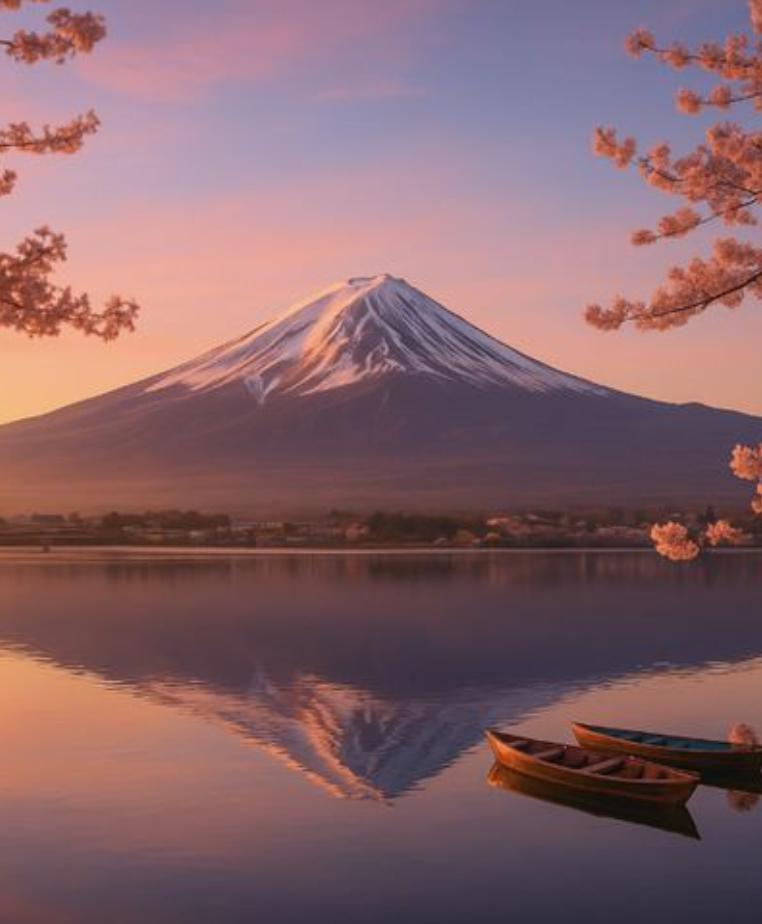
At sunrise, Mount Fuji looks less like a mountain and more like a breath held by the Earth.
The sky warms slowly — pale lavender shifting to rose, then to soft peach as the sun begins its gentle climb. A hush lies over Lake Kawaguchi. Cherry blossoms, delicate as sighs, drift on the breeze and float on the water’s surface. Each petal seems suspended in time, as if reluctant to disturb the lake’s flawless stillness. And there, rising with elegant certainty, is Fuji — perfectly mirrored in the glassy reflection below.
The symmetry is astonishing.
A mountain in both earth and water.
A symbol suspended between worlds.In this early morning quiet, with the scent of blossoms drifting through cool air and the warmth of light beginning to touch your skin, something inside you softens. You feel small and infinite at the same time. You inhale deeply, and it feels like the mountain is breathing with you.
This is where our journey begins — at the foot of Japan’s sacred peak, in the tender quiet where nature carries wisdom older than any temple.
But the story of mountains is a global one.
Every culture has its peaks — places where earth meets sky, where myth and geology intertwine, where pilgrims climb not only upward but inward. From the Himalayas to Mount Sinai, from Mauna Kea’s star-drenched summit to the volcanic spires of the Andes, mountains shape identity, spirituality, and the timeless desire to rise above the world’s noise.This is a journey through those mountains — a meditation on their stories, their symbolism, and the way they shape us as we stand before them, humbled by their silence and strength.
Part I: Fuji at Dawn — The Heartbeat of Japan
Fuji as Image and Spirit
Mount Fuji, or Fujisan, is not merely Japan’s tallest mountain. It is an icon of perfection — its symmetrical cone almost impossibly balanced, its presence woven into the nation’s collective imagination. Fuji appears everywhere: on screens, in paintings, on postcards, in poems, in the whispered recollections of travelers who first saw it through morning mist on a speeding train.
To the Japanese spirit, Fuji is not just a location.
It is a guardian.
A muse.
A spiritual axis around which countless lives have turned.For centuries, pilgrims have climbed its slopes seeking purification, enlightenment, and connection to something beyond human time. To see Fuji is to feel the echo of that longing.
Cherry Blossoms and Seasons of the Soul
No image captures the Japanese spirit more tenderly than Fuji framed by cherry blossoms. These blossoms — soft, ephemeral, and fleeting — symbolize the impermanence of life. Their bloom is both celebration and reminder: beauty is momentary, and it is precisely its brevity that makes it sacred.
Fuji, in contrast, stands eternal.
One represents the passing of time; the other, the persistence beyond it.
When the two meet — blossoms drifting before an ancient volcanic peak — the Japanese concept of mono no aware becomes tangible: the bittersweet awareness of impermanence, of beauty that slips through fingers even as it fills the heart.
Fuji in Shinto Tradition
In Shintoism, mountains are sacred embodiments of kami — divine spirits that inhabit natural features. Fuji is home to Konohanasakuya-hime, the blossom princess and guardian of volcanos. Shrines dedicated to her dot its base and summit, inviting travelers to pause, bow, and offer gratitude before beginning their journey upward.
Climbing Fuji has long been considered a spiritual pilgrimage. Historically, only priests and monks ascended its sacred slopes. Today, thousands climb every summer, following the same ancient paths that once echoed with chants and prayers.
There is a saying in Japan:
“Everyone should climb Fuji once, but only a fool climbs it twice.”The ascent is grueling — steep, rocky, exposed to unpredictable weather.
But reaching the summit at dawn, watching sunlight spill across the world from 3,776 meters above sea level, feels like witnessing creation itself.Fuji in Art — Hokusai’s Endless Inspiration
No artist immortalized Fuji more powerfully than Katsushika Hokusai in his famous woodblock series Thirty-Six Views of Mount Fuji. Each print shows the mountain from a different angle, in different seasons, through storms, in calm, behind waves, beside travelers, over villages.
What Hokusai captured was not just scenery.
He captured the relationship between people and the mountain — the way it watches, shelters, and witnesses life.Fuji is not simply a background.
It is a presence.
A reminder of nature’s permanence in contrast to human ephemerality.
Part II: The Himalayas — Where the Earth Touches the Heavens
Stepping Into the Realm of Giants
Leave Japan’s gentle symmetry behind and travel west to a place where mountains rise like gods themselves: the Himalayas.
Here, the peaks are not poetic silhouettes but monumental spires, sharp and awe-inducing. The air thins. The horizon teeths with jagged snow. Prayer flags flutter from every ridge, carrying whispered wishes into thin blue air.
If Fuji feels like a guardian, the Himalayas feel like creators — ancient forces shaping both land and spirit.
Spirituality Written Into Stone
For Buddhists and Hindus alike, these mountains are more than geographic.
They are cosmological.Mount Kailash is believed to be the home of Shiva.
Mount Meru, a mythic peak, is thought to stand at the center of the universe.
The snow-capped summits symbolize purity, transcendence, enlightenment.Monasteries cling to cliffs, saffron-robed monks chant at dawn, and yak bells echo across valleys that feel untouched by time.
To travel here is to feel the Earth’s spiritual pulse.
The Slow Ascent of Self
Trekkers who journey through Nepal, Bhutan, or northern India often speak not of reaching summits but of being transformed. The thin air forces slow footsteps; the altitude requires humility. Each step is a meditation.
The Himalayas remind you that climbing is not conquering.
It is surrendering — to breath, to silence, to something bigger than yourself.The Stories of Sherpa Tradition
Many travelers encounter the Sherpa people — a community whose resilience, kindness, and deep mountain knowledge have guided climbers for generations. For the Sherpa, mountains like Everest (Chomolungma, “Mother of the World”) are sacred, alive, and deserving of respect.
Their belief is profound:
You do not climb a mountain. The mountain allows you to come.It is a worldview rooted in reverence — an understanding that mountains offer not challenge, but communion.
Part III: Mount Sinai — Where Revelation Meets Landscape
The Desert at Dawn
From the snowy Himalayas, travel southwest into the heat of the Sinai Peninsula, where copper-coloured peaks rise from golden sands. Here, the landscape feels stripped to its essence — rock, sky, silence. Nothing unnecessary. Nothing to distract from what is eternal.
Mount Sinai, known as Jebel Musa, is a place of profound religious significance to Judaism, Christianity, and Islam. According to tradition, it is here that Moses received the Ten Commandments.
When you climb before sunrise — as many pilgrims do — you move upward guided only by starlight and the soft conversations of travelers. Camels occasionally shuffle past, their silhouettes outlined against moonlit stone.
At the summit, as dawn begins to bloom, clouds blush pink and orange, and the desert shifts from darkness to gold. The experience feels biblical even if you’ve never opened a scripture.
A Mountain of Messages
Unlike Fuji’s symmetry or the Himalayas’ majesty, Sinai’s power lies in its starkness.
It feels ancient.
It feels humbling.
It feels like a place where silence is its own language.Mount Sinai teaches a different kind of spirituality — one rooted in restraint, reflection, and the simplicity of listening.
Faith as Pathway
Pilgrimages up Sinai are acts of devotion, but also acts of transformation.
The journey is not hard in a physical sense, but emotionally it becomes something else: a time to release, to remember, to seek clarity.You reach the top, sit on warm stone, and watch the world wake.
And something shifts — quietly, undeniably.This is what sacred mountains do.
They change you without demanding anything in return.
Part IV: Mauna Kea — Stars, Creation, and the Sacred Hawaiian Sky
A Mountain Born From Fire
Cross the ocean to Hawai‘i, and stand before a very different kind of sacred peak: Mauna Kea. At first glance, it does not resemble the sharp, dramatic mountains of the Himalayas or the iconic silhouette of Fuji. Its summit is gentle, rounded, often snow-covered — even though it rises from tropical shores.
But what makes Mauna Kea extraordinary is this:
Measured from its base beneath the ocean, it is the tallest mountain on Earth.A Sacred Summit
In Hawaiian spirituality, Mauna Kea is the meeting place of the gods — a bridge between earth and sky. It is said to be the birthplace of the islands themselves, formed by volcanic fire and shaped by ancient forces.
Because of its height and remoteness, the summit is one of the best places in the world for stargazing. Observatories from around the globe dot the peak, but the land remains sacred — a site of ceremony, offering, and deep cultural meaning.
The Night Sky Like an Ocean
Visit Mauna Kea at night and you witness something unforgettable:
The Milky Way stretches across the sky with impossible clarity. Stars look close enough to touch. The universe feels vast and intimate at the same time.Here, the concept of “mountain” expands.
It becomes not just a rise in land, but a rise in consciousness.You stand on Mauna Kea’s summit and feel both anchored and uplifted.
The mountain connects you to Earth — and the sky invites you into infinity.Respect and Responsibility
Hawaiian culture teaches that sacred places require care. Visitors are encouraged to treat the mountain with humility, leaving no trace, listening to its quiet, and understanding its significance beyond tourism.
Mauna Kea reminds us that spirituality is not only about ascent —
but about respect.
Part V: Other Sacred Peaks — Myth, Memory, and Meaning
The Andes — Mountains that Hold Stories
In South America, the Andes rise like a jagged spine across the continent.
For the Quechua and Aymara peoples, mountains — known as apus — are living guardians.They believe the apus watch over villages, guide travelers, and protect the land. Offerings are left at stone altars. Stories pass through generations. Even today, hikers who journey to Machu Picchu feel that presence — a quiet power woven into the landscape.
Mount Kilimanjaro — The Roof of Africa
Lone and majestic, Kilimanjaro stands above the plains of Tanzania like a snow-crowned king. For the Chagga people, it is a symbol of life, fertility, and ancestral connection. Climbers speak of the meditative silence on its slopes, where each step feels like a conversation with the horizon.
Mount Athos — The Holy Mountain
In Greece, Mount Athos has been a monastic sanctuary for over a thousand years. Its slopes are home to twenty monasteries where monks live in deep devotion, surrounded by mist, forest, and silence. It is a mountain of contemplation — a place where time seems to breathe more slowly.
Part VI: Why Mountains Transform Us
Mountains Offer Perspective
When you stand before a mountain, something inside you reorders.
The worries of daily life shrink.
The horizon widens.
Breath deepens.Mountains place us in scale — reminding us of our fragility and strength at once.
They Teach Us Stillness

Mountains do not rush.
They do not bend easily.
They stand, they witness, they wait.Travelers often describe mountain moments as pauses — times when life’s pace shifts from frantic to meditative.
They Hold Our Stories
Mythology everywhere is full of mountains:
- Olympus, home of Greek gods
- Ararat, where Noah found land
- Fuji, beacon of poetry
- Sinai, site of divine revelation
- Kailash, axis of the cosmos
Mountains gather human imagination like rivers gather rain.
They Inspire Pilgrimage
People climb mountains not only to reach the top, but to understand themselves.
The upward path becomes inward reflection.
The summit becomes a moment of awakening.
Part VII: The Traveler’s Journey — Mountains as Mirrors
The Mountain Inside You
What we seek in mountains is often something we seek in ourselves:
- clarity
- courage
- peace
- perspective
- renewal
We hike to reconnect.
We climb to reset.
We stand before peaks to remember what matters.The Power of Being Small
Mountains invite humility.
Not the kind that diminishes —
but the kind that opens you.Standing at Fuji’s lakeside, or on a ridge in the Himalayas, or beneath Sinai’s dawn, or atop Mauna Kea’s star-soaked summit, you feel it:
The world is vast.
And yet you belong in it.Wanderlust and the Call of Heights
Travelers have long been drawn to mountains because they symbolize possibility.
A high place.
A clear view.
A rising path.We visit them not only to see the world, but to see ourselves differently.
Conclusion: A World Shaped by Peaks and Dreams
Imagine Fuji at sunrise once more.
The lake still calm.
The blossoms still drifting.
The mountain glowing softly as the day begins.Travel begins in moments like this — when something inside you shifts quietly, when you feel the world speaking in a language beyond words.
Mountains are those moments made physical.
They rise from the earth like reminders — of myth, of memory, of meaning.
They hold centuries of stories and offer them freely to anyone willing to look up and listen.From Japan to Nepal, from Sinai to Hawai‘i, the sacred peaks of the world guide us inward as much as they guide us across continents. They invite reflection, reverence, and renewal.
And long after you descend — long after the path becomes flat and ordinary again —
you carry the mountain with you.In breath.
In memory.
In perspective.
In the quiet knowing that you, too, have touched the place where earth meets heaven.
-
Where the Sea Paints the World: A Poetic Journey Through the Most Enchanting Coastal Towns on Earth
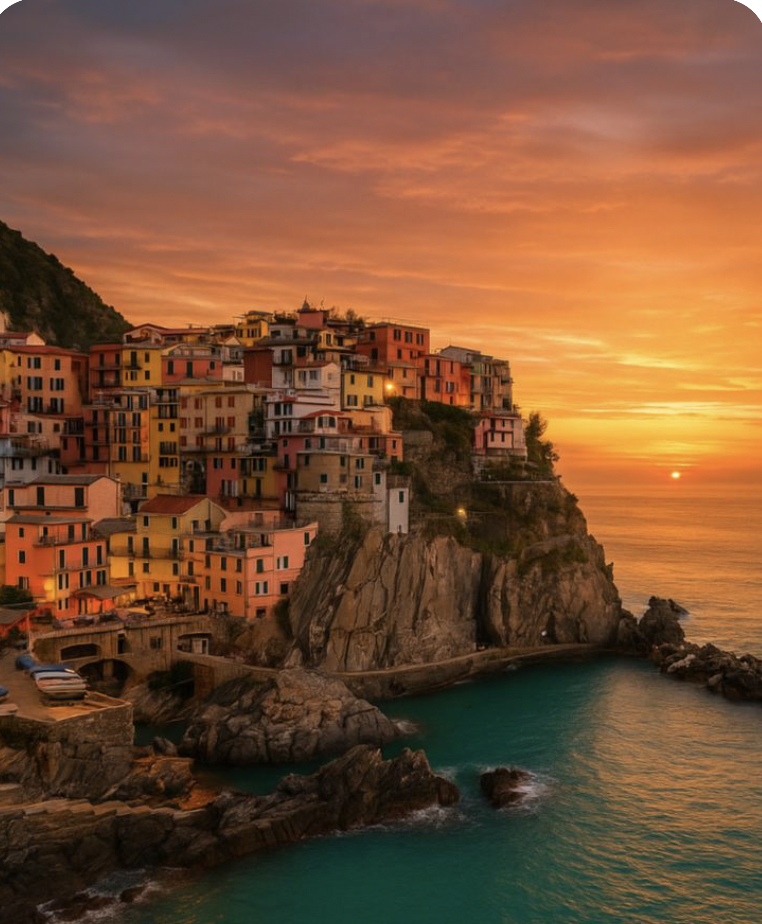
At sunset, Cinque Terre looks like a dream someone painted onto the cliffs.
The sky burns in shades of apricot and rose, the kind of colours that feel too dramatic to be real. The sea below glows with molten gold as waves inhale and exhale against darkened stone. And there, clinging to impossible cliffs like a cluster of precious jewels, are the pastel villages — Riomaggiore in rust-red, Vernazza in sunflower yellow, Manarola glowing like a lantern on the water.Laundry sways like soft flags from balconies. Fishing boats rock gently in little harbours. The smell of salt, lemons, and warm tomato sauce mixes with the breeze.
This is where our journey begins: on a cliffside path in Liguria, watching the sun sink into the Mediterranean while the world slows to a heartbeat you can finally hear.
Cinque Terre is not just a place.
It is a feeling.
A rhythm.
A moment you want to fold carefully and place inside your pocket.But so many coastal towns share this magic — the sparkle of water, the scent of ancient stone, the stories told through food and colour. The world’s coasts are living poems, and the towns built along them are verses shaped by salt, wind, and time.
Tonight, we follow that poem.
From Italy’s dramatic cliffs to the whitewashed glow of Greece, from the terracotta romance of Positano to the walled majesty of Dubrovnik, this is a journey along the edges of the world — where land surrenders to water, and beauty surrenders to memory.
Part I: Cinque Terre — Where Colour Meets the Sea
The Five Villages of the Slow Life
Cinque Terre was once five isolated fishing hamlets connected only by mule paths and the sea. Today, the train makes the journey easy, but the villages still glow with old-world simplicity.
Riomaggiore is all narrow lanes and leaning facades, like a deck of cards tilted against the wind.
Manarola is a painter’s palette — houses stacked like warmth itself.
Corniglia, perched high above the sea, feels like a secret whispered between cliffs.
Vernazza is the jewel — its harbour a perfect embrace of boats and turquoise water.
Monterosso is the beach lover’s dream — long sands and relaxed charm.Each town has its own personality, but together they form a symphony of Italian coastal life.
The Taste of Liguria
Food here is a kind of devotion.
Basil grown on terraced hillsides becomes pesto — bright, fragrant, almost shockingly alive.
Anchovies caught minutes before find their way into lemony, tender dishes.
Focaccia appears everywhere — salted, oiled, sometimes topped with rosemary and olives.And the wine — the crisp, dry white grown on steep terraces — tastes like sunlight trapped in a bottle.

The Pace of a Place Untouched by Hurry
In Cinque Terre, people walk more than they drive. They swim before breakfast. They greet neighbours with a nod that feels like a ritual. Time stretches out — not in boredom, but in presence.
This is the essence of slow travel:
not checking sights off a list,
but surrendering to the rhythm of a place.Cinque Terre teaches you to sit.
To breathe.
To feel the way the sea speaks without words.
Part II: The Amalfi Coast — Cliffs, Lemons, and Golden Light
Positano: A Vertical Poem
Approach Positano by boat and it feels as if a giant hand carved the cliffs and sprinkled houses like confetti. The whole town is a cascade of peach, coral, and white homes clinging to Mount Lattari, tumbling toward the sea.
The air smells of jasmine, espresso, and sun-warmed stone. Bougainvillea spills over balconies in purple clouds.
This place feels cinematic because it is — Fellini, Steinbeck, and half the poets of Europe found inspiration in these serpentine paths and shimmering coves.
Positano is romance sculpted in stone.
The Limoncello Coast
Sorrento and Amalfi are bathed in citrus. Lemons grow impossibly large — sweeter, more fragrant than anywhere else in the world. Their zest perfumes everything:
- gelato tart and golden
- limoncello sipped slowly on warm nights
- pastries dusted with citrus sugar
- seafood kissed with brightness
On the Amalfi Coast, lemons aren’t ingredients — they’re companions.
The Road of Dreams
The Amalfi Drive is legendary. Hairpin bends, sheer drops into infinite blue, terraced villages glowing like secrets. This coastline feels alive — pulsing with history, beauty, and the voices of travellers who fell in love with it long before you arrived.
Here, the sea is not just a view.
It is a presence.
A reminder that nature writes better poetry than we ever could.
Part III: Santorini — Whitewashed Light and Endless Blue
A Floating Village on the Edge of a Volcano
If Positano is a poem, Santorini is a dream made of colour. White walls. Blue domes. Pink bougainvillea. Black volcanic sand. The kind of beauty that feels mythical — because it is.
Santorini sits on the rim of a caldera formed by one of the largest volcanic eruptions in history. And yet what remains is breathtaking: villages perched like pearls above the Aegean, light so bright it feels divine.
Oia at Sunset
Oia is the most famous sunset in the world. Thousands gather every evening to watch the sky ignite — gold, pink, lavender, deep blue. The white buildings catch the light and glow as though lit from inside.
It’s not just the view.
It’s the feeling of witnessing something ancient and familiar, something the island has repeated for thousands of years.Greek Hospitality and Slow-Living Magic
Santorini’s charm goes far beyond beauty. It lies in the details:
- tomatoes grown in volcanic soil
- wine aged in cool cellars carved from stone
- fishermen mending nets at dawn
- donkeys trotting through lanes
- the aroma of grilled fish drifting through evening air
Greek coastal life is slow, warm, and full of stories.
Part IV: Dubrovnik — The Pearl of the Adriatic
A City of Stone and Sea
Dubrovnik rises on Croatia’s coast like a fortress of dreams — marble streets, terracotta rooftops, ancient ramparts overlooking sapphire water.
Walk its walls and you feel as if you’re walking the spine of history itself.
Below you: the old port, glittering with boats.
Beyond you: the Adriatic stretching infinitely.The town feels suspended between eras — medieval yet modern, vibrant yet timeless.
Courage and Culture
Dubrovnik has endured earthquakes, sieges, and war. And yet it stands — proud, intact, radiant. Its resilience is part of its beauty.
Inside the walls, you hear music, laughter, clinking glasses.
Seafood grills over open flames.
Church bells echo softly.
Cats lounge in every sunny corner.Dubrovnik is both strong and soft — a combination only sea towns can carry.
Part V: Beyond the Icons — Hidden Coastal Gems
Portofino, Italy
A crescent-shaped harbour painted in peach and coral. Luxury yachts beside tiny fishing boats. Restaurants spilling onto the waterfront. Portofino is a postcard — elegant, quiet, intoxicating.
Kotor, Montenegro
An emerald bay surrounded by mountains. A medieval town of stone alleys and red roofs. The smell of pine, sea, and wood-fired bread. Kotor feels like a secret whispered between peaks and water.
Essaouira, Morocco
Blue-and-white buildings. Atlantic winds. Fishermen with bright boats. Sea mist mixed with spices. Essaouira is raw, musical, soulful — a coastal town touched by both Africa and the sea.
Madeira, Portugal
Black cliffs, emerald terraces, natural lava pools, flowers blooming year-round. Madeira feels like nature singing.
Part VI: The Deep Connection Between Humans and the Sea
Why We Gravitate Toward Water
Across cultures, humans have always built their lives around water. Not just for survival — but for emotion.
The sea:
- calms us
- humbles us
- invites introspection
- inspires creativity
- connects us to something larger
When you stand at a cliff’s edge, watching waves fold into each other, something inside you settles.
Coastal Towns as Emotional Sanctuaries
Every coastal village has a rhythm:
- mornings of soft light and quiet
- afternoons of shimmering heat
- evenings scented with grilled fish and sea breeze
- nights where the sound of waves is the only song
These rhythms create presence — the feeling of being exactly where you are.
The Romance of Edges
Coastal towns live on edges — where land ends and water begins. Edges are places of transformation, invitation, imagination.
This is why travellers fall in love with cliffs, harbours, beaches, and bays.
Edges remind us that change is inevitable and beautiful.
Part VII: Food, History, and the Art of Slow Coastal Living
Food as Story
In every coastal town, food tells the tale of the sea:
- pesto in Liguria
- lemons in Amalfi
- fava in Santorini
- oysters in Dubrovnik
- grilled sardines in Portugal
- couscous and fresh catch in Morocco
Dishes are simple, fresh, immediate — the kind of food that demands nothing but appreciation.
History Written in Stone
Cliffs hold stories.
Villages keep whispers.
Ports remember every ship.Coastal towns have seen pirates, traders, explorers, lovers, storms, wars, and peace. When you walk their narrow paths, you are walking through centuries.
Slow Living by the Water
Fishermen know patience.
Sailors know surrender.
Villagers know the value of each day.Slow living is not a trend here — it is a tradition shaped by tides.
In coastal towns, people measure time by sunlight, seasons, and sea moods.
Part VIII: Travel Reflections — The Meaning of Edges
The Sea Teaches You to Let Go
Standing on a balcony in Manarola, watching the waves crash far below, you realize: the sea has been doing this forever — moving, shifting, breaking, returning.
It teaches you to:
- release what no longer serves
- trust your own rhythm
- embrace change
- find beauty in impermanence
Coastal Towns Invite You to Be Present
In these towns, you are not just a visitor — you become part of the scenery. You slow down, breathe deeply, eat well, sleep softly, walk with purpose but without hurry.
You begin to live in colour and light again.
Wanderlust Was Born From Waves
Travel began with the sea — with sailors, dreamers, explorers leaning over the edges of boats and imagining what lay beyond.
Maybe that’s why coastal towns touch something ancient in us. They remind us that we’ve always been wanderers, guided by tides and sunset horizons.
Conclusion: The World Written in Water
At sunset, Cinque Terre glows again in your mind.
The colours return — apricot sky, coral cliffs, lemon light on the water.
You remember the sound of waves folding onto rocks, the smell of pesto and wine, the warmth of stone beneath your hands.You remember Positano’s terraces at dusk.
Santorini’s white walls glowing blue.
Dubrovnik’s ramparts glowing gold.
Small harbours where fishermen mend nets.
Terraced vineyards catching the sun.
The laughter of strangers.
The silence of the sea.The world is full of coastal towns, each one a love letter written in water and stone.
And when you wander through them — when you climb their steps, taste their food, breathe their air — you carry their rhythm inside you.Because the sea does not just shape landscapes.
It shapes the human heart.And in the end, all great coastal towns remind us of the same truth:
We are meant to slow down.
We are meant to feel the wind.
We are meant to stand at the edge of the world and remember that we, too, are made of water. -
Cities in Stone and Steel: A Journey Through the World’s Most Iconic Architectural Landmarks
There are places we know long before we ever visit them — shapes we can sketch from memory, silhouettes that stir something inside us even if we’ve only ever seen them in photographs. Landmarks that feel like old friends. Buildings that become symbols of cities, countries, entire eras.
And sometimes, all it takes is a single glance.
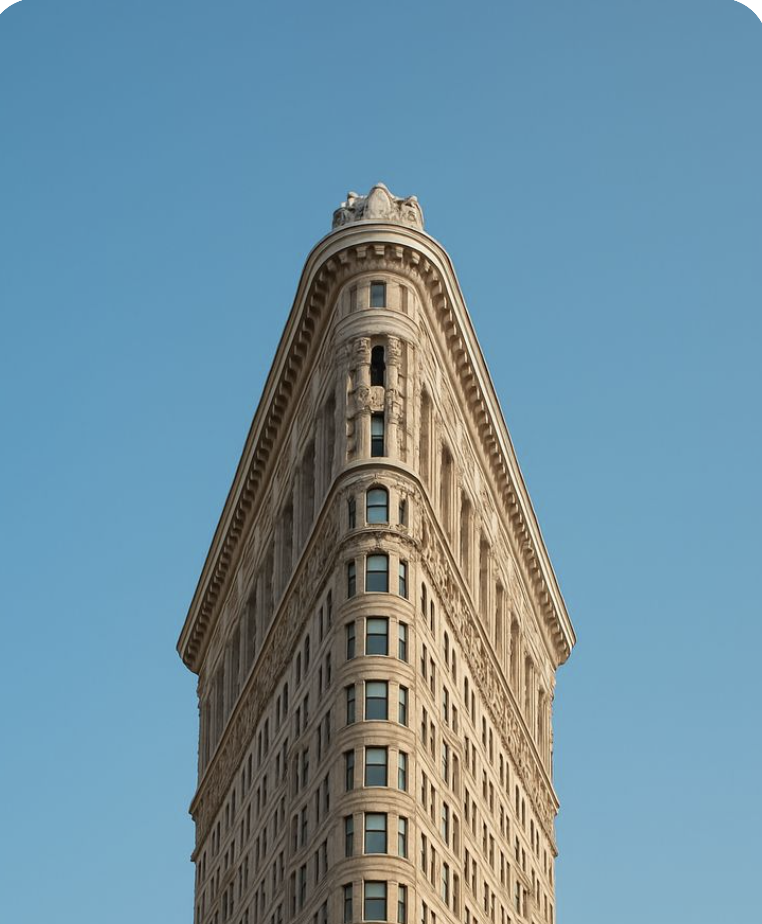
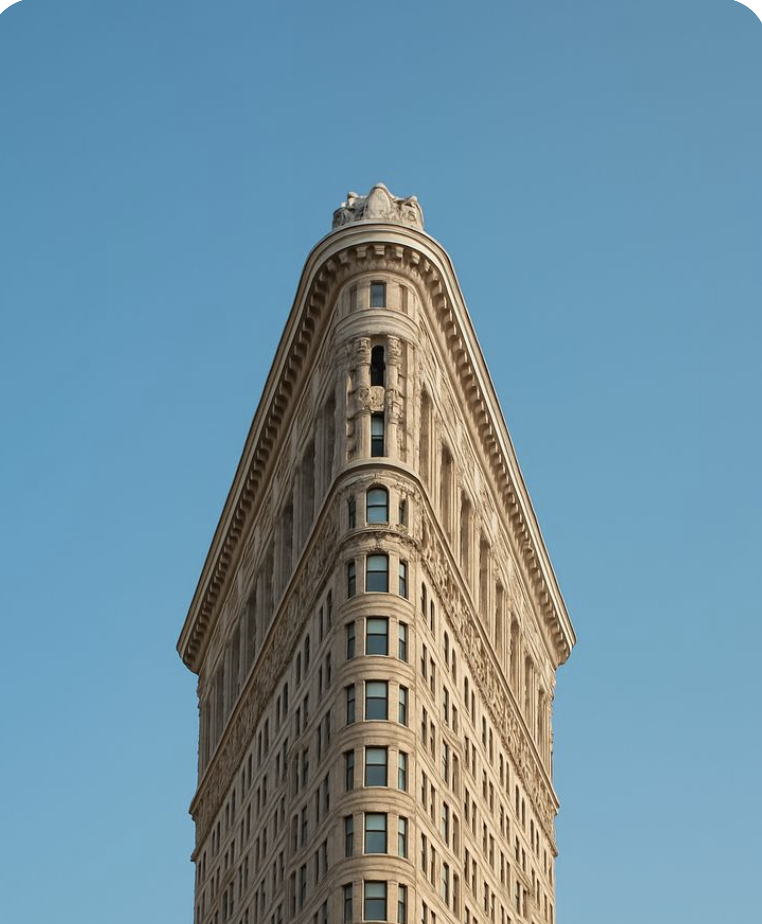
Imagine standing at the corner of Fifth Avenue and Broadway on a crisp New York morning. The light has that golden, early-day clarity that makes everything seem cinematic. Cars hum past. People flow along the sidewalks. And then you look up — and there it is: the Flatiron Building.
It’s as if the city suddenly gathers itself into a single shape. Thin. Triangular. Elegant in its simplicity. A slice of limestone and steel rising into the sky, anchoring a crossroads of movement and life. For more than a century, travelers have stopped here — letting their footsteps slow, their eyes lift, their minds wander.
Landmarks do this to us.
They place us.
They move us.
They become the way we pin a memory to a place.This is a journey into the world’s most iconic architectural landmarks — from the Flatiron to the Eiffel Tower, from the Sydney Opera House to the Parthenon — and an exploration of why certain structures become more than buildings. Why they become emblems. Why they shape how we experience a city. And why, long after we’ve left, we keep returning to them in memory, photographs, and wanderlust.
Part I: The Flatiron — New York’s Unexpected Icon
A Building That Shouldn’t Have Worked
When the Flatiron Building was completed in 1902, people weren’t sure it would survive. Its triangular shape was radically unusual, and critics feared that the structure wouldn’t withstand New York’s famously strong winds.
But it did more than survive — it thrived.
Designed by Daniel Burnham, the Flatiron was an early steel-frame skyscraper, standing proudly at 22 stories tall when most buildings barely reached 10. Its narrowest corner measures less than two meters wide, giving it the unmistakable look of a prow cutting through the streets.
Its form was not arbitrary. The building sits on a triangular plot at the intersection of Broadway, Fifth Avenue, and 23rd Street — a chaotic crossroads that demanded creativity instead of conformity. Burnham leaned into the challenge and created something that looked improbable, almost playful.
The result? A building that instantly captured the world’s imagination.
A New Kind of New York
The Flatiron symbolized the early 20th century optimism of New York — a city leaping upward, shedding limits, embracing speed and innovation. Its crisp Beaux-Arts façade, with its decorative limestone details, showed that a skyscraper didn’t have to be cold or mechanical.
It could be elegant.
It could be expressive.
It could have personality.The Flatiron was photographed endlessly — not just because of its design, but because of the way it shaped the experience of the city around it. The wind that curled around its pointed edge, the shadows it cast across Madison Square Park, the way sunlight danced along its limestone skin.
It became one of those places where New Yorkers — and travelers — learned to fall in love with the city.
Architecture as Identity
Some buildings take decades to become beloved. The Flatiron took days. It was instantly iconic, instantly symbolic, instantly “New York.”
To see the Flatiron is to understand something about the city:
That it embraces eccentricity.
That it celebrates perspective.
That its beauty lies not in order, but in energy.And so our journey begins here, with a building that taught the world a truth about landmark architecture:
Sometimes the most iconic structures are the ones that dare to be themselves.
Part II: When Buildings Become Symbols
The Shape of a City’s Soul
Why do certain structures become icons while others fade quietly into the skyline?
It isn’t only about beauty.
It isn’t only about size.
It isn’t even about fame.Iconic landmarks capture something essential about their cities — history, culture, ambition, identity. They become shorthand for a feeling.
The Eiffel Tower symbolizes romance and French flair.
The Sydney Opera House symbolizes creativity and coastal freedom.
The Taj Mahal symbolizes devotion and timeless love.
The Burj Khalifa symbolizes ambition without ceiling.
The Parthenon symbolizes philosophical dreaming and ancient legacy.Landmarks are emotional anchors — places where travelers experience a city at its most distilled.
The Power of Shape
Think of the Eiffel Tower. You only need its outline — that iron lattice curve blooming toward the sky — to instantly know the place.
Architecture becomes symbolic when it becomes unforgettable.
A perfect arc.
A daring triangle.
A symmetrical dome.
A soaring spire.
A wave of white sails.
A ring of stone pillars.These shapes live in our imagination long before we ever stand beneath them.
Part III: Paris — The Eiffel Tower and the Art of Becoming Iconic
A Tower That Was Almost Temporary
When Gustave Eiffel built his tower for the 1889 World’s Fair, Parisians hated it. Critics called it an eyesore, a monstrosity, a “metal smokestack” ruining the classical skyline.
But as the tower rose, something changed.
People began to feel something — awe, curiosity, pride.What was once controversial became beloved.
And over the decades, the Eiffel Tower transformed into Paris’s beating heart — a place where travelers propose, dream, photograph, picnic, linger, and watch the city glow.
Engineering as Elegance
The Eiffel Tower is beauty born from physics — a structure that is strong because it is delicate. Its iron lattice reduces wind resistance. Its tapered silhouette guides the eye upward. Its transparency allows sunlight to pour through.
It is both industrial and poetic — a perfect metaphor for Paris itself.
The Symbol of Romance
Why is the Eiffel Tower so romantic?
Not because of its shape alone.
But because of what it represents:Possibility.
Perspective.
The spark of wonder.Standing beneath it, Paris feels infinite — a city that invites you to dream a little bigger.
Part IV: Sydney — Where Architecture Becomes Sculpture
The Opera House That Changed a Coastline
If the Eiffel Tower is a symbol of metal and sky, the Sydney Opera House is a symbol of water and freedom.
Designed by Jørn Utzon, the structure is composed of interlocking white shells — like sails catching the wind, or waves breaking against the harbor. Its curves echo nature. Its boldness echoes Australia’s spirit.
When you see the Opera House, you know where you are.
Engineering Meets Vision
The structure was famously difficult to build. The shells were mathematically complex. Construction ran years over schedule. Engineers had to invent new methods just to bring it to life.
But that’s what iconic architecture does — it asks the impossible, then becomes the proof that creativity and technology can meet.
Sculpture You Can Enter
The Sydney Opera House is not just seen; it is experienced. You walk inside its soaring halls, touch its tiled exterior, feel the harbor breeze along its edges. The building becomes a character — part of your memory of Australia.
This is the magic of architecture: when it becomes a sensory experience, it becomes unforgettable.
Part V: Rome — Classical Grandeur and the Architecture of Time
The Colosseum: A Monument of Echoing Voices
In Rome, architecture is not just design — it is history alive and breathing. The Colosseum, with its rings of arches and monumental presence, tells stories from two thousand years ago.
You stand inside its ancient skeleton and hear echoes: of crowds, of gladiators, of emperors and everyday Romans.
The Colosseum reminds us that architecture can hold memory — not just of one era, but of many.
The Pantheon: A Lesson in Perfect Geometry
Step inside the Pantheon and you experience one of the greatest architectural achievements in human history. Its dome — once the largest in the world — feels effortless, floating above you like an open sky.
The oculus lets in a perfect circle of sunlight, shifting across the marble floor as the day passes.
The Pantheon is a reminder of what architecture can do:
Transport us. Astonish us. Connect us across time.Classical vs Modern
Classical architecture uses ornament, proportion, and symbolism to communicate meaning. Modernism uses simplicity, clarity, and form.
Both approaches shape how we experience a place — one through grandeur, the other through purity.
Part VI: Minimalist Modernism — When Simplicity Becomes Iconic
The Beauty of Less
Minimalism in architecture strips away excess to reveal essence. Think of:
- The sleek lines of Barcelona Pavilion
- The glass-and-steel transparency of the Louvre Pyramid
- The geometric serenity of Tadao Ando’s Church of the Light
- The quietude of Japanese modern homes
These buildings are iconic not because they overwhelm, but because they whisper.
Light as a Material
Modernism often plays with light — letting it enter, reflect, expand. Glass walls, open plans, simple surfaces. The experience becomes one of clarity.
While classical architecture impresses through complexity, modernism impresses through calm.
Both become iconic in their own way.
Part VII: How Architecture Shapes Experience
Buildings as Emotional Landscapes
Architecture is about feeling as much as function.
Standing beneath the Eiffel Tower feels hopeful.
Walking along the Brooklyn Bridge feels expansive.
Entering the Sagrada Família feels spiritual.
Standing inside the Taj Mahal feels intimate.
Approaching the Sydney Opera House feels freeing.Landmarks shape emotion — and emotion is what makes travel memorable.
Photography and Perspective

Iconic structures become part of our visual culture:
- silhouettes at sunset
- reflections in water
- skylines from afar
- textures up close
Photography captures not just the building, but the feeling of being there.
Memory Anchors in Travel
We associate cities with the landmarks that moved us most.
Paris becomes Eiffel.
Rome becomes Colosseum.
Sydney becomes Opera House.
New York becomes Flatiron — or the Chrysler Building, the Empire State, the new World Trade Center.Architecture becomes the way we carry a place home with us.
Part VIII: Wanderlust and the Architecture of Dreams
Why We Travel Toward Landmarks
Landmarks are promises:
That a place is unique.
That a city holds stories.
That beauty can be built, not just found.
That human creativity has no borders.We chase buildings because they help us imagine ourselves inside a different life, a different moment, a different world.
The Global Language of Landmarks
Whether minimalist or ornate, ancient or futuristic, landmarks speak a language beyond words:
shape, shadow, scale, material, light.
You can feel a landmark even if you don’t understand its history. But when you learn its story, it becomes even richer.
Conclusion: The Memory of Cities
Think again of the Flatiron.
The way it rises like a ship’s bow slicing through Manhattan wind.
The way it catches morning light.
The way people stop — even locals — to look up, pause, breathe.This is the power of iconic architecture.
Buildings become more than structures.
They become symbols.
They become teachers.
They become the way we understand a city’s soul.And in the end, they become part of us — woven into our photographs, our travel journals, our dreams of where we might go next.
The world’s landmarks remind us that cities, like people, express themselves through their most iconic shapes — and that every traveler carries those shapes forward, turning architecture into memory, meaning, and wanderlust.
-
Where the Earth Breathes Warm: A Global Journey Through Hot Springs, Onsen Traditions, and the Ancient Art of Thermal Healing
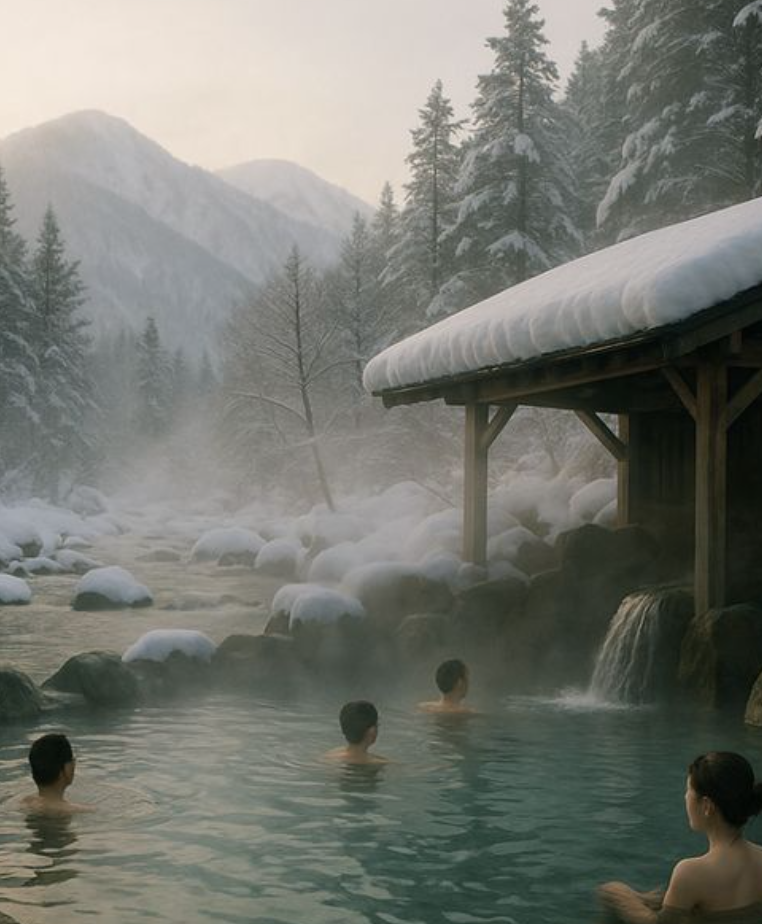
There are few experiences as quietly transformative as sinking into warm, mineral-rich water while winter presses softly against the world outside. Steam rises like a veil. Snowflakes drift down without a sound. Your breath becomes visible in the crisp air, then disappears into the stillness as if the mountains themselves are exhaling with you.
This is the magic of hot springs — places where the Earth opens its palms and offers warmth. Places where time slows, senses expand, and something ancient inside you begins to relax and remember.
Across cultures and continents, human beings have always been drawn to natural heat. From Japan’s snowy onsens to Iceland’s blue geothermal lagoons, from the stone-ringed pools of Italy’s Saturnia to the red desert springs of New Mexico, the ritual remains the same: step into nature’s warm embrace, release what you carry, and let the water reshape you.
This is a story about those waters — about how different cultures bathe, heal, connect, and find meaning in the simple, profound act of lowering oneself into the Earth’s warmth.
Part I: Winter in Japan — Entering the World of Onsen
The Stillness of Snow and Steam
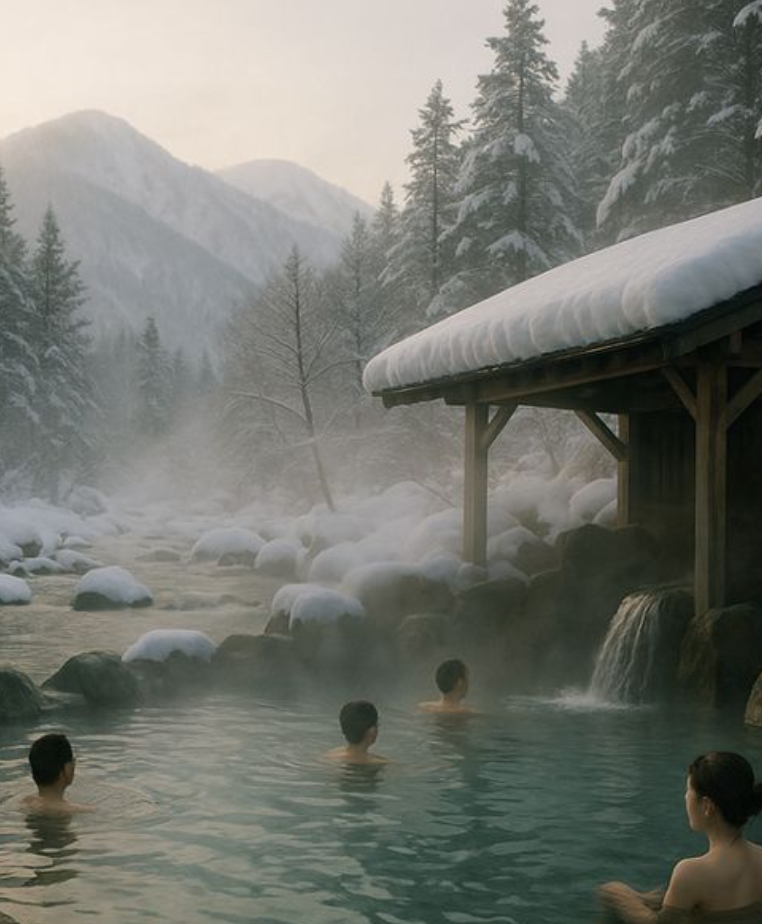
Picture this: a deep winter night in the mountains of Nagano. The forest is silent except for the soft hiss of snow landing on cedar branches. Lanterns hang gently from wooden walkways, each glowing a quiet amber. And before you, framed by drifted snow and jagged rock, lies a steaming onsen pool.
You step in.
The shock of heat against the cold air makes your breath catch. Then — a long, releasing exhale. Your muscles soften, the world falls away, and for a moment, nothing exists outside this pool of warmth and light.
Japanese onsen culture is not simply about bathing. It’s about harmony — between body and environment, between calm and chaos, between you and the land beneath your feet.
A Tradition Thousands of Years Old
Japan has over 3,000 natural hot springs, many of them active for millennia. The oldest onsens were used as far back as the 8th century and appear in some of the country’s earliest recorded texts. Ancient monks wrote about their healing effects. Samurai visited to soothe battle-worn bodies. Farmers soaked after long seasons in the fields.
Onsen waters vary dramatically depending on geography — sulfur-rich springs in volcanic regions, iron-heavy pools that stain stone a deep red, silky alkaline waters in remote valleys. Each spring has its own personality, its own history, its own healing reputation.
But beyond minerals, the real essence of onsen culture lies in its mindset.

Ritual, Purity, and Presence
Before entering the water, you cleanse yourself. You rinse slowly, mindfully, each gesture deliberate. This is not about hygiene; it’s symbolic. You’re washing off the weight of days, the noise of the outside world.
Onsen reminds you:
Leave your burdens at the edge of the pool.Then you step into warmth — a warmth that feels like returning to the beginning of the world.
In Japan, bathing is a form of meditation. It teaches stillness. It invites you to let the mind drift like steam rising into cold air.
The Role of Nature in Japanese Wellness
Onsens are rarely just pools. They are landscapes. You bathe beside waterfalls, in caves, under pine trees, at the foot of volcanic cliffs.
To soak in an onsen is to experience the concept of shinrin-yoku — forest bathing — through water. You become part of the environment instead of separate from it.
Japan reminds us:
Wellness is not something you buy. It is something you return to — something nature gives freely.The Spiritual Meaning of Water
In Shintoism, water is cleansing, sacred, alive. Natural springs are considered gifts from kami — spirits inhabiting mountains and earth. To immerse yourself is to receive a blessing, a renewal.
You step out of the onsen lighter. Calmer. Somehow more honest with yourself.
This is where our global journey begins — in warmth, in snow, in silence.
Part II: Iceland — Bathing in a Land of Fire and Ice
Steam Rising from Black Lava Fields
Fly thousands of kilometers northwest, and you arrive in a place that feels like another planet: Iceland.
Here, hot springs are everywhere — steaming rivers weaving through moss-covered valleys, turquoise pools beside frozen lakes, natural hot pots hidden among jagged lava formations.
The contrast is stunning: ice against heat, darkness against light, the fierce energy of the earth beneath a sky that glows with northern lights.
Geothermal Living: A Way of Life
In Iceland, geothermal energy powers homes, heats water, warms sidewalks in winter. Bathing in natural springs isn’t a luxury — it’s part of everyday life. Communities gather after work in local pools, sharing stories, relaxing, reconnecting.
While Japan’s onsen tradition is contemplative, Iceland’s is communal — a meeting point between nature and society.
Stories in the Steam
Travel deeper into the countryside and you find the poetic heart of Iceland’s spring culture: rugged pools tucked into mountainside crevices and warm rivers running like veins from volcanic peaks.
One of the most magical experiences is soaking in a natural riverside hot spring in the dark Icelandic night while aurora lights dance overhead. The steam blurs everything into softness, and you feel the earth churn beneath you — alive, pulsing, ancient.
Healing Through Extremes
Icelandic culture embraces the idea that contrast strengthens the spirit: cold plunges followed immediately by hot spring immersion, icy winds followed by warm waters. It mimics life — challenge followed by relief, effort followed by rest.
Geothermal bathing becomes a metaphor:
Even in the coldest environments, warmth is always waiting beneath the surface.
Part III: Italy’s Saturnia — Ancient Heat and Roman Myth
The Milk-Blue Pools of Tuscany
Travel southeast to Italy, where the landscape softens and the light becomes golden. In southern Tuscany lies Saturnia — a series of terraced pools flowing with turquoise geothermal water.
Mineral-rich steam rises into the countryside. Rolling hills stretch beyond the horizon. Cypress trees stand like sentinels. The scent of sulfur lingers in the warm air.
Unlike the quiet reverence of Japan or the communal relaxation of Iceland, Saturnia feels joyful. Playful. Alive.
A Legend Born of Gods
According to Roman mythology, the Saturnia springs were created when the god Saturn threw a lightning bolt to earth, splitting the land and releasing underground waters. He intended the springs as a gift — a place where humans could find peace and harmony.
For thousands of years, travelers, nobles, farmers, and monks have visited these waters to soak, heal, and socialize.
Thermal Baths in Roman Culture
Ancient Romans were masters of bathing culture. Public baths were social hubs — places to relax, converse, debate, and conduct business. Thermal springs were particularly revered for their health benefits and spiritual importance.
Saturnia, with its naturally warm flow, became one of the most beloved.
A Ritual of Ease
Today, the experience feels timeless:
You step from pool to pool, letting the water’s warmth circulate through your body. You find a quiet spot by a rock, listen to the waterfall’s steady hum, and let the Tuscan sun warm your face.Here, bathing is leisure — a reminder that slowing down is an art form.
Italy teaches us:
Comfort is not indulgence; it is nourishment.
Part IV: New Zealand, Turkey, Morocco & Beyond — The World’s Secret Springs
New Zealand — Māori Thermal Traditions
In Aotearoa (New Zealand), geothermal springs hold deep cultural significance for Māori communities. Natural pools were used for healing, cooking, and ceremonial rites. Water was considered both practical and sacred — a connector between physical and spiritual realms.
Rotorua, a region where steam vents erupt from the earth and geysers rumble, remains one of the world’s most active geothermal areas. Bathe here and you feel the planet’s pulse.
Turkey — The Cotton Castles of Pamukkale
Pamukkale’s terraces, formed from white mineral deposits, look like frozen waterfalls. Within each terrace, warm spring water gathers, shimmering under the sun.
These “cotton castles” were used for millennia by Greeks and Romans, who believed the water healed ailments and restored vitality. Bathing here feels like stepping into a dream — white, soft, surreal.
Morocco — Desert Springs Under Starry Skies
In the Moroccan Sahara, scattered oases hide natural springs warmed by geological layers beneath the sand. Here, bathing is both communal and essential — a way to cool, hydrate, and restore during desert journeys.
At night, under the vast desert sky, warm springs become sanctuaries of story, song, and connection.
United States — Red Rocks and Quiet Healing
In the American Southwest — Colorado, New Mexico, Arizona — mineral springs bubble up beside red canyons and desert plateaus. Indigenous communities used these waters for ceremonial cleansing, healing, and communal gathering.
Today, travelers soak beneath broad desert skies, watching stars blink to life as steam curls into darkness.
Part V: The Universal Meaning of Hot Springs
A Shared Human Instinct
What unites Japan’s snowy onsens, Iceland’s volcanic pools, Italy’s ancient baths, and New Zealand’s steam-covered valleys?
A shared longing for warmth.
A shared belief in nature’s ability to comfort.
A shared instinct to gather, reflect, and renew.Across cultures, hot springs symbolize the same things:
- healing,
- connection,
- rebirth,
- a return to the essential.
The Sensory Soul of Thermal Bathing
Regardless of where you are, the experience engages every sense:
- The sound of water trickling.
- The feel of heat seeping into bone.
- The scent of minerals or forest air.
- The glow of lanterns, auroras, or desert stars.
- The taste of crisp winter or salty steam.
To bathe in natural hot water is to be fully, completely present.
Mindful Travel Through Water
Hot springs remind travelers of a truth often forgotten in modern travel:
You don’t have to do much to experience a place.
You can simply be in it.You can sit in a pool carved by nature itself and feel a country’s heartbeat. Its climate. Its culture. Its quiet wisdom.
Thermal bathing becomes an act of mindful travel — a way to slow down, reconnect with the body, and listen to the landscape.
The Earth as Caregiver
In every culture, hot springs symbolize something profoundly hopeful: the Earth, despite everything, continues to offer warmth.
When you soak in a spring, you are held by the planet. Sustained by it. Healed by it.
Part VI: Reflections at the Edge of the Steam
Imagine returning to that snowy onsen.
The forest is still quiet. Steam rises softly. Lanterns flicker. Somewhere in the distance, a river murmurs beneath ice.
You sink deeper into the water, letting warmth spread slowly, like light entering a room. Around you, snow continues to fall, each flake melting instantly when it touches the surface of the pool.
As you watch the shapes of mountains blur through steam, one truth settles inside you:
Hot springs are reminders that comfort can be found even in the coldest places — both in the world and within ourselves.
Every culture expresses this truth differently, beautifully, uniquely.
But the message remains the same:Slow down.
Let warmth in.
Let the earth hold you.
Be present in your own body.And remember that you carry these waters with you — traces of comfort, memory, and meaning — long after you leave the pool.
-
Reflections of the Sacred: The Stillness of Machapuchare
I. Dawn Over the Lake
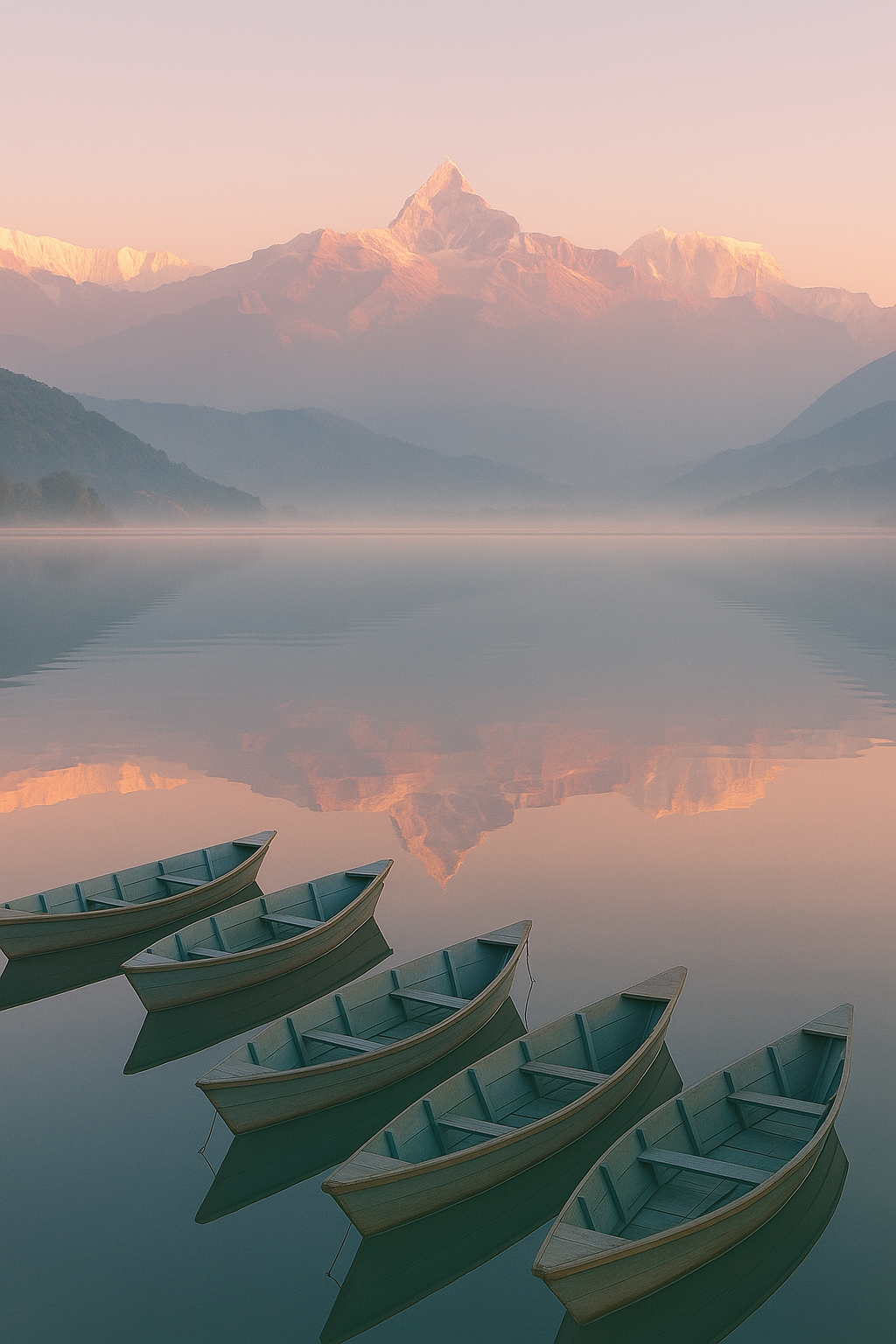
The world awakens slowly in the shadow of the Himalayas. Before the first bird calls, before the fishermen push their boats from the shore, the air lies suspended in perfect stillness. Across the surface of Phewa Lake, a soft mist curls upward, touched by the faintest blush of dawn. The water mirrors the sleeping peaks above — a reflection so clear that sky and earth seem indistinguishable.
At the center of this vision rises Machapuchare, the sacred mountain of Nepal. Its distinctive double summit, resembling the tail of a fish, pierces the heavens like a divine blade. Bathed in the tender pink of early light, it stands untouched and eternal — both a monument of stone and a symbol of spirit.
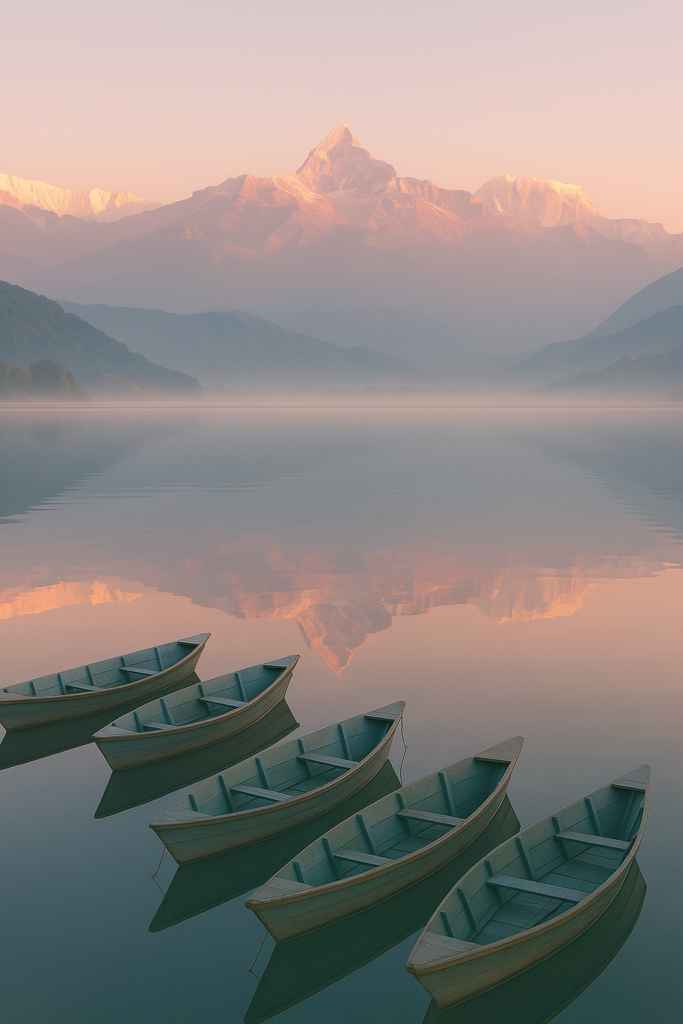
In the foreground, five wooden boats float motionless, their hulls gently tracing ripples across the water. They are small human presences in a vast natural symphony — silent witnesses to the meeting of light and stillness. This image, simple and profound, captures a truth often lost in the rush of the modern world: that peace is not found in motion, but in reflection.
II. The Mountain That No One Climbs
Machapuchare — or Machhapuchhre in Nepali — stands at 6,993 meters (22,943 feet). Though not among the tallest of the Himalayan giants, it holds a distinction no other mountain shares: it remains unclimbed. In 1957, a British expedition led by Wilfrid Noyce came within a few hundred meters of the summit but stopped short out of respect for local beliefs. Since then, the Nepalese government has declared the mountain sacred and off-limits to all climbers.
To the Gurung people who live in the region, Machapuchare is the home of Shiva, the great destroyer and transformer in the Hindu pantheon. Its twin peaks are said to represent his presence — masculine and feminine, creation and destruction, held in perfect balance.
Thus, it is not merely a mountain, but a temple — a divine abode where human footsteps have no right to trespass. While Everest and Annapurna have become symbols of conquest, Machapuchare endures as a symbol of reverence. Its untouched summit reminds us that not all summits are meant to be reached. Some are meant to be worshiped from afar.
III. Pokhara: Mirror of the Gods
Nestled in a lush valley beneath the Annapurna range, the city of Pokhara is often described as Nepal’s most beautiful. Its lakes, forests, and mountain vistas have made it a place of pilgrimage for travelers, artists, and seekers alike. But beyond its scenic allure lies something deeper — a spiritual geography that binds the land and the human soul in quiet dialogue.
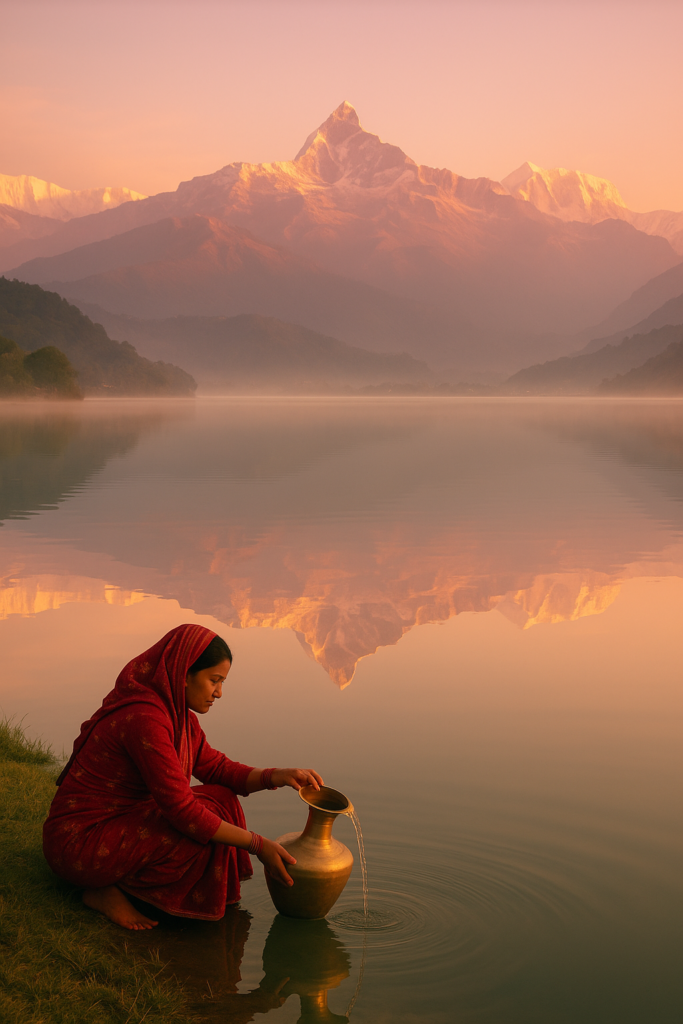
The heart of Pokhara is Phewa Lake, a natural mirror cradled among rolling hills. Locals rise before dawn to paddle across its tranquil waters, their wooden boats gliding like prayers toward the rising sun. On clear mornings, the snow-capped peaks of Annapurna, Dhaulagiri, and Machapuchare reflect perfectly in its surface, creating a vision so symmetrical it feels like a passage between worlds.
Floating on the lake’s center is the Tal Barahi Temple, a small two-tiered pagoda dedicated to the goddess Barahi — protector of the valley. Pilgrims arrive by boat, carrying offerings of flowers and rice. The gentle sound of bells drifts across the water, mingling with the splash of oars and the cry of herons.
Here, water and mountain, human and divine, all merge into a single frame. Pokhara is not merely a place of beauty; it is a threshold — a point where heaven and earth meet in reflection.
IV. The Language of Stillness
There is something profoundly human in the act of looking into still water. Reflection, both literal and symbolic, has long been a metaphor for contemplation. In the mirror of a lake, the external world becomes internalized — mountains become memories, clouds become thoughts.
To sit by the water’s edge and watch a reflection tremble with the passing breeze is to witness the fragility of perception. What seems solid — the mountain, the sky — becomes fluid, ephemeral. The reflection is perfect until disturbed, just as peace is whole until interrupted by desire or fear.
In Buddhist philosophy, this is the nature of the mind. The surface of the lake is consciousness; the ripples are our thoughts. Only when the mind grows still does it clearly reflect reality. The mountains were always there — we just had to stop stirring the water.
Thus, in the image of Machapuchare reflected on Phewa Lake lies not only natural beauty but a spiritual teaching: to find peace, we must learn to see without disturbance.
V. The Light of Impermanence
The dawn light in the image is not static — it changes by the second. One moment the peaks are rose-gold, the next they are ivory, and soon after, pale blue. The boats, though anchored, drift imperceptibly with the currents. Even the reflection that seems eternal shifts with every ripple.
This, too, is the essence of Buddhist and Hindu thought — the truth of impermanence, or anicca. Everything that exists is in motion, and beauty lies not in permanence but in transience.
The Japanese call it wabi-sabi — the appreciation of fleeting perfection. The Nepali landscape embodies this truth effortlessly: each sunrise is a masterpiece that vanishes within minutes, leaving behind only memory and gratitude.
In a world obsessed with preservation and possession, Machapuchare stands as a silent teacher. Its beauty cannot be conquered or captured. It can only be witnessed, and then — like dawn — let go.
VI. The Boats: Humanity at Rest
In the foreground of the image, five boats rest gently on the water. Their arrangement feels almost intentional, as if they were placed by an unseen hand to balance the scene. They represent, in their simplicity, human presence — fragile yet enduring, small yet significant.
Each boat tells a story. Perhaps they belong to fishermen who will soon set out to cast their nets as the sun climbs higher. Perhaps they are the same boats used to ferry pilgrims to the temple. Or perhaps they are empty for now, waiting for the day’s first travelers — a pause before movement, a breath before life resumes its rhythm.
Their stillness mirrors the larger stillness of the landscape. In them, humanity’s relationship to nature is expressed not through domination, but through harmony. The boats do not disturb the reflection; they become part of it. They remind us that belonging to the world means learning how to rest within it.
VII. The Sacred Geometry of the Himalayas
The Himalayas are not merely mountains; they are architecture on a cosmic scale. Their ridges, valleys, and summits form patterns of energy that have inspired spiritual seekers for millennia. Ancient yogis believed that the Himalayas were the spinal column of the Earth, channeling divine energy between heaven and ground.
Machapuchare, in particular, holds a unique position in this sacred geometry. It is seen as the guardian of the Annapurna Sanctuary, a natural amphitheater surrounded by peaks that form a circle of snow and silence. To enter it is to step into a temple without walls — a space where nature performs the rituals of creation itself.
Standing at dawn before such majesty, one cannot help but feel the presence of something beyond comprehension. The geometry of the mountain and its reflection form a perfect symmetry — an image of unity, of oneness. It is a reminder that the spiritual and the physical are not separate realms but reflections of one another.
VIII. The Silence of the Morning
Silence in the Himalayas is not absence — it is fullness. It hums softly, like a held note that never fades. The rustle of leaves, the distant cry of a bird, the whisper of wind over water — all become part of this larger stillness.
To those who listen, silence is not empty; it speaks. It tells stories of time before humanity, of glaciers carving valleys, of gods dwelling among peaks. It invites humility — not as submission, but as reverence.
In a time when noise dominates our days — the hum of machines, the chatter of screens, the constant rush of thought — to encounter such silence is to rediscover a forgotten dimension of being.
This silence is what makes the image so powerful. It captures not movement, but the moment before movement. It is the pause that holds eternity.
IX. The Human Need for Mountains
Throughout history, mountains have drawn humanity upward. They appear in our myths, our scriptures, our dreams. From Mount Olympus to Mount Sinai, from Kailash to Fuji, they have served as bridges between mortals and the divine.
The Himalayas, however, are unique. They are not just a mountain range — they are a state of mind. For the people who live in their shadow, the mountains are not obstacles but teachers. They embody endurance, patience, and balance. They remind humans of their smallness and their belonging.
Machapuchare, being forbidden to climbers, amplifies this truth. It invites awe instead of ambition. In its untouchability lies a subtle critique of modernity — a world that measures worth by conquest. Here, reverence replaces victory. The goal is not to reach the top, but to understand why some peaks are sacred.
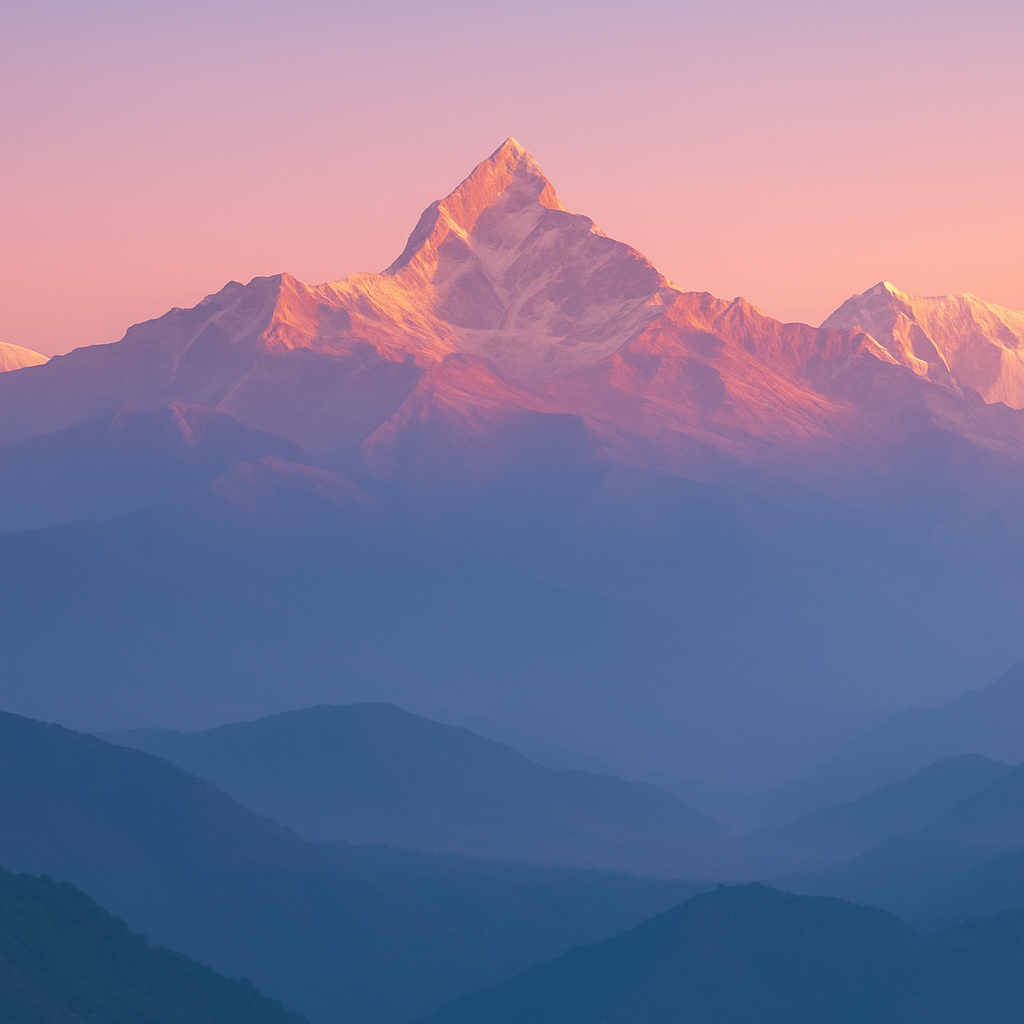
X. Pokhara’s Morning Rituals

Each morning, Pokhara awakens in quiet reverence. Women walk to the lake carrying copper pots to collect water for their households. Fishermen untie their boats and cast nets that shimmer like silk in the first light. Monks from local monasteries chant along the shore, their voices rising and falling with the lapping waves.
Tourists, too, join this ritual — though unknowingly. Some come with cameras, others with sketchbooks or journals. They stand in awe as the reflection of Machapuchare unfolds before them. Whether or not they understand the mythology, they feel its presence.
The air itself seems charged with gratitude — gratitude for another sunrise, another chance to see the sacred in the ordinary.
XI. The Philosophy of Reflection
Reflection, in Eastern philosophy, is not merely introspection; it is participation. The world reflects the self, and the self reflects the world. What you see depends on the clarity of your perception — just as the mountain’s reflection depends on the stillness of the water.
In the image, if the water were disturbed, the reflection would break apart. Similarly, when the mind is restless, truth becomes fragmented. Thus, the act of contemplation is not passive but active — a discipline of stillness.
This understanding is central to Nepal’s spiritual heritage. Whether in Hindu temples, Buddhist stupas, or quiet lakes, reflection is always at the heart of enlightenment. To see clearly, one must first become still enough to allow reality to appear as it truly is.
XII. Between Heaven and Earth
Machapuchare’s sharp peak rises like an arrow pointing heavenward, while its reflection descends into the water like a mirror arrow pointing toward the depths. The symmetry forms a complete mandala — heaven above, earth below, and human presence in between.
This duality — ascent and descent, light and shadow — is the essence of balance. The mountain reaches upward, but its beauty depends on its reflection below. One cannot exist without the other.
In this, the image becomes more than a landscape; it becomes a visual koan, a teaching on the nature of harmony. To reach the divine, one must also embrace the ground. To ascend, one must also reflect.
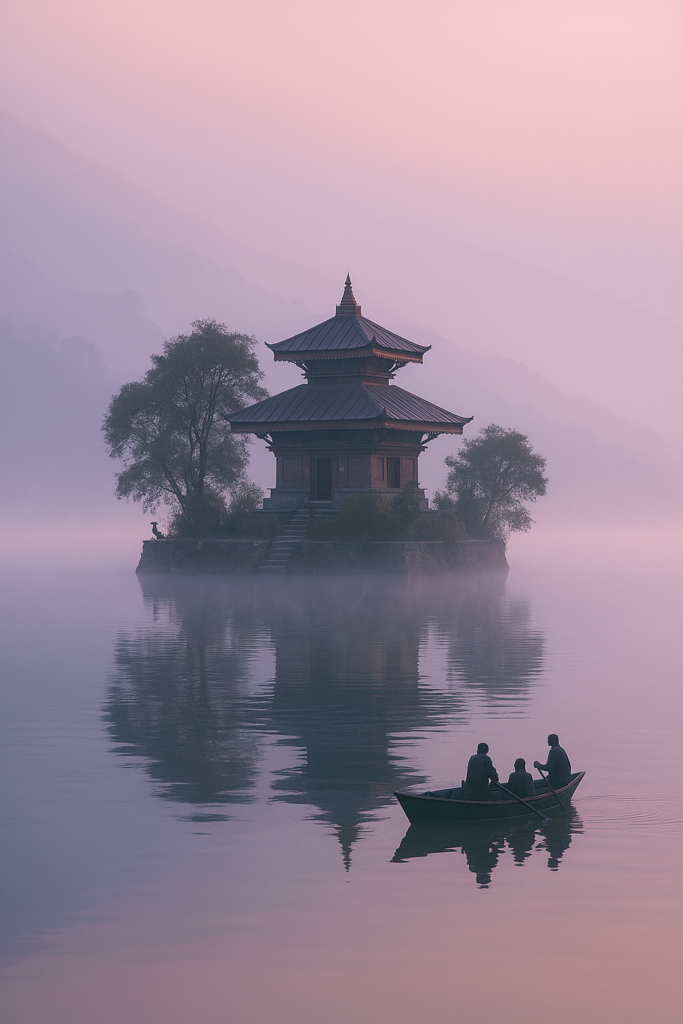
XIII. The Quiet Lessons of Nature
Every element in the image carries a lesson. The snow teaches purity. The water teaches acceptance. The boats teach patience. The light teaches impermanence.
Together, they form a silent scripture — one that requires no words, only attention.
Nature, in this sense, is not a backdrop but a guide. It speaks in shapes and silences, in reflections and rhythms. Those who listen to it deeply enough begin to understand that spirituality is not separate from the physical world — it is the way the physical reveals the infinite.
XIV. Memory and Meaning
Long after one leaves Pokhara, the image of Machapuchare lingers in the mind. It returns in dreams, in moments of stillness, in reflections caught on quiet ponds. It becomes a personal symbol — of peace, of humility, of the longing for clarity.
What makes such images unforgettable is not their grandeur but their gentleness. They remind us that beauty need not be loud to be profound. A single mountain reflected on still water can hold more meaning than the loudest spectacle.
In a sense, to carry the image of Machapuchare within is to carry a compass — a reminder of the direction we must return to whenever life grows turbulent: inward, toward stillness.
XV. The Eternal Reflection
As the day rises and the mist dissolves, the reflection fades. The mountain remains, but its mirror vanishes. Yet even in absence, it leaves an imprint — the memory of harmony.
This is the way of all things sacred. They appear briefly, illuminate deeply, and disappear gracefully. Their gift is not permanence but transformation.
To witness Machapuchare at dawn is to glimpse eternity — not in duration, but in depth. The mountain may be eternal, but the reflection teaches us how to see eternity in a fleeting moment.
And that, perhaps, is the truest reflection of all.
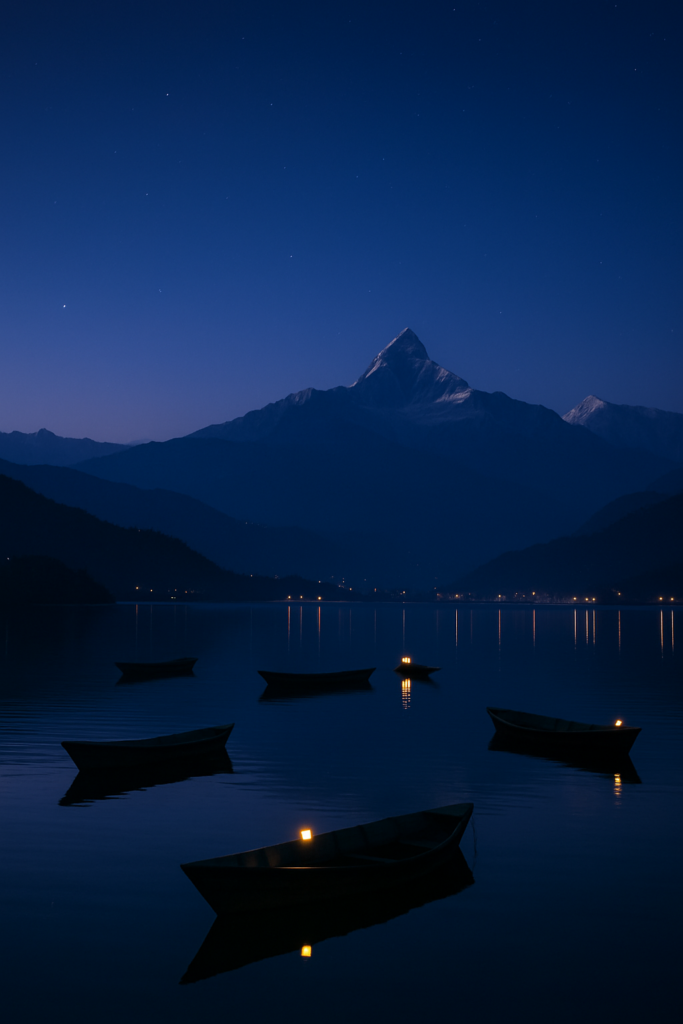
-
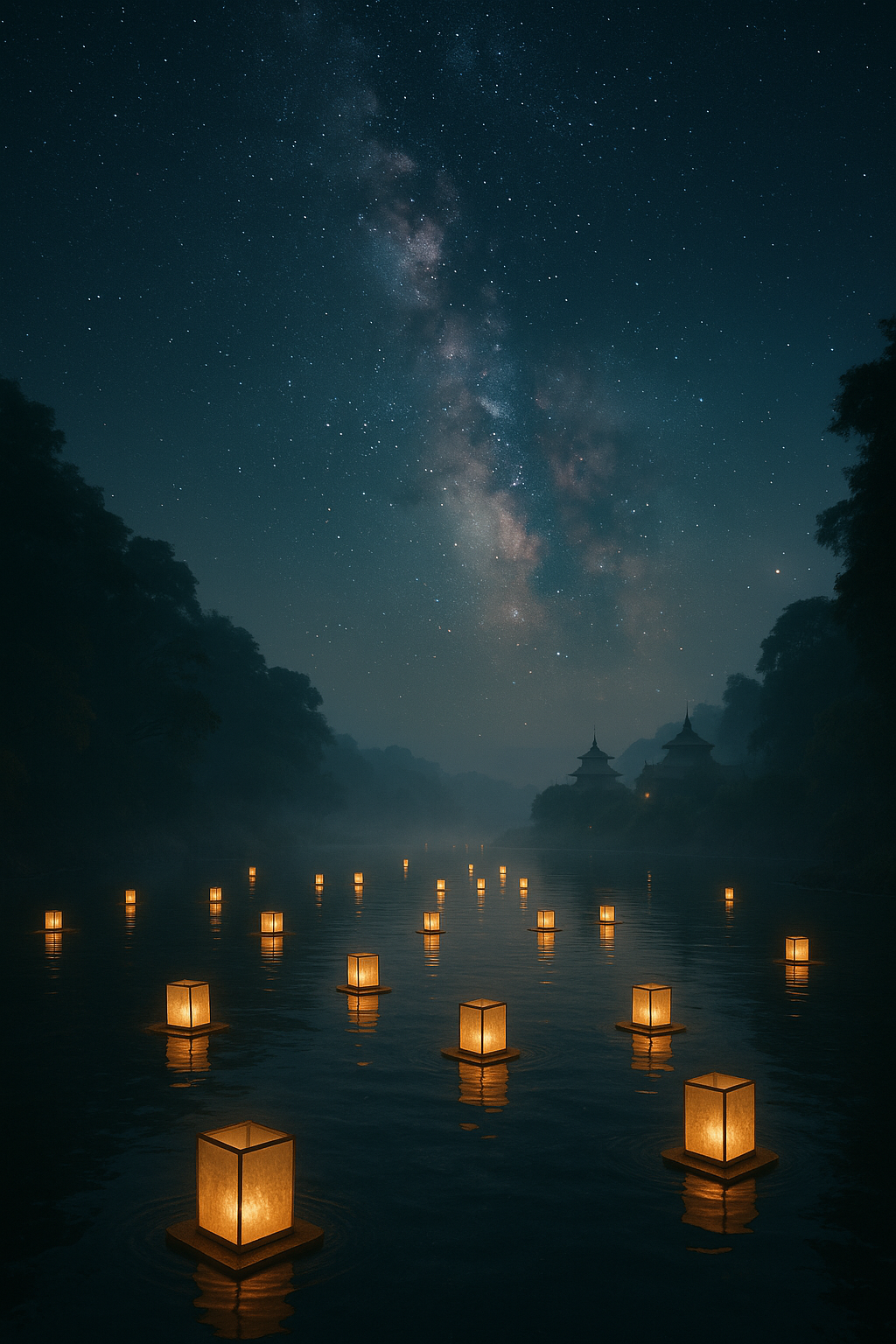
Under Lantern Light: The Spirit of Japan’s Summer Festivals
I. The Evening Begins
As the last light of day fades, a quiet anticipation fills the air. The heat of summer lingers like a memory, softened by a faint evening breeze. Down narrow streets lined with red paper lanterns, people begin to gather—children in bright yukata, couples holding hands, elders moving slowly but smiling as they take in the familiar sounds and scents of the matsuri, the festival.
The first lanterns flicker to life, glowing like fireflies suspended between rooftops. Somewhere, a taiko drum echoes—a deep, steady heartbeat calling the night to awaken. And then, as dusk deepens, the festival begins in earnest.
This is Natsu Matsuri, Japan’s beloved summer festival season—a time when cities, towns, and even remote mountain villages burst into celebration. It is a season of joy, nostalgia, and renewal. Every step, every scent, every spark in the sky carries centuries of tradition and the quiet poetry of impermanence.
II. The Origins of Celebration
Japanese festivals, or matsuri, are as old as the country’s myths. They trace their roots to Shinto, Japan’s indigenous spirituality, where humans, nature, and the divine coexist in delicate balance. Originally, these gatherings were offerings to kami—the spirits of mountains, rivers, rice fields, and ancestors—thanking them for the blessings of the harvest or asking for protection from disaster.
Over the centuries, these sacred rituals evolved into grand communal events, blending Shinto purification with Buddhist reverence and a uniquely Japanese love for seasonal beauty. By the Edo period (1603–1868), matsuri had become both spiritual observance and cultural celebration—a living link between the celestial and the earthly.

The summer festivals, in particular, are deeply connected to gratitude for nature’s bounty and the honoring of the departed. They are moments when the boundary between the worlds of the living and the spirits grows thin, allowing remembrance and joy to coexist beneath the same sky.
III. A Symphony of Senses
To walk through a Japanese festival is to step into a symphony of sensation.
The air is thick with the scent of sizzling food—grilled yakitori skewers, sweet-and-savory okonomiyaki, buttery roasted corn, and the irresistible aroma of takoyaki—golden spheres filled with octopus and topped with bonito flakes that dance in the steam.
Vendors shout their welcomes, children laugh as they play goldfish scooping (kingyo sukui) or ring toss, and the rhythmic drumming of taiko echoes from a distant stage where dancers prepare for the Bon Odori.
Lanterns sway gently overhead, their light casting a warm glow on faces painted with fleeting joy. The sounds, smells, and colors blur into a kind of dream—one that feels both timeless and heartbreakingly brief.
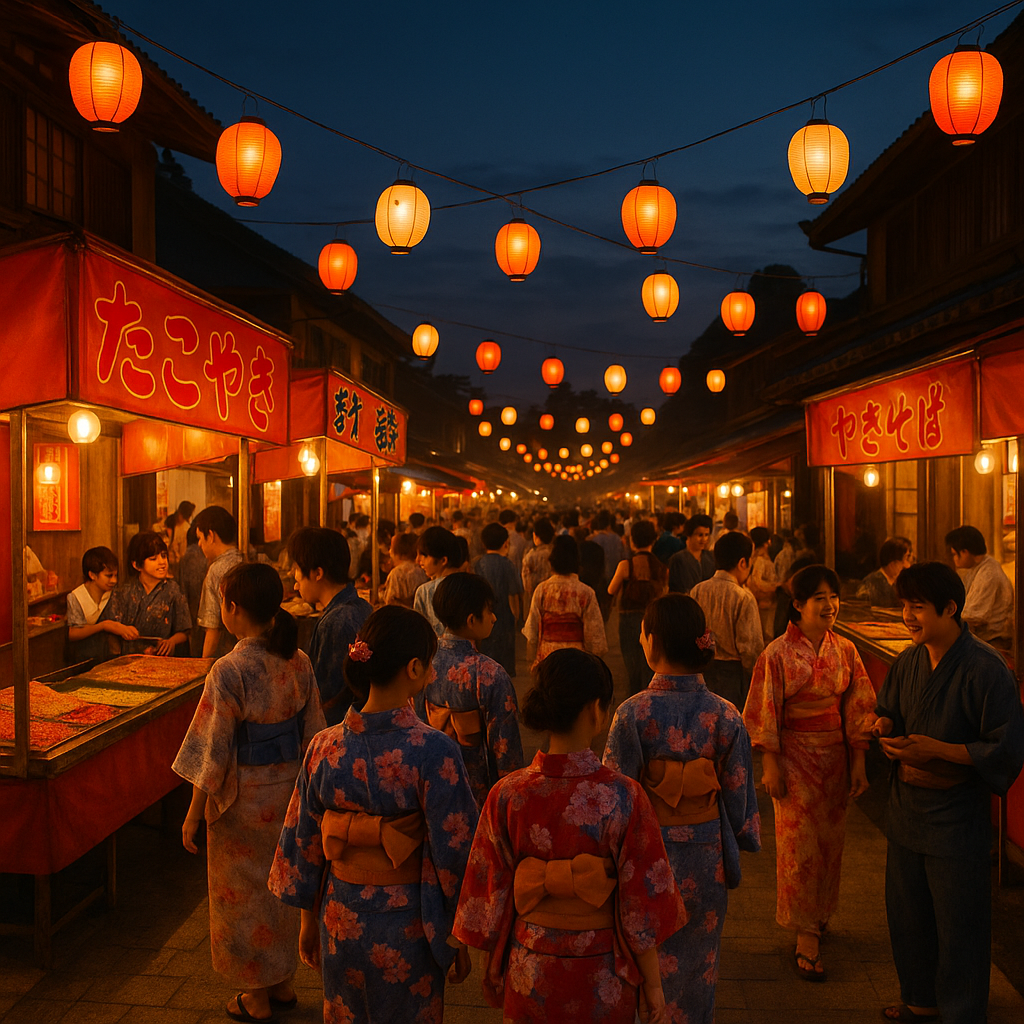
IV. The Yukata: Summer’s Kimono
Among the festival crowd, the yukata reigns supreme. Made of light cotton and tied with an obi sash, it is both elegant and practical—a garment born for summer evenings. Women’s yukata bloom with floral patterns in indigo, crimson, and violet; men’s are understated, in shades of slate and navy.
The ritual of dressing is itself an act of celebration. The fabric rustles softly, the obi tightens at the waist, and sandals—geta or zōri—clack gently on the stone streets. Hair is adorned with pins or flowers, and the air smells faintly of yuzu and sandalwood perfume.
For many, the yukata carries a sense of nostalgia. It transforms the wearer, if only for a night, into part of an unbroken tradition. Under the glow of lanterns, everyone becomes a participant in something larger than themselves—a shared expression of beauty and belonging.
V. The Dance of Bon Odori
As the night deepens, the crowd begins to move toward the main square. At the center stands a raised platform draped with lanterns—the yagura. Drummers strike their taiko in steady rhythm, and the festival’s heart begins to pulse.
This is Bon Odori, the dance of Obon, one of Japan’s most sacred times. According to tradition, during Obon the spirits of ancestors return to visit their descendants. Families welcome them with lanterns and offerings, and communities gather to dance in their honor.
The steps of Bon Odori are simple, circular, and repetitive—hands raised, feet sliding, fans turning. But in their simplicity lies something profound. Young and old, strangers and friends move together, their shadows swaying in unison beneath the paper lanterns. It is not performance but participation—a living connection to those who came before.
As the drums continue, one can almost feel the veil between worlds lifting—the living and the departed dancing side by side in the timeless rhythm of remembrance.
VI. Fire in the Sky
Then comes the hush. The crowd turns toward the river or the open field. Children sit on their parents’ shoulders. The lights dim, and for a heartbeat, the festival holds its breath.
A single flare arcs upward—then bursts open, scattering petals of fire across the heavens. The first firework of the night.
The sky becomes a canvas of color and sound. Gold, crimson, and violet explode into chrysanthemums and willows of light, their reflections trembling in nearby waters. Each burst blooms, fades, and dies in moments, yet the joy it ignites endures.
Fireworks, or hanabi (literally “flower fire”), are central to Japan’s summer identity. Their fleeting beauty embodies mono no aware—the bittersweet awareness of impermanence that runs through Japanese art and philosophy. Like cherry blossoms in spring, fireworks remind the heart that all beauty is temporary, and that is what makes it precious.
For many, this is the climax of summer—the instant when light, sound, and emotion converge into something indescribable, leaving the air thick with wonder and the faint scent of smoke.
VII. The Street of Lanterns
When the fireworks fade, the festival resumes with renewed intimacy. The crowd disperses into side streets where paper lanterns hang low, each painted with family crests, poetry, or the names of local businesses. Their reflections shimmer in puddles left by afternoon rain, turning the ground into a mirror of the sky.
These lanterns are more than decoration—they are prayers made visible. Each flame carries a wish: for good fortune, for love, for health, for the safe journey of the departed souls.
In the hush that follows the spectacle, people slow their steps. Conversations grow quieter. The festival softens into a gentle hum—the calm after celebration, where gratitude takes the place of excitement.
VIII. The Flavor of Memory
No matsuri would be complete without its flavors—each bite a thread in the tapestry of summer memory. Vendors call out in cheerful tones, their stalls bright with color: red apples gleaming in sugar glaze (ringo ame), cups of shaved ice (kakigōri) drenched in syrup, skewers of grilled eel, and steaming piles of yakisoba noodles sprinkled with seaweed.
Each food is ephemeral, meant to be enjoyed in the moment and remembered long after it’s gone. The act of eating at a festival is itself a celebration of life’s fleeting pleasures—simple, sensory, shared.
Many Japanese adults can recall a childhood festival—the first taste of sweet corn, the sticky fingers from candy, the sound of fireworks blending with laughter. These memories linger, returning each summer with the smell of charcoal and the sound of distant drums.
IX. Between Modernity and Tradition
In today’s Japan, summer festivals are both ancient and new. The modern skyline may rise beyond the trees, and smartphones may light up among the lanterns, but the essence remains unchanged. The matsuri endures because it speaks to something timeless—the need to gather, to celebrate, to belong.
For a few nights each year, the boundaries of everyday life dissolve. The salaryman becomes a dancer; the child becomes a keeper of tradition. The air hums with laughter and prayer, commerce and communion. In this space, Japan’s future and past intertwine.
And though the festival may look different in Tokyo’s neon streets or a countryside shrine, its spirit remains the same: gratitude for life, connection to others, and reverence for the beauty of now.
X. Fireworks and Philosophy
The Japanese relationship with impermanence—mono no aware—finds its purest expression in summer festivals. Everything that defines the matsuri is transient: the fireworks vanish, the lanterns burn out, the food is eaten, the laughter fades. And yet, that transience is what makes it meaningful.
In this way, the matsuri mirrors life itself. It teaches through joy rather than sorrow. Where Western thought often seeks permanence, Japanese philosophy celebrates the fleeting. Beauty lies not in what lasts, but in what glows briefly and then disappears—leaving memory in its wake.
To stand beneath the fireworks, surrounded by warmth and sound, is to feel this truth: that happiness is not something to hold, but to witness, again and again, in moments like these.
XI. The Art of Togetherness
Festivals also reveal something deeper about Japanese society—the art of wa, or harmony. Even in the bustle of a crowded street, there is a quiet order. People move naturally, respectfully, attuned to the rhythm of the collective.
Children bow before elders; strangers share food; volunteers clean the streets after the festivities end. The matsuri is not chaos—it is choreography. Its joy is communal, not individualistic. Each person contributes to the atmosphere simply by being present, kind, and aware.
In this way, the festival becomes a microcosm of Japan itself: a place where beauty and discipline, reverence and exuberance, coexist in perfect balance.
XII. The Final Lanterns
As midnight approaches, the crowd begins to thin. Vendors douse their fires, and the last notes of taiko echo off temple walls. The fireworks are long gone, but the air still holds their echo.
A final procession moves toward the river, carrying paper lanterns lit from within. People lower them onto the water, one by one, watching as they drift away in silence.
This is tōrō nagashi—the floating lantern ceremony. Each light represents a soul, a prayer, or a farewell. Together, they form a glowing constellation upon the dark surface, moving gently toward the horizon.
It is perhaps the most hauntingly beautiful moment of the festival—the transformation from noise to stillness, from celebration to contemplation.
The lights fade into the distance, and with them, summer itself begins to wane.
XIII. What Remains
When morning comes, the streets are empty again. The lanterns are gone, the stalls dismantled, the paper scraps swept away. But something lingers—an invisible warmth, a collective exhale.
The festival may have ended, but its essence remains in the hearts of those who walked its streets. It survives in the smell of grilled food, in the memory of laughter, in the colors that danced across the night sky. And when the next summer comes, the lanterns will rise again, the drums will sound, and the dance will begin anew.
Because matsuri is not an event—it is a rhythm. It is Japan’s heartbeat in summer.
XIV. A Season of Soul
For outsiders, a Japanese summer festival may seem like a spectacle of lights and crowds. But for those who live it, it is something deeper: a reunion of the senses and the spirit.
It is the way the yukata feels against the skin, the sound of geta clogs on stone, the shared smiles between strangers. It is the hum of life magnified, made visible, made sacred.
In a country that moves with quiet precision, the matsuri is an act of joyful surrender—a reminder that even within order, there is room for celebration, spontaneity, and awe.
XV. The Eternal Firework
And so, the fireworks fade, but their echo stays within us. Each explosion, each sparkle, is a brief resurrection of light against darkness—a symbol of hope renewed every year.
In their vanishing brilliance lies the oldest lesson of all: that to live is to shine briefly and beautifully before disappearing into memory.
As lanterns dim and the crowd disperses, the matsuri whispers its final blessing:
Cherish the moment, for it is already passing.
-
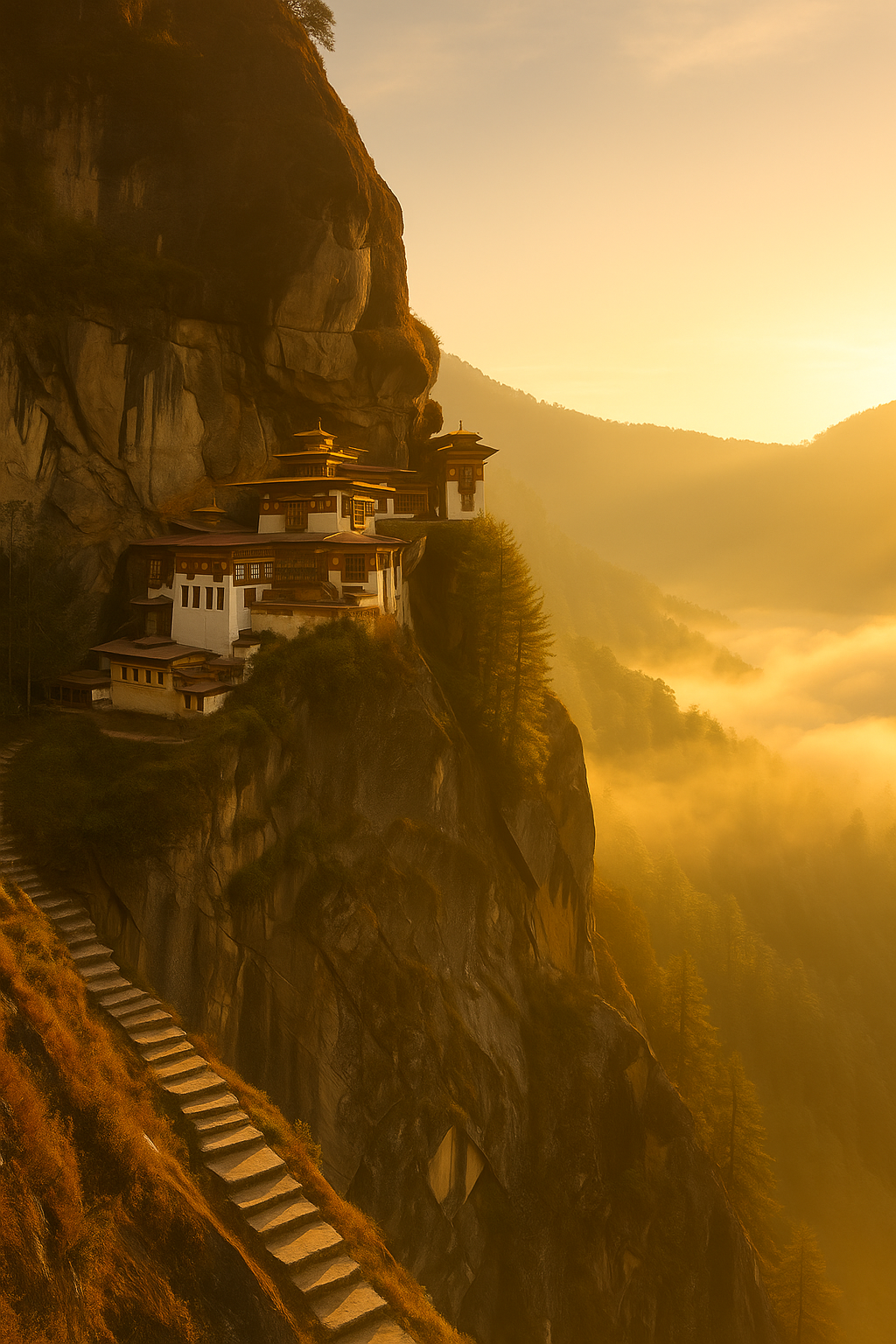
The Tiger’s Nest: Where Earth Meets the Divine
I. The Edge of the World
The trail winds upward through whispering pines, prayer flags strung like rainbows between ancient trunks. The air thins as the path climbs, each step heavy but sacred. And then, as the forest parts, you see it: a monastery clinging to the cliffs like a vision, suspended between sky and stone.
Paro Taktsang — the Tiger’s Nest — looks less like a building and more like a revelation. Perched high on a sheer granite face in Bhutan’s Paro Valley, it seems to defy the laws of gravity and reason alike. Clouds curl below it, as if the earth itself has exhaled. The golden roofs glint in the thin sunlight, and crimson-robed monks descend a staircase carved into the rock, their movements slow and measured against the immensity of the landscape.
To stand before it is to witness the impossible made real — a structure built on faith, maintained by centuries of devotion, and existing at the seam between the human and the divine.
II. A Myth Born of Meditation
The legend of Taktsang begins not with stone and timber, but with spirit. Over 1,300 years ago, Guru Padmasambhava — known across the Himalayas as Guru Rinpoche, the “Precious Master” — flew to this cliffside on the back of a tigress. Some say she was his consort transformed into a blazing creature of light; others say she was a manifestation of his enlightened power.
Landing upon this very rock, Guru Rinpoche entered a cave and meditated for three years, three months, three weeks, three days, and three hours. It was here that he subdued local demons and blessed the land, sowing the seeds of Buddhism in Bhutan.
From this legend, the name Taktsang — “Tiger’s Nest” — was born. And centuries later, a monastery was built around that sacred cave to honor his presence, turning the site into one of the most venerated pilgrimage destinations in the Himalayan world.
The monastery is not just a physical structure; it is a living continuation of myth. Every stone and stair tells the story of human devotion meeting the divine.
III. The Architecture of Faith
At first glance, the Tiger’s Nest seems impossibly placed — as though the mountain itself is holding its breath to keep it aloft. Built in 1692 by Gyalse Tenzin Rabgye, the fourth Druk Desi (temporal ruler of Bhutan), the monastery is a masterpiece of Bhutanese architecture and spiritual design.
It consists of four main temples and several smaller shrines, interconnected by winding stairways and wooden bridges that hug the cliffside. The structures are built into the rock itself, blending seamlessly with the mountain. Their whitewashed walls, golden roofs, and red banded trim glimmer with understated majesty.
Inside, flickering butter lamps illuminate thangkas (sacred paintings), altars, and statues of Guru Rinpoche. Incense smoke curls upward, mingling with the mountain air that seeps through cracks in the stone. Chanting resonates softly through the chambers — a rhythm that feels eternal.
This is architecture not as conquest, but as prayer. Each beam, each nail, seems to bow before the vastness around it. The monastery’s design does not dominate nature; it listens to it, breathes with it, becomes part of it.
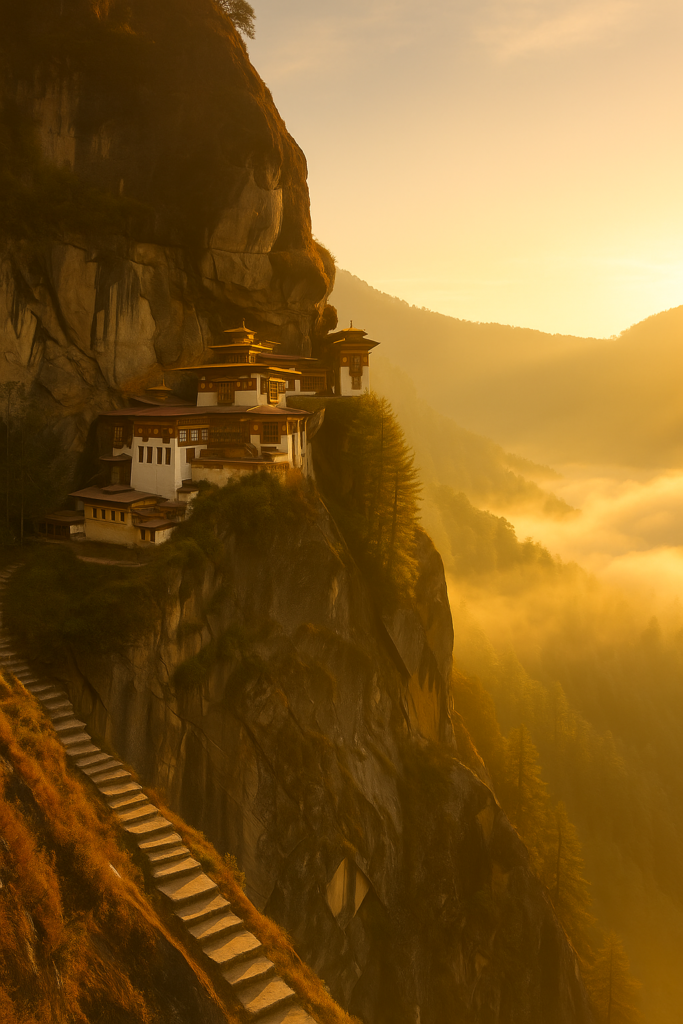
IV. The Path to the Nest
Reaching the Tiger’s Nest is not a casual walk — it is a pilgrimage in every sense. The trail ascends nearly 900 meters (3,000 feet) from the valley floor, snaking through pine forests draped in moss and lichen. The scent of juniper and sandalwood fills the air, and at intervals, visitors pass chortens (stupas) and spinning prayer wheels, each whispering blessings into the wind.
About halfway up lies a viewpoint where trekkers rest, sip butter tea, and gaze across the ravine at the monastery perched impossibly high above. From here, the trail narrows, leading to a final descent into a gorge and a steep climb up to the entrance itself.
At the last stair, as you catch your breath, you cross a wooden bridge above a waterfall — a final threshold between the mundane and the sacred. The sound of rushing water mixes with the chants of monks, and for a moment, the senses blur — you are neither entirely here nor elsewhere.
Those who make the journey say the climb mirrors the inner path of awakening: challenging, humbling, and deeply rewarding.
V. The Monks and the Mountain
The monastery is home to monks who live in quiet devotion, following a rhythm that has changed little over centuries. Their day begins before sunrise, with the deep sound of the dungchen (long horn) echoing across the valley. They chant sutras, light butter lamps, and turn the great prayer wheels, sending blessings to all beings.
Their crimson robes flow like rivers of life against the gray rock and snow. Watching them descend the narrow stairways carved into the cliff is to glimpse a kind of grace — a harmony between human fragility and divine purpose.
Isolation is not loneliness here. It is communion — with silence, with the mountain, with something greater than self. In their simplicity, these monks embody what so many seekers journey to find: peace born not of escape, but of presence.
VI. Fire and Rebirth
In 1998, tragedy struck. A fire broke out in the monastery, believed to have started from a butter lamp. Flames consumed much of the complex, destroying priceless relics and paintings. For Bhutan, the loss was not just architectural; it was spiritual — a wound to the nation’s soul.
But like the phoenix, Taktsang rose again. With the same devotion that had built it centuries earlier, the Bhutanese people — from kings to commoners — came together to rebuild the monastery. The reconstruction was painstaking, guided by traditional craftsmanship and rituals. Every stone was laid with reverence; every detail was restored as an act of devotion.
By 2005, the Tiger’s Nest was reborn — not as a replica, but as a continuation of its eternal story: impermanence, loss, and renewal woven into one unbroken cycle.
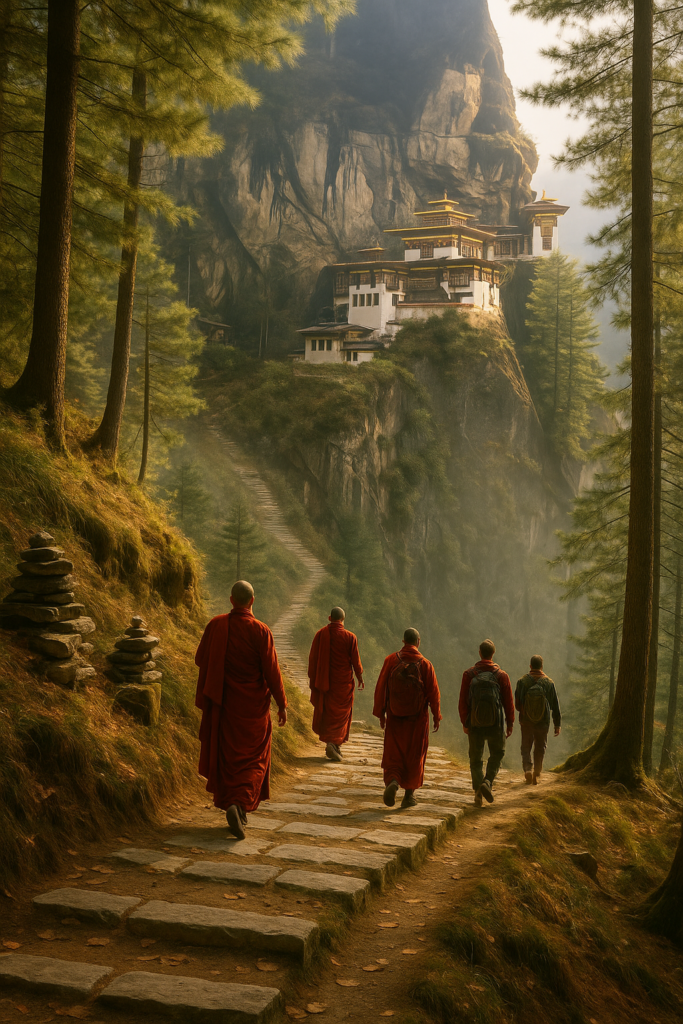
VII. The Philosophy of Height
Why do humans build sacred spaces in impossible places? From Machu Picchu to Meteora, from cliffside temples in China to Taktsang in Bhutan, there is something universal in our impulse to reach upward — to make the climb a metaphor for transcendence.
In Buddhism, mountains represent both physical and spiritual elevation. The journey upward mirrors the ascent toward enlightenment — each step a shedding of attachment, each breath a prayer.
Taktsang’s location is not meant to intimidate but to invite. The cliff face is not a barrier but a teacher, reminding pilgrims that spiritual awakening is not found in comfort, but in the courage to go higher, even when the air grows thin.
In a world obsessed with ease, the Tiger’s Nest reminds us of the value of effort. Enlightenment, like the monastery itself, must be earned one step at a time.
VIII. Bhutan: The Land of Gross National Happiness
To understand the monastery is to understand Bhutan — a kingdom that measures success not by GDP, but by Gross National Happiness. This small Himalayan nation is the last remaining stronghold of Vajrayana Buddhism, a philosophy that infuses every aspect of its culture, governance, and daily life.
Bhutan’s approach to progress is rooted in harmony: between development and nature, tradition and modernity, material and spiritual well-being. The Tiger’s Nest stands as the perfect emblem of that balance — a place where human hands and divine purpose coexist without conflict.
For the Bhutanese, visiting Taktsang is not tourism; it is an act of renewal. It reminds them — and the world — that happiness does not lie in abundance, but in alignment.
IX. The Silence Between Worlds
Inside the monastery, time dissolves. The air is thick with incense, and the murmur of monks’ chants reverberates through stone corridors. Butter lamps flicker before images of Guru Rinpoche, casting a golden glow that seems to breathe.
There are moments of profound stillness, where the only sound is the wind moving through the mountain. In that silence, visitors often feel something stir within — an ancient recognition, a reminder of the sacred that lies dormant in all of us.
Perhaps this is the true power of Taktsang: it does not ask for belief, only presence. You don’t need to understand its rituals to feel its truth. The mountain, the monastery, the monks — all speak a universal language of awe.
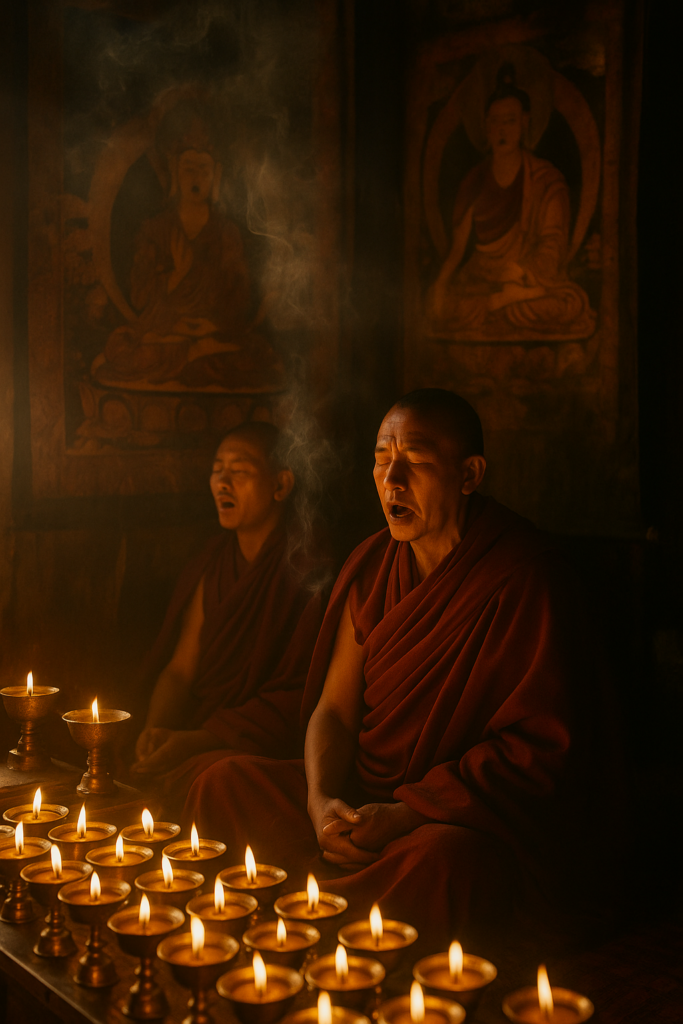
X. A Lesson in Impermanence
In Buddhism, everything is impermanent — even mountains crumble, even gods fade. Yet impermanence is not tragedy; it is liberation. The Tiger’s Nest embodies this teaching in its very being.
Perched precariously on stone, rebuilt after fire, buffeted by centuries of wind and snow, it endures not by resisting change, but by embracing it. Its beauty lies in its fragility — in the way it survives precisely because it does not cling.
As one monk once told a visiting pilgrim, “Even the cliff will one day fall. But the prayer carried by the wind — that will never end.”
XI. Pilgrimage and Perspective
Every year, thousands of pilgrims from around the world make the journey to Taktsang. They come for different reasons — some seeking peace, others healing, others meaning. Yet all leave transformed.
The climb strips away distraction. The altitude slows you down. The silence humbles you. And when you finally stand before the monastery, suspended between heaven and earth, something in you softens. You realize that enlightenment is not a destination, but a way of seeing — a way of being.
In a world that worships speed, the Tiger’s Nest is a call to stillness. It teaches that progress is not always upward, but inward.
XII. A Living Icon
Though ancient in spirit, Taktsang continues to shape the present. It is a site of pilgrimage for Bhutanese kings, scholars, and monks, and an enduring symbol of Bhutan’s identity. Its image adorns stamps, art, and textbooks. Yet its power remains undiminished — because it is not merely seen; it is felt.
The monastery has also become a bridge between cultures. Travelers from across the globe, regardless of faith, find something universal here — a reminder that all human longing, in the end, points toward the same summit: connection, meaning, transcendence.
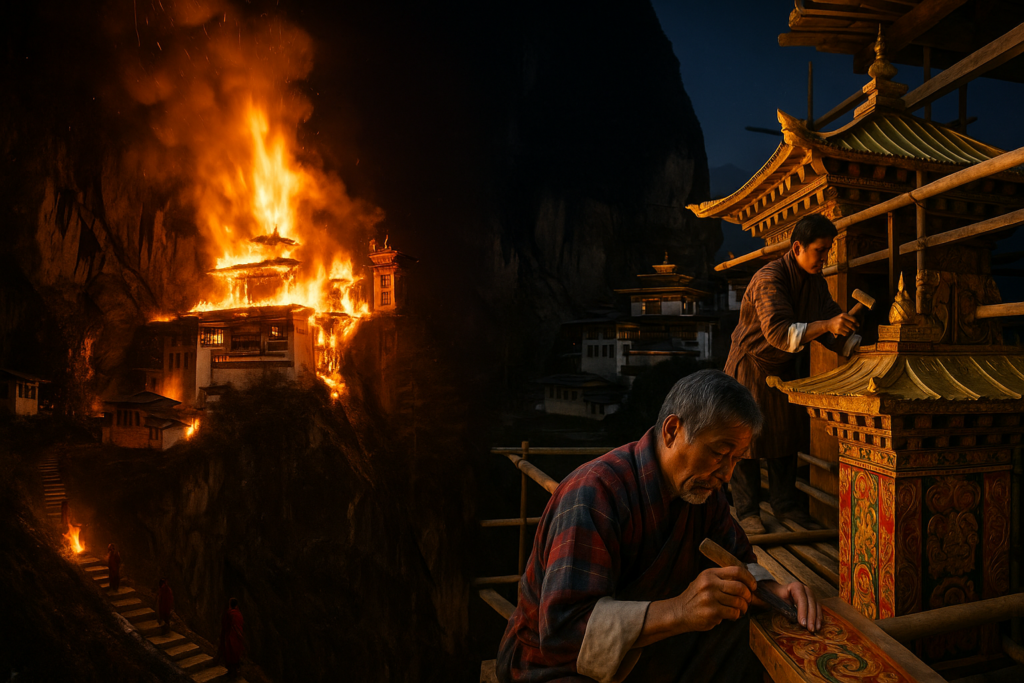
XIII. Beyond the Cliff
When the day ends, and the sun sinks behind the peaks, the Tiger’s Nest glows in the last light — an ember against the vastness of dusk. The monks return to their quarters, and the valley below falls silent. The mountain breathes.
In that quiet, the monastery seems to float — a dream made of stone, a whisper made visible. Its beauty is not in grandeur but in grace; not in permanence but in persistence.
Taktsang is more than a place. It is an idea — that even in the most fragile conditions, the human spirit can reach the heights of the divine.
XIV. The Eternal Return
Long after you’ve descended the mountain, Taktsang remains with you. You remember the sound of the wind, the rhythm of footsteps on stone, the faint scent of incense. You remember how small you felt — and how right that felt.
Perhaps that is its final teaching: that humility and wonder are the same thing. That the divine is not somewhere above, but within the act of looking up.
The Tiger’s Nest doesn’t simply belong to Bhutan. It belongs to all who seek — all who, even for a moment, believe that the sacred might still exist in this world.
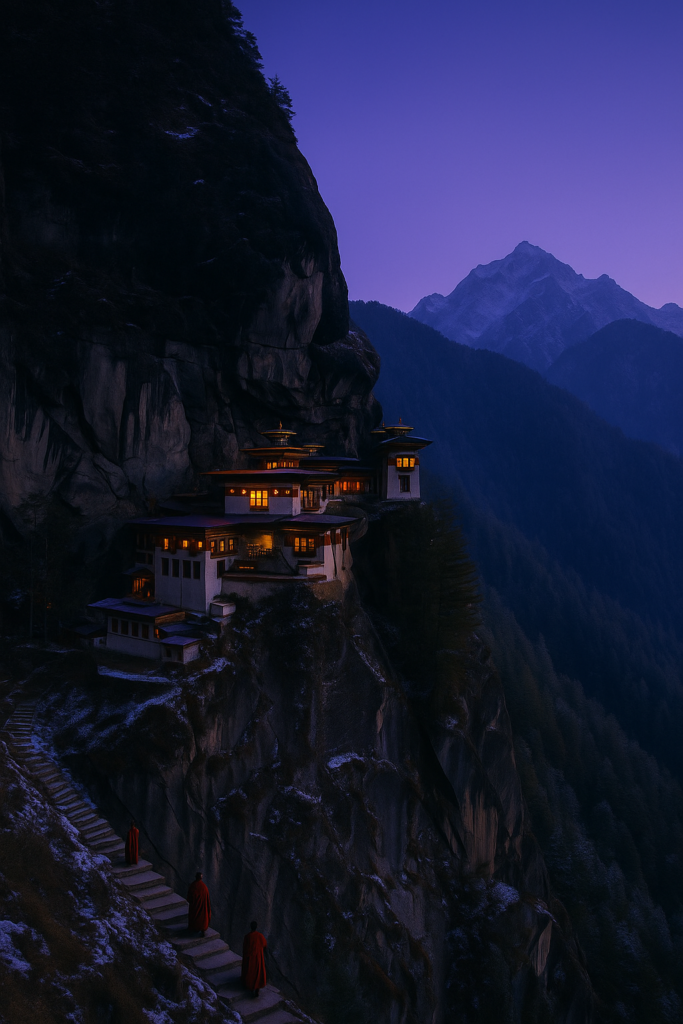
Conclusion: The Cliff Between Worlds
The image of the Tiger’s Nest Monastery is more than photography. It is a meditation. A reminder that human aspiration, when aligned with reverence, can create miracles.
As mist gathers and monks descend its stone stairs, the monastery stands — fragile yet eternal, humble yet transcendent. It is the meeting point of heaven and earth, of myth and reality, of impermanence and eternity.
In a single glance, it asks — and answers — the oldest question of all:
How do we touch the divine while still being human?
-
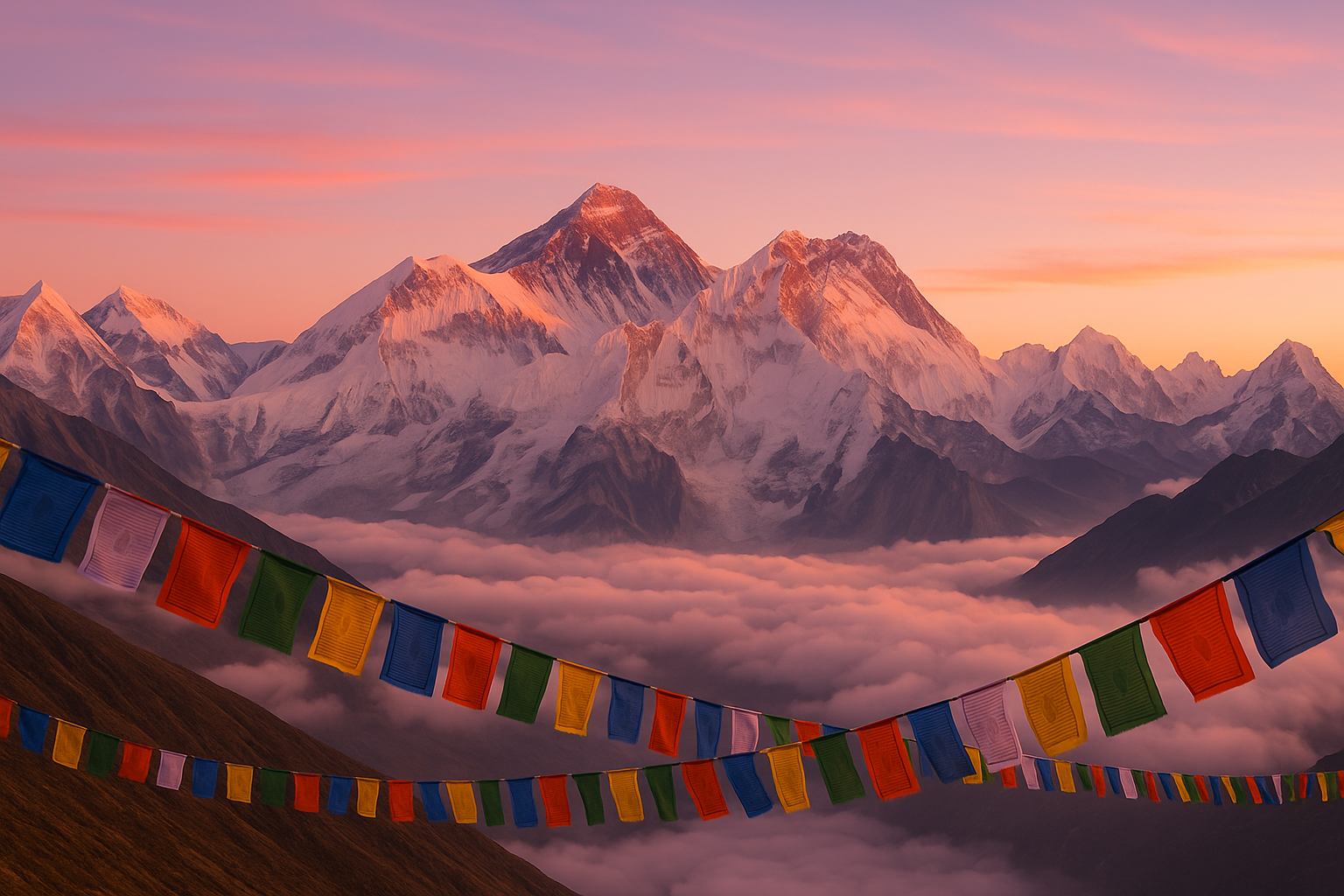
Eternal Heights: The Soul of the Himalayas
I. The Moment the Sun Touches the Gods
There are moments in the mountains when time itself seems to kneel.
As dawn breaks over the Himalayas, light spills like liquid gold across the frozen summits. The world’s tallest peaks awaken under a soft coral glow, their icy ridges igniting with fire while the valleys below remain cloaked in the lingering hush of night.Prayer flags—worn, frayed, and radiant—flutter across the frame, whispering mantras into the morning wind. Beneath them, a sea of clouds stretches endlessly, blurring the boundary between earth and sky. It is as if the world is suspended between breath and silence.
The image captures more than a mountain; it captures a moment of awakening—of the planet, of the spirit, of the self. To witness such light over the world’s highest point is to understand what it means for nature to transcend beauty and enter the realm of the sacred.
II. The Roof of the World
The Himalayas are more than a mountain range—they are a world unto themselves, a living spine stretching across Asia for nearly 2,500 kilometers. From Pakistan’s Karakoram to Bhutan’s emerald valleys, they cradle more than fifty peaks above 7,000 meters, including the crown jewel of Earth: Mount Everest, or Sagarmatha to Nepalis and Chomolungma to Tibetans—“Mother Goddess of the World.”
These are not passive landscapes; they are active, evolving, and alive. The Himalayas were born from a collision—when the Indian plate slammed into the Eurasian plate around fifty million years ago, the crust buckled upward, forming these colossal walls of rock and ice. Even today, the mountains continue to rise by a few millimeters each year, as if still reaching for the heavens.
To stand before them is to stand at the intersection of geology and divinity. Here, science and spirituality meet not as opposites but as two languages describing the same awe.
III. The Alpenglow Mystery
There’s a word for the pink-gold light that graces mountain peaks at dawn and dusk: alpenglow. It’s not merely sunlight—it’s sunlight filtered, scattered, and reflected by the atmosphere long after the sun has dipped below or before it has risen above the horizon.
In the Himalayas, alpenglow is more than a meteorological phenomenon—it’s a daily ritual of transfiguration. When the first or final rays strike the ice, the entire mountain appears to breathe light. The cold, immovable mass of stone becomes fluid, glowing, almost sentient.
Locals often interpret it as a sign of divine presence. The mountains, they say, are alive—and the light is their spirit showing itself to those who are still enough to notice.
IV. The Language of Flags and Wind
The prayer flags in the foreground tell their own story. In Tibetan, they are called Lungta, or “wind horses.” Each flag carries sacred texts and symbols that are said to spread compassion, peace, and wisdom with every flutter.
The five colors represent the five elements:
- Blue — the sky and space
- White — air and wind
- Red — fire
- Green — water
- Yellow — earth
Together, they form a cosmic balance. As the wind brushes through them, the prayers are believed to be carried across mountains and valleys, touching every corner of the world.
What’s profound is the humility of the act. The flags are not hung for personal gain but for the benefit of all beings. They fade with time, their disintegration a visual sermon on impermanence. Even as they fray and tatter, they continue to serve—a lesson in selfless devotion and beauty in decay.
V. The Mountain of Names
Mount Everest, the centerpiece of this photograph, has many names—each one a reflection of a different relationship with the mountain. To the Nepali, she is Sagarmatha: “Forehead of the Sky.” To Tibetans, Chomolungma: “Goddess Mother of the World.” To Western explorers, she became “Everest,” named in 1865 after the British surveyor Sir George Everest, who ironically never saw the peak himself.
These names tell a story of perspective. Where the Western tradition saw a summit to be conquered, the Himalayan peoples saw a spirit to be respected. For them, these peaks were not “mountains to climb” but deities to be honored from afar.
It’s a profound contrast: one of ambition versus reverence, conquest versus coexistence. And perhaps that’s what this image gently reminds us—to shift from dominion to devotion.
VI. The People of the High Valleys
Life in the Himalayas has always defied reason. Thin air, steep terrain, and extreme cold would seem to make human habitation impossible. Yet for thousands of years, communities have flourished here, adapting to the rhythms of altitude and isolation.
The Sherpa people of Nepal’s Khumbu region are among the most well-known. Their name, derived from “Shar-wa,” means “people from the East.” For them, the mountains are not obstacles but kin. Every peak, stream, and meadow carries a spiritual charge. Before setting out on a climb or journey, offerings are made to mountain gods for protection and permission.
Their resilience is legendary—but so too is their humility. In every gesture, from spinning prayer wheels to offering butter lamps in monasteries, there is an understanding that survival here is not a triumph over nature but a partnership with it.
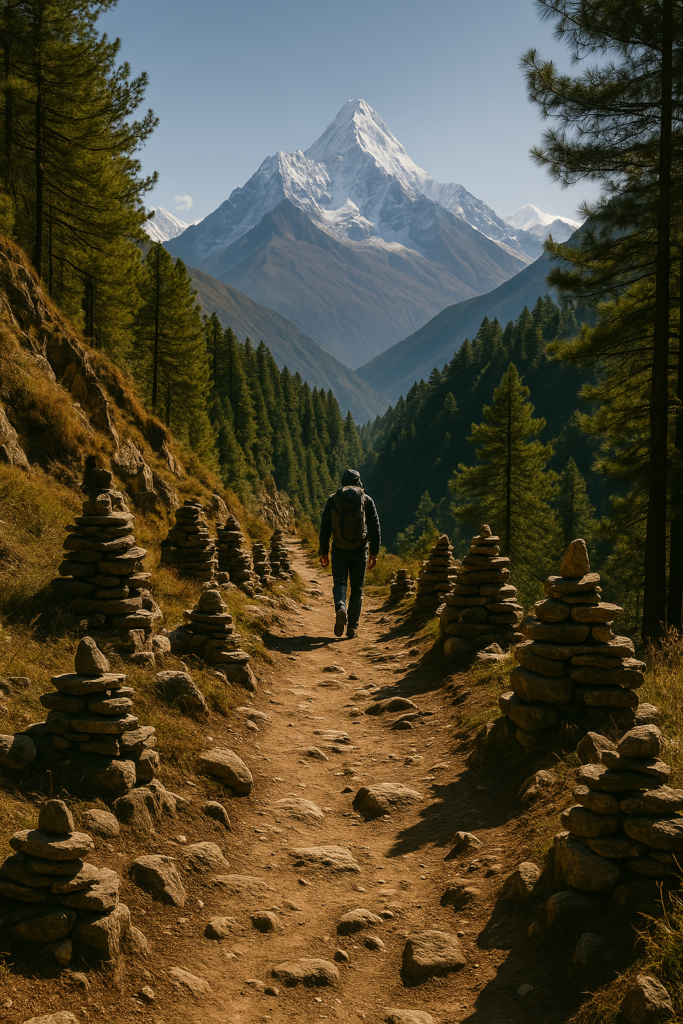
VII. The Sea of Clouds
Beneath the radiant summits in the image, a sea of clouds rolls across the valleys, soft and infinite. It’s as if the earth has exhaled a great sigh of mist. This “cloud ocean” is a common sight in the high Himalayas, formed when warm, moist air from the lowlands rises and cools against the mountain slopes.
From above, it feels like standing at the edge of heaven. The mountains rise like islands from the white expanse, and for a moment, you lose all sense of scale—are these peaks enormous, or are you simply small?
In Buddhist philosophy, clouds often symbolize the mind: ever-shifting, impermanent, obscuring yet revealing. Just as the peaks stand unmoved above the clouds, the enlightened mind stands still above thought—unperturbed by the turbulence below.

VIII. A World on the Edge
The Himalayas are often called the “Third Pole” because they contain more ice and snow than any region on Earth outside the Arctic and Antarctic. These glaciers feed the great rivers of Asia—the Ganges, Brahmaputra, Indus, Mekong, and Yangtze—nourishing over a billion lives downstream.
But this lifeline is fragile. Rising global temperatures are melting Himalayan glaciers at alarming rates, altering river flows, threatening water security, and destabilizing entire ecosystems. Villages that once relied on predictable snowmelt now face floods or droughts. Ancient trails crumble under landslides.
In the shimmering light of this photograph lies an urgent truth: beauty and vulnerability often coexist. The same peaks that inspire awe also remind us of what we stand to lose if reverence does not translate into responsibility.
IX. Pilgrimage of the Soul
For centuries, pilgrims have ventured into these mountains in search of something beyond the physical. The Himalayas are home to countless sacred sites—Tibet’s Mount Kailash, Nepal’s Tengboche Monastery, India’s Kedarnath, Bhutan’s Paro Taktsang. Each offers not just a destination but a transformation.
To walk these paths is to participate in a kind of spiritual architecture—the carving of patience, the building of humility, the ascent toward understanding. The act of pilgrimage mirrors the mountain itself: steep, slow, demanding surrender.
In the thin air, stripped of distraction, one confronts the essential. The mountain becomes a mirror, reflecting both your insignificance and your infinite potential.
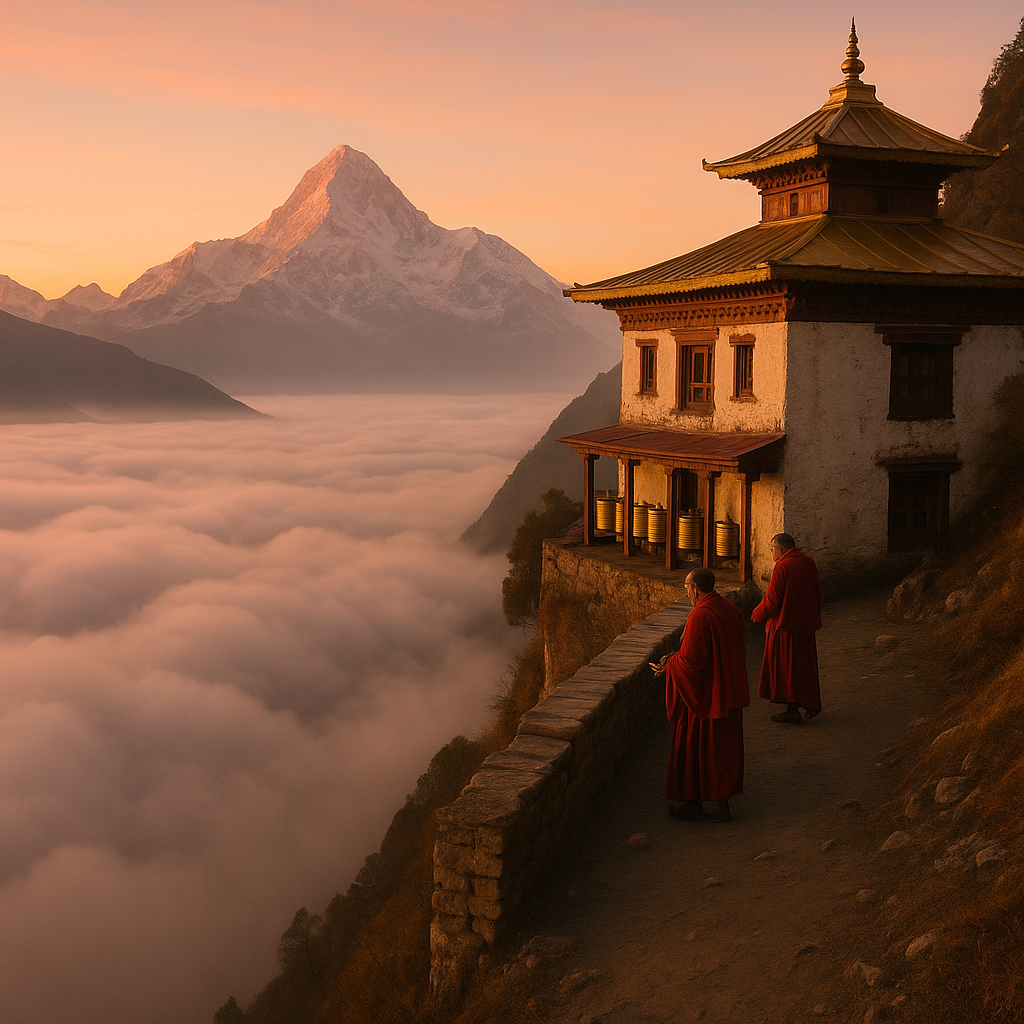
X. The Science of Silence
Silence in the Himalayas is not an absence of sound but a presence of space. It’s the hush between wind gusts, the pause before an avalanche, the stillness of snow settling on a ledge. Scientists have measured that high-altitude soundscapes register some of the lowest decibel levels on Earth.
But the quiet is not empty—it hums with life. The crack of ice, the murmur of rivers beneath frozen skin, the distant call of a lammergeier (a bearded vulture with wings like prayer flags in motion).
Modern life, with its constant noise, rarely allows such silence. Yet it is in this stillness that our minds recalibrate, returning to their natural rhythm. The Himalayas do not just test endurance; they test our capacity for listening.
XI. The Eternal Dialogue
The relationship between humans and the Himalayas has always been a conversation—sometimes gentle, sometimes harsh. The mountains give water, wood, wisdom; humans offer reverence, ritual, and sometimes recklessness.
Mountaineering, for all its glory, is a double-edged pursuit. While early expeditions sought exploration, modern climbing has often tilted toward conquest. Everest, once considered untouchable, now bears the scars of over-tourism—abandoned oxygen tanks, littered camps, traffic jams of climbers waiting their turn for the summit.
Yet even in the face of human intrusion, the mountains remain patient. They have seen empires rise and fall, glaciers come and go. Against such scale, our dramas are but echoes in the wind.
XII. The Light That Endures
What makes this image timeless is its illumination—not just the sunlight, but the illumination it evokes in us. The glow on Everest’s flanks is fleeting, but the feeling it stirs lasts far longer.
Light in the Himalayas has a sacred quality because it reveals the union of opposites: warmth over ice, day born from night, stillness within movement. Every sunrise is a reminder that beauty requires contrast—that even in the harshest environments, grace endures.
Photographers often wait hours, even days, for this exact moment of alignment—when the clouds, light, and landscape conspire to create something transcendent. Yet the best images, like this one, don’t just capture light; they capture reverence.
XIII. The Spirit of Impermanence
In Buddhist philosophy, the mountains are not static monuments but expressions of impermanence. Even Everest, the world’s tallest, is constantly changing—growing, eroding, shifting under the invisible hands of time.
To gaze upon it is to confront the paradox of existence: that permanence is an illusion, yet within change lies continuity. The prayer flags in the image embody this beautifully—they will fade, disintegrate, and be replaced, just as generations come and go.
But the wind remains. The prayers continue. The mountains stand—not as eternal objects, but as eternal processes.
XIV. The Gift of Perspective
Perhaps the greatest gift the Himalayas offer is perspective. Standing before them, one realizes how small our worries truly are. Deadlines, arguments, and ambitions lose their weight when measured against the slow heartbeat of stone and ice.
In that humility lies liberation. To feel small is not to feel insignificant, but to feel part of something vast. The mountains dissolve the illusion of separation. You are not standing before them—you are part of them, made of the same earth, breathing the same air that dances through the flags.
And when you finally turn away, you carry a piece of that immensity inside you.
XV. The Last Light
As evening descends, the golden peaks fade into lavender shadow. The prayer flags grow still. The clouds below blush and dissolve. Night returns, vast and velvet, scattered with stars.
But even as the colors fade, the feeling remains—a quiet reverence, a recognition that beauty and meaning are not things to be possessed but moments to be witnessed.
The Himalayas, in their silence and splendor, teach us the most ancient lesson of all:
That everything we seek—the sacred, the stillness, the sublime—has always been right here, waiting in the light.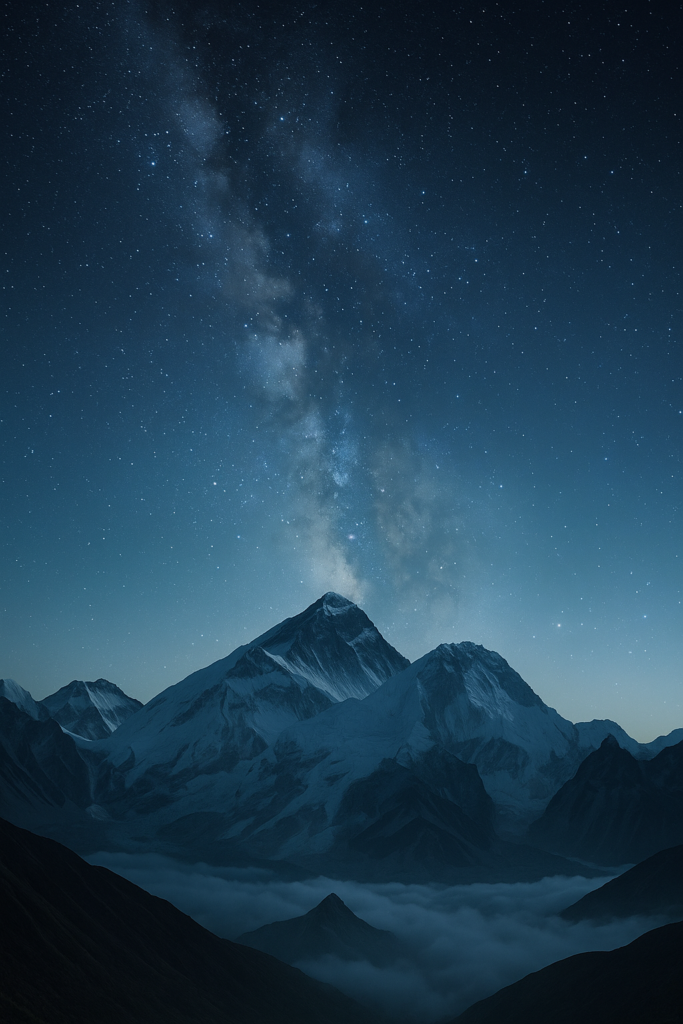
Conclusion: Where Earth Meets Eternity
This photograph is not merely a depiction of Mount Everest. It is a window into the human soul—a reminder of our capacity for wonder, humility, and connection.
The mountains do not need us, but we need them. We need their scale to measure our smallness, their silence to hear ourselves, their endurance to remind us what truly lasts.
As the prayer flags flutter against the dying light, they carry the oldest prayer of all:
May all beings be at peace.
May the earth endure.
May we remember that we, too, are part of the mountain.